Flat fee booking means paying one fixed subscription for reservation software instead of a cut of every booking. It usually beats commission once your direct-booking volume clears a breakeven point, but only if you also account for hidden setup, payment and integration costs. Run the maths before you switch, not after.
TL;DR:
- Hidden costs such as payment gateway markups, per-user fees, and contractual escalators can erode flat fee savings, requiring thorough upfront review.
- Confirm that your preferred platform supports direct payout control, real-time channel synchronization, and full data ownership before switching.
- Small venues may find commission cheaper initially, but growing venues should calculate breakeven points regularly as direct bookings increase.
- Contract agreements should include clear termination clauses, stable pricing, and guarantees of data portability to avoid future disputes.
Table of Contents
- What flat fee booking means and how the pricing models differ
- How to calculate your breakeven point
- Hidden costs and contract terms that erode flat-fee savings
- What to check before switching to a flat-fee platform
- Cost scenarios: small, growing and seasonal venues
- How a commission-free, flat-subscription model works in practice
- Legal implications and consumer protection in flat-fee booking agreements
- Best practices for negotiating flat-fee booking contracts
- How flat-fee models compare across industries
- When switching to a flat-fee system is the strategic move
- Getting started with a flat-fee switch that actually pays off
- Sources
- FAQ
What flat fee booking means and how the pricing models differ
Flat fee booking is a fixed, predictable software cost that doesn't change however many tables or rooms you fill. Commission models take a percentage of each booking, so your software bill grows in step with your success. That difference sounds small until you scale.
Three pricing structures dominate hospitality and service booking software:
- Flat subscription: one monthly or annual fee, unlimited bookings, no per-transaction cut.
- Commission or revenue-share: no upfront fee, but a percentage (often 3% to 20%) taken from every confirmed booking.
- Per-unit pricing: a fee scaled to rooms, covers, or seats, sitting somewhere between the two.
As bookings scale, flat-fee software keeps costs fixed while commission scales with volume, which changes the economics entirely once you're busy. A quiet venue barely notices commission. A full one pays for it every single night.
One separate point worth flagging early: payment-processing fees (Stripe, card networks and similar) are not part of this comparison. They pass through regardless of pricing model, so don't count them against either side when you run your numbers.
How to calculate your breakeven point
The formula is simple:
Commission cost = Annual bookings value × commission rate Flat-fee cost = Monthly fee × 12 (+ known add-ons)
When commission cost overtakes flat-fee cost, you've crossed your breakeven point.
Here's a worked example using a conservative 5% commission rate:
- A venue processes £250,000 in bookings a year through a commission platform charging 5%. That's £12,500 a year in fees.
- The same venue is quoted a flat-fee platform at £99 a month, or £1,188 a year.
- Even adding a generous £300 in setup and integration costs, the flat-fee route costs £1,488 for the year against £12,500 in commission.
- The breakeven point here sits at roughly £29,760 in annual bookings value, above which flat fee wins outright.
Pro Tip: Copy this into a spreadsheet with two columns, one for your current commission rate and one for the flat fee you're quoted. Multiply your last 12 months of booking revenue by the commission rate and compare it against the annual flat cost. Most venues find the answer in under five minutes.
Hidden costs and contract terms that erode flat-fee savings
A "commission-free" headline doesn't always mean commission-free in practice. Vendor guides consistently warn that free platforms often recover costs elsewhere, through marketplace fees, feature gating, or charges for new customers acquired via the platform.
Watch for these before signing anything:
- Payment gateway markups: some platforms force you onto their own processor at inflated rates rather than letting you use your own Stripe account.
- Per-integration or per-feature fees: channel management, SMS reminders, or extra staff seats can each carry a separate charge.
- Per-user costs: a "flat" fee that quietly multiplies once you add front-of-house staff logins.
- Annual price escalators: contracts that increase the fee by a fixed percentage every renewal.
- Lock-ins and termination penalties: multi-year commitments with punitive exit clauses.
- Feature gating: core functionality (like exports or reporting) locked behind a higher tier.
Pro Tip: Ask any vendor for the full fee schedule in writing before you sign, not just the headline number on their pricing page. Industry analysis suggests budgeting 1.3 to 1.5 times the advertised monthly fee to cover the setup and integration costs that rarely make it onto the homepage.
What to check before switching to a flat-fee platform
A checklist beats a sales call every time. Before you commit to any flat-fee platform, confirm the following:
- Payout flow: do you control your own Stripe (or equivalent) account, or does the platform sit between you and your money?
- Channel sync: does the calendar update in real time across every channel to avoid double bookings?
- Team accounts: how many staff seats are included, and what happens when you add more?
- Floorplan and cover management: can you manage seating layouts and table turns, not just a booking list?
- Cancellation policies: are refund rules configurable per venue, or fixed by the platform?
- Support SLAs: is support a chatbot, a ticket queue, or an actual person who answers?
- Data export and compliance: can you take your guest data with you, and does the platform meet GDPR requirements?
This checklist consolidates points that recur across vendor guides and market comparisons, and it's worth working through methodically rather than trusting a demo call alone.
Cost scenarios: small, growing and seasonal venues
The numbers shift depending on where your venue sits.
A small, low-volume venue doing £15,000 a year in bookings may genuinely find commission cheaper. Flat fee only makes sense here if growth is imminent.
A growing venue tells a different story. As direct bookings climb past the breakeven threshold, flat fee becomes rapidly more profitable, and shifting even a modest share of bookings from OTAs to direct channels can multiply the return on a fixed subscription.
A seasonal venue, a seaside café or a ski-town restaurant, needs a different lens entirely. The subscription doesn't shrink in the off-season, so seasonal operators should model annual cash flow rather than monthly averages when deciding whether flat fee suits their rhythm.
| Venue type | Annual bookings value | Better model |
|---|---|---|
| Small, low-volume | £15,000 | Commission, for now |
| Growing, direct-booking focused | —+ | Flat fee |
| Seasonal, high variance | Varies by month | Flat fee, with cash reserves |
- Small venues should revisit the breakeven calculation every six months as volume changes.
- Seasonal venues should budget for the subscription across 12 months, not just peak season.
How a commission-free, flat-subscription model works in practice
Some platforms run on exactly this principle: one flat subscription, no commission on any booking. Venue owners keep every reservation they take, regardless of time.
That structure delivers a few concrete advantages:
- Guest-data ownership: customer data remains with the venue rather than with third parties.
- Confirmed bookings: guests can reserve without additional steps or delays.
- Predictable software cost: consistent fees regardless of booking volume aid budgeting.
- Real-time menu updates: listings reflect current offerings instantly.
- Human support: customer questions are answered by real people.
- Growth Scan: a tool that checks online visibility and highlights improvement areas before signup.
Legal implications and consumer protection in flat-fee booking agreements
Flat-fee booking contracts are still contracts, and the fine print carries real weight. Most disputes between venues and booking platforms centre on three areas: fee transparency, cancellation terms, and data ownership.
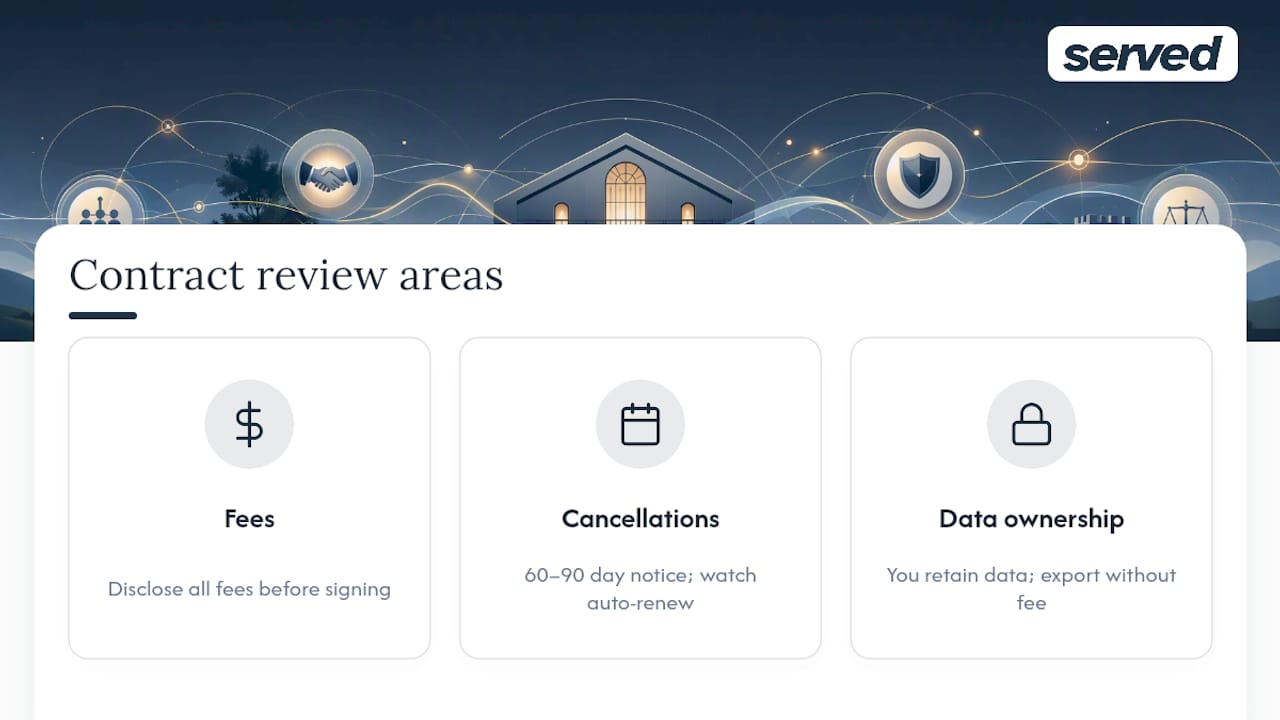
Consumer protection law in most jurisdictions requires that fees be disclosed clearly before a contract is signed, not buried in a schedule you only see after payment. If a platform advertises "commission-free" but then charges undisclosed marketplace fees or new-customer surcharges, that can fall foul of unfair trading or consumer protection rules depending on where you operate. Always ask for the complete fee structure in writing and keep it on file.
Contract length matters too. Many flat-fee agreements run on rolling monthly terms, but some lock venues into annual or multi-year commitments with automatic renewal clauses. Read the termination section closely: some contracts require 60 or 90 days' notice before the renewal date, and missing that window can trap you for another year.
Data ownership deserves particular attention. Your guest list, contact details, and booking history are a business asset. Some platforms treat this data as their own, restricting export or charging a fee to release it if you leave. A well-drafted agreement should state explicitly that you retain full ownership and can export your data on request, without cost or delay.
If your venue takes online payments through the platform, check who holds the funds and for how long. Delayed payouts or currency conversion charges can quietly reduce what actually reaches your account, regardless of what the headline fee promised.
Best practices for negotiating flat-fee booking contracts
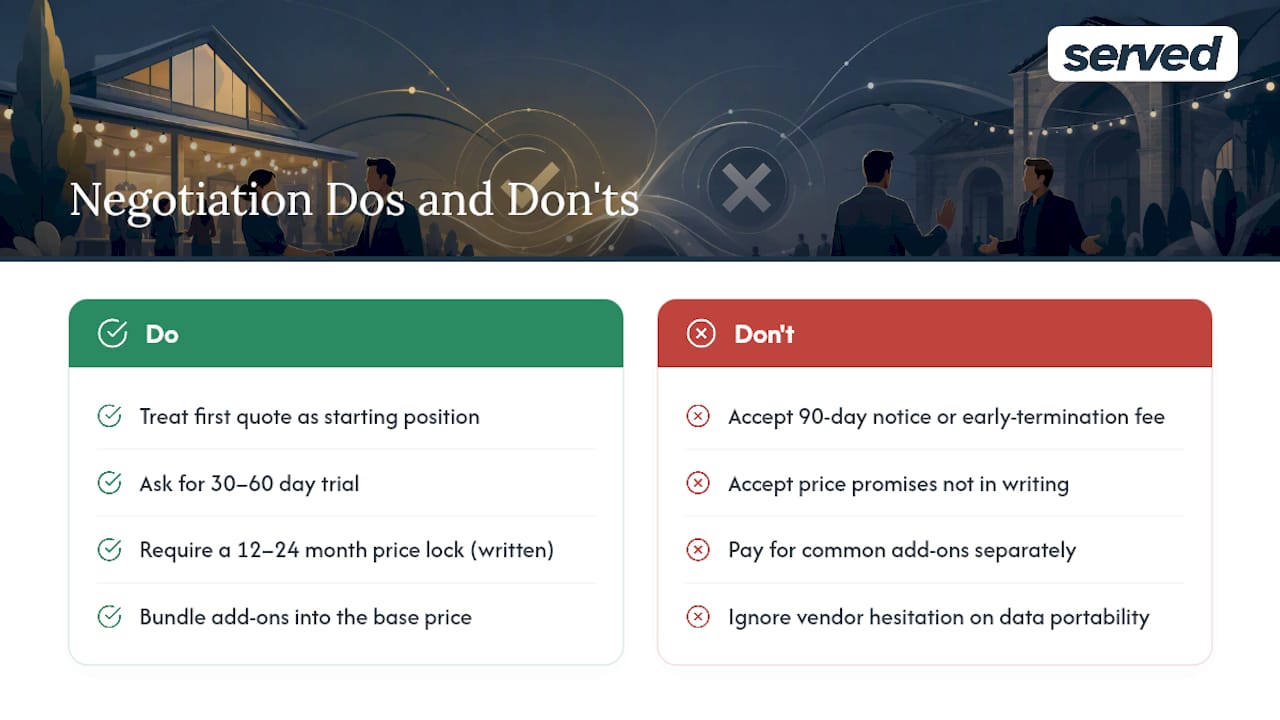
Treat the first quote as a starting position, not a final offer. Most booking software vendors have room to move, particularly on annual contracts or multi-venue deals.
Start by asking for a shorter trial period before committing to an annual term. A 30 or 60-day trial reveals whether support response times, sync reliability, and reporting actually match what the sales pitch promised.
Push for price locks, not just low headline pricing. Ask the vendor to confirm in writing that your rate won't increase for a fixed period, ideally 12 to 24 months, rather than being exposed to a renewal-time price rise.
Negotiate add-ons into the base price wherever possible. If a vendor wants to charge extra for SMS reminders, extra staff seats, or channel sync, ask whether those can be bundled into your tier rather than billed separately.
Request a clean exit clause. Thirty days' notice with no penalty is a reasonable standard; anything demanding 90 days or an early-termination fee should be a red flag worth challenging or walking away from.
Finally, ask for data portability in writing. A vendor confident in their product won't hesitate to guarantee you can leave with your guest data intact. Hesitation on this point tells you something about how they expect the relationship to end.
How flat-fee models compare across industries
Flat-fee booking isn't unique to restaurants. The same tension between fixed subscriptions and commission cuts plays out across hospitality and service industries, though the breakeven arithmetic shifts with each one.
In the vacation rental and short-let sector, flat-fee software vs commission comparisons tend to favour flat fee once a property is consistently booked, since a single owner managing several units feels commission far more acutely than a single-property host.
Hotels and multi-room operators often see workspace-style pricing, where flat monthly tiers bundle every feature with no per-room or per-user surcharge, and the savings become clearest for properties in the 10 to 20 room range, where commission on high occupancy would otherwise be substantial.
Restaurants, bars and cafés sit closer to the vacation rental pattern: booking value per cover is lower, but volume is higher and more frequent, so the breakeven point often arrives faster than owners expect.
Service businesses, like salons, clinics and studios, tend to favour flat-fee or per-seat pricing because their booking values are typically lower and more consistent, making commission percentages feel disproportionately expensive relative to the service delivered.
When switching to a flat-fee system is the strategic move
The maths rarely lies. Run your breakeven calculation, stress-test it against a slow season, and demand transparent payment terms in writing before you sign anything.
Postpone switching if direct-booking demand is still minimal. Act once direct bookings are growing and commission is visibly eating into margin.
Once the numbers point one way, don't overthink it: calculate, shortlist two or three vendors, and trial the strongest one.
— Ignacy Jurkowski
Getting started with a flat-fee switch that actually pays off
If you've run the numbers and direct bookings are climbing, a flat subscription is the one lever guaranteed not to grow with your success. Certain platforms offer a flat fee with no commission on bookings and allow full ownership of guest data from the start.

Served maps directly onto the checklist covered above. Real-time menu updates keep your listing accurate without manual edits. Human support means a real person answers when something needs fixing fast. The free Growth Scan flags exactly where your online visibility is costing you bookings, before you commit to anything. It suits restaurants, bars and cafés of any size, but particularly venues where direct bookings are already growing and commission has started to bite.
If you're currently on a commission platform and the breakeven maths favours a switch, consider implementing rezerwacje przez WhatsApp bez programisty as an alternative booking channel to enhance direct reservation options, then see how migrating to Served works or start with the platform itself to check pricing against your own numbers.
Sources
- Flat Fee vs. Commission: Best Vacation Rental Software for 2026
- OTA Commission vs PMS Cost: Which One Is Really Eating Your Margin? | Smart Order
- Booking fees explained: commission vs flat fee · Theybook
FAQ
Why am I being charged a booking fee?
Booking fees usually come from commission-based platforms taking a percentage of each reservation to cover their own costs and profit margin. Flat-fee platforms avoid this by charging one fixed subscription regardless of booking volume.
What is the best booking software for small businesses?
The right choice depends on your booking volume: low-volume venues often do better on commission, while growing venues typically save more with a flat subscription like Served once they clear their breakeven point.
How can I avoid high commission fees on bookings?
Shift more bookings to direct channels rather than third-party marketplaces, and compare your annual commission spend against a flat-fee alternative to see where the breakeven point falls.
How much commission do booking platforms typically take from a venue?
Commission rates commonly range from 3% to 20% per booking depending on the platform and industry, which is why flat-fee costs stay fixed while commission scales with every booking as volume grows.