Fix your owned booking channel, cut no-shows with automated confirmations, and run targeted weeknight promotions. Those three moves, backed by seat-hour tracking, typically raise usable covers within 30 to 90 days. Served's approach to visibility and booking pairs with this playbook directly, and the industry data on no-shows and cancellations shows exactly where the leaks are.
TL;DR:
- Sending staged reminders for high-risk bookings can reduce no-shows from 18% to around 6%, significantly increasing seat utilization.
- Unifying booking data and inventory across all channels prevents double-bookings and phantom availability, which are common sources of revenue loss.
- Prioritizing fixing the booking widget and confirmation process offers the best return, often outperforming promotion efforts if neglected.
- Building capped, early-bird midweek offers that reward loyal guests can effectively fill quiet nights without sacrificing margin.
- Using a commission-free platform with real-time menu updates and human support helps retain full guest data and maximizes contribution margin per seat-hour.
Table of Contents
- Quick wins to lift bookings this week
- Optimise your online presence and owned booking channel
- Unify your booking channels and cut no-shows with data
- Promotions and pricing that actually fill quiet nights
- Which marketing channels actually drive bookings?
- Operations that turn bookings into profitable covers
- Publisher perspective: why these tactics work together
- Why the standard restaurant marketing advice misses the point
- How Served helps you put this into practice
- Sources
- FAQ
Quick wins to lift bookings this week
You don't need a new system to move the needle by Friday. Some of the fastest gains come from tightening what you already have.
- Add a visible "book" button everywhere. Every page of your website, your Instagram bio, your Google Business profile and your Facebook page should carry one obvious button that opens your owned booking widget, not a third-party marketplace. If a guest has to hunt for it, you've already lost them.
- Post same-day availability on Instagram Stories. A photo of an empty table at 6pm with "3 spots left tonight, book here" outperforms a polished feed post because it signals urgency and links straight through to booking.
- Launch one limited-slot midweek offer, email-first. Cap it at 15 or 20 tables and send it to your email list before you post it publicly. Regulars get first access, and scarcity does the rest.
- Send SMS reminders timed to your riskiest slots. Sunday and Monday bookings, along with two-tops, carry the highest chance of a no-show, so a reminder text landing four hours before the booking catches people before plans quietly change.
Pro Tip: Test your own booking button on your phone right now. If it takes more than two taps to reach a confirmed reservation, that's covers walking out the door before they even arrive.
Optimise your online presence and owned booking channel
If your website isn't getting bookings, the problem usually sits in one of five places. Run through this checklist before you touch anything else:
- Google Business profile accuracy — opening hours, phone number, and address must match your website exactly, because mismatched details push you down in local search.
- Consistent NAP (name, address, phone) across every directory and social profile, since search engines treat inconsistency as a trust signal against you.
- A clear "book" call-to-action above the fold on your homepage and menu page, not buried in a navigation menu.
- A mobile-first booking widget that loads in under three seconds and doesn't require pinch-zooming, given that most restaurant searches happen on a phone.
- Accurate, current menu and pricing so guests aren't confirming a booking based on information that's a year out of date.
Migrating bookings away from third-party marketplaces and onto your own widget isn't just about saving on commission. It's about who owns the guest record afterwards. When a diner books through a marketplace, that platform keeps the contact details and can market to that guest on behalf of your competitors next week. When they book through your own widget, you keep the email, the phone number and the visit history. Given how much the reservation marketplace layer has consolidated through acquisitions and partnerships, owning that relationship has become more valuable, not less.
To measure the shift, track what share of total bookings arrives through your own widget versus third parties each month, and watch it move as you push promotion there. A practical audit mirrors what's often called a growth scan: check your search visibility for local terms, test your booking widget on a phone as a guest would, and verify your menu against what's actually on the pass tonight. Guides on what travellers expect from digital reservations are worth a read if you want the guest-side view of where friction usually creeps in.
Unify your booking channels and cut no-shows with data
Every channel you accept bookings through, your website, phone, walk-ins, third-party apps, needs to write to the same table inventory. Split inventories are the single biggest cause of double-bookings and phantom availability, because your POS shows one picture while your online widget shows another. Digital reservation systems only work reliably when a single seat-hour inventory sits behind every channel, with the point-of-sale system acting as the system of record.
Before buying anything new, measure your baseline for 21 to 90 days:
- No-show rate broken down by booking channel (phone, website, third-party app).
- Party size distribution, since smaller groups behave very differently to larger ones.
- Average table cycle time by daypart, from seating to bill paid.
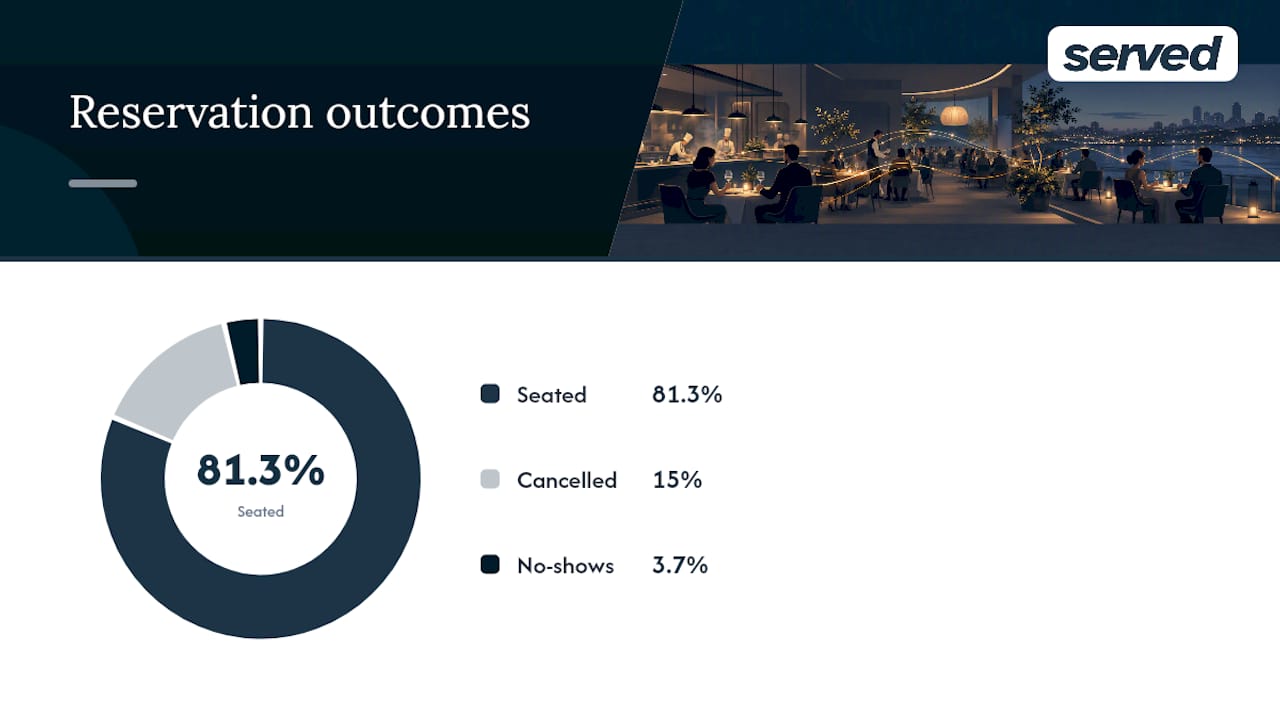
The scale of the no-show problem is worth stating plainly. Across more than 641,000 reservations analysed since January 2025, 3.7% of bookings never arrived and another 15% cancelled, meaning close to one in five booked tables produced no seated guest at all. Smaller parties no-show more frequently than large parties, indicating where reminders have the most impact.
The pattern that matters: Sundays, Mondays and small parties carry the highest no-show risk. A blanket policy wastes effort on low-risk bookings while under-protecting the ones actually likely to fail.
Build a staged reminder sequence rather than a single message: an instant confirmation the moment someone books, a reminder at 24 hours, and a final nudge at four hours for higher-risk slots. Automated, behaviour-based reminder flows convert far more cancellations into rebooked slots than a single generic text, because they catch changed plans early enough to refill the table.
Card holds and deposits have a place, but reserve them for high-stakes bookings, large parties, tasting menus, private rooms, rather than everyday two-tops. Deposits add friction that regular diners resent, and the data suggests the return on automated reminders beats deposits for routine bookings. Pair this with waitlist automation that texts the next name on the list the instant a slot frees up, so a cancellation at 6pm doesn't sit empty until 8.
Pro Tip: One practitioner case tracked in the same reservations whitepaper saw no-shows drop from 18% to 6%, and second-turn rotation rise from 1.6 to 2.1, over eleven weeks, achieved purely by unifying inventory and introducing staged confirmations. No extra seats, no extra marketing spend.
Promotions and pricing that actually fill quiet nights
Quiet Tuesdays don't need a discount thrown at them blindly. They need a designed offer with a clear cap and a clear deadline.
- Build weeknight set menus with a hard slot cap. Fifteen tables at a fixed early-bird price between 5.30pm and 6.45pm creates urgency without cannibalising your Friday and Saturday margin.
- Limit the allotment publicly. "12 of 15 tables booked" does more work than "book now", because it turns a slow night into a countdown.
- Give loyal guests first access. Send the offer to your email list a day before it goes public. It rewards the guests who already choose you and often fills half the allotment before a stranger sees it.
- Measure contribution margin per seat-hour, not covers. A packed Tuesday running on thin margins can still lose money against a slower night at full price. Track margin per seat-hour and let that number, not the headcount, decide whether a promotion is working.
Consumer research backs the demand side of this: measurable appetite exists for special offers and promotions, which is exactly why a well-capped midweek deal tends to convert faster than a permanent discount ever does.
Which marketing channels actually drive bookings?
Not every channel deserves the same effort, and matching content to booking intent is what separates marketing that fills tables from marketing that just gets likes.
- Instagram Stories and feed posts work best for last-minute availability and same-day discovery. Link every post straight to your booking widget, never to a bio link menu that adds an extra tap.
- Email and SMS segmentation should reward regulars with early access to offers, while lapsed guests get a distinct, time-limited "come back" message rather than the same blast everyone receives.
- Reviews and guest photos reduce friction for anyone unfamiliar with your venue. A guest deciding between two restaurants at 6pm on a Friday will book the one with recent five-star reviews and a photo of the actual dish, not a stock image.
- Track conversion by channel monthly, and shift budget towards whichever one produces the best return per seat-hour rather than the one that simply drives the most traffic.
Operations that turn bookings into profitable covers
Getting the booking is only half the job. What happens on the floor decides whether that booking turns into a second seating.
Set cycle-time targets by daypart and train hosts to manage pacing against them, since a table that runs ten minutes over on a Friday can cost you an entire extra turn by 9pm. Document your overbooking rule in writing, and test it against your own measured no-show data rather than a gut-feel percentage carried over from years ago. A waitlist that fills within minutes, with clear communication to the guest still waiting, keeps frustration low and turns cancellations into opportunity rather than lost revenue. Staff rotas should follow your measured booking patterns, not habit. If Wednesday bookings have shifted earlier because of a new midweek offer, your kitchen and floor staffing needs to shift with them.
Publisher perspective: why these tactics work together
This playbook draws on hospitality technology practice and the reservation data that underpins it, not theory. The pattern across the research is consistent: venues that unify their booking data and act on it outperform venues relying on instinct alone.
Fixing the booking path is rarely one dramatic change. It's usually five or six small corrections, a clearer button, a better-timed reminder, a capped offer, that compound over a quarter.
A proposition that includes a commission-free model, a free Growth Scan that flags visibility gaps, real-time menu updates so guests never book against stale information, and human support rather than a chatbot when something goes wrong. [Case studies from venue owners using Served, and the internal booking-uplift metrics behind them, will be added here as they become available.]
Why the standard restaurant marketing advice misses the point
Most advice on filling tables focuses on covers: get more bookings, fill more seats, run more ads. That framing misses the economics underneath it. A restaurant can increase covers by 20% and still lose money if those covers land in low-margin slots or arrive through a marketplace taking a cut of every booking.
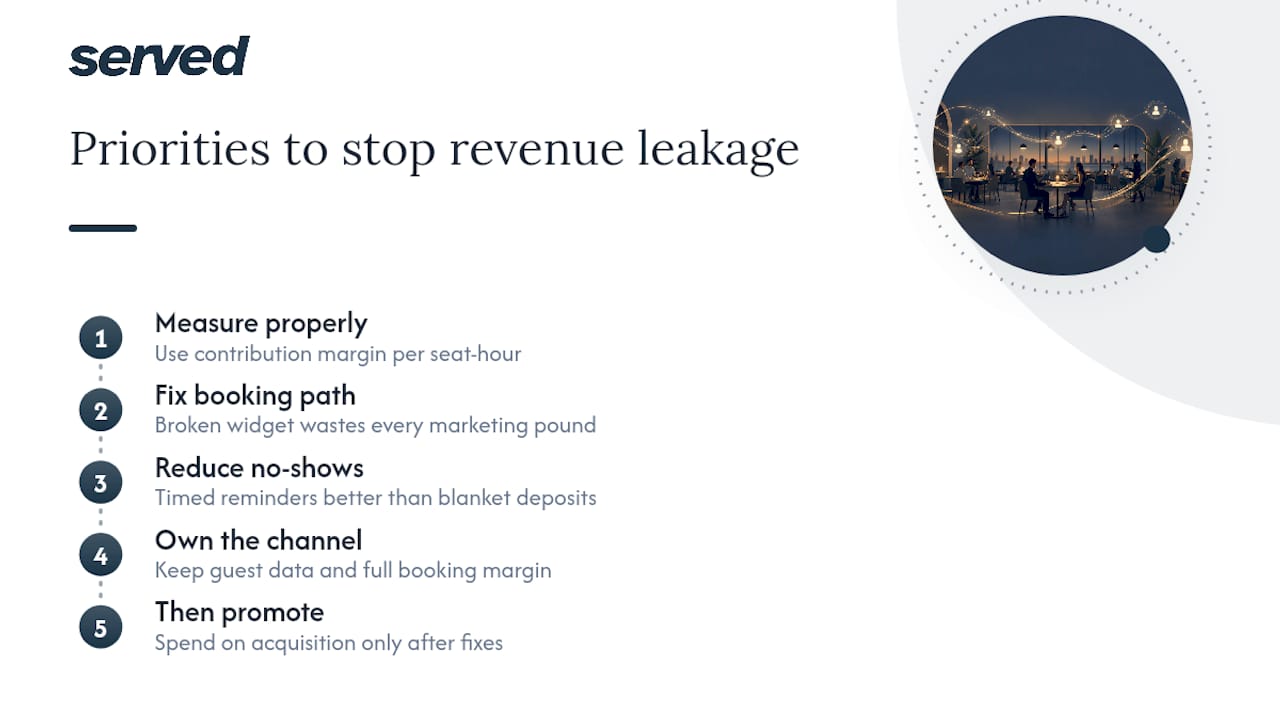
The research points somewhere more useful: measure contribution margin per seat-hour, not raw booking counts, and fix the two things that quietly bleed money before spending on acquisition. That means killing no-shows with timed reminders rather than blanket deposits, and moving demand onto an owned channel where you keep the guest data and the full margin.
Prioritise in this order: fix your booking path first, because a broken widget wastes every marketing pound spent afterwards. Then fix confirmations, because a no-show is a wasted seat-hour no promotion can recover. Only then turn to promotions and channels. Most operators do it backwards, spending on ads to fill a leaky bucket.
— Ignacy Jurkowski
How Served helps you put this into practice
A platform that offers a commission-free way to run everything covered here from one place, without the per-cover fees that third-party marketplaces quietly stack up. Venue owners keep every booking, guest record and revenue, while a free Growth Scan flags exactly where visibility and booking widgets are leaking covers before spending to fix it.

Real-time menu updates help ensure guests do not book against outdated pricing, and human support means problems get solved by a person, not a chatbot queue. If you want a concrete next step, run the free Booking Path Scan this week, then test your booking widget on a single quiet daypart and measure the seat-hour shift before and after. If you're currently paying commission on every booking, it's also worth looking at switching to Served and comparing the flat subscription against what marketplaces currently take from you.
Sources
- Restaurant No-Show Data 2026: 641K Reservations Analyzed | Bloom Intelligence
- Digital reservations and orders: 2026 whitepaper · White Paper
- Statista — consumer attitudes pursuing special offers and promotions in the UK
- The restaurant reservation wars show no signs of slowing down — Boston Globe (excerpts)
FAQ
What is the 30/30/30 rule for restaurants?
There's no single agreed definition of a "30/30/30 rule" in restaurant management, and it isn't backed by consistent industry data. If you've seen it referenced elsewhere, treat it as a rough rule of thumb rather than an established standard, and focus instead on measured metrics like your own no-show rate and seat-hour margin.
What are the fastest ways to increase restaurant sales?
The fastest gains typically come from fixing your booking button and widget, sending timed reminders to cut no-shows, launching a capped midweek offer, and posting same-day availability on social media. Beyond that, unifying your booking channels onto a single inventory and tracking margin per seat-hour, as detailed in reservation industry research, tends to produce steadier results than one-off sales pushes.
What are the three C's in a restaurant?
This phrase gets used loosely across hospitality content without one settled definition, so treat any specific version you encounter with caution. What the data in this guide does support consistently is a focus on booking clarity, confirmation discipline and capacity measurement, whatever labels you choose to give them.
What is the best booking system for restaurants?
The best system is one that keeps your table inventory unified across every channel, automates confirmations and reminders, and doesn't charge commission on every booking you take. Served is built around exactly that combination, commission-free bookings, a single calendar, and a free Growth Scan to check your current setup, alongside human support if something breaks.
How much does Served cost?
Served's Visibility Brain plan is €69 per month or €660 per year, with a free plan and an OmniBrain plan also available at prices listed on the Served website. Dedicated onboarding and ticketing fees are available on request.