
Listing consistency means your restaurant's name, address, phone number, hours, menu link and booking path read identically across every platform where diners and AI assistants find you. The single action to take right now: write down your canonical NAP in one document, then fix your Google Business Profile to match it exactly. That one move restores machine confidence in your data and starts the propagation process across every other directory.
TL;DR:
- Maintaining exact NAP and operating hours across all platforms is essential, as inconsistent data reduces search visibility and machine confidence.
- Using structured data markup like schema.org helps search engines and AI assistants correctly interpret your information, improving your chances of being booked.
- Prioritize fixing your Google Business Profile and reservation platform listings first, as they significantly influence local search rankings and AI-generated booking capabilities.
- Avoid using call-tracking numbers as your primary contact to prevent conflicting signals and ensure seamless booking and communication.
- Regularly recheck and update your listings, especially after major changes, since propagation can take up to six weeks and inconsistencies silently cost you bookings.
Table of Contents
- What is listing consistency for a restaurant?
- Why inconsistent listings cost you bookings and trust
- The most common NAP mistakes restaurants make
- How to audit your restaurant listings properly
- Fixing your listings in the right order
- How to choose and document your canonical NAP
- Which directories to update first
- How long do listing fixes take to show results?
- Why this matters more than most owners realise
- Keep your listings accurate without the manual chasing
- Sources
- FAQ
What is listing consistency for a restaurant?
Listing consistency, often shortened to NAP consistency, means your Name, Address and Phone number appear character-for-character identical wherever your restaurant is listed. In 2026, that definition has expanded. Search engines and AI assistants now also expect matching opening hours, a working menu link, correct categories and a live booking path.
Why does exact matching matter so much? Machines don't read context the way humans do. A human sees "St." and "Street" and understands they're the same. Search algorithms and AI systems often treat them as conflicting signals about the same business.
This is where structured data earns its keep. Schema let you mark up your name, telephone, address, opening hours and menu in code that machines can lift directly, rather than guess at from a webpage's visual layout.
A complete listing profile covers:
- Exact legal or brand name (no keyword stuffing, no location suffixes)
- Full address in one standardised format
- One phone number per location
- Hours, including separate service periods where relevant
- A direct link to a machine-readable menu, not a PDF
- Consistent business categories and an active booking link
Why inconsistent listings cost you bookings and trust
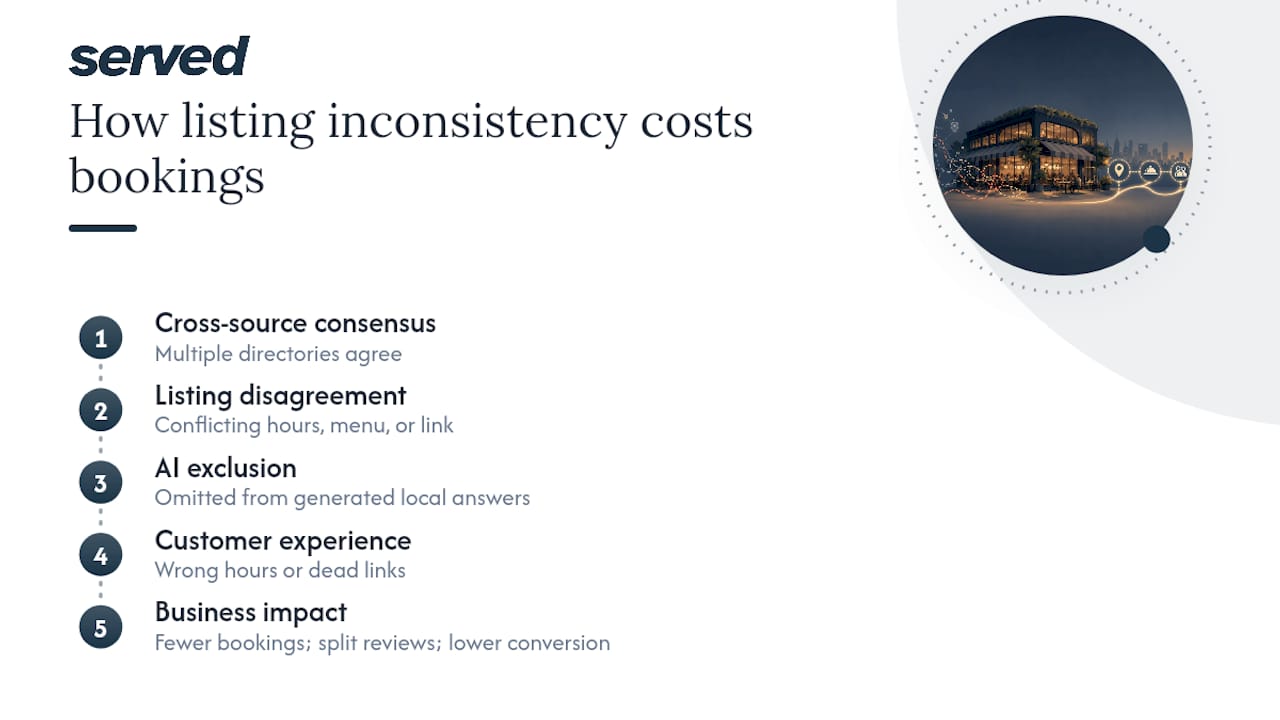
Search engines and AI assistants treat cross-source agreement as a confidence signal. When five directories say the same thing about your restaurant, that consensus behaves as evidence you're real, open and reliable. When they disagree, confidence drops, and so does your visibility.
Consistency is now a booking eligibility test, not just a ranking factor. Google's rebuilt AI Mode can generate a local answer and complete a reservation through OpenTable, Resy or Tock in the same conversation. If your listed hours contradict your booking platform's availability, or your menu link is dead, you risk being left out of that generated answer entirely, regardless of how good your food actually is.
The everyday examples are mundane, but costly. Google says you close at 10pm, your own website says 9pm, and a customer turns up to find you shutting the doors. Your Yelp listing still shows a Sunday brunch menu you discontinued eighteen months ago. One directory has no booking link at all, so a hungry AI assistant simply recommends the competitor next door instead.
The business impact compounds: fewer completed bookings, reviews split across duplicate profiles instead of consolidating your rating, and lower conversion from every channel that touches your listing data.
The most common NAP mistakes restaurants make
Most listing problems fall into a handful of repeat offenders. Spotting them early saves weeks of chasing corrections later.
- Name variants and keyword stuffing. "Marco's Trattoria" on Google, "Marco's Trattoria Italian Restaurant Downtown" on Yelp. Directories increasingly penalise the second version as keyword stuffing, and it breaks the exact-match test machines rely on.
- Address format drift. "Suite 4" versus "Unit 4" versus no suite number at all. Pick one format and use it everywhere, floor and unit number included.
- Phone number inconsistency. Using a call-tracking number on your website but your direct line on Google Business Profile creates two "true" numbers, and neither directory knows which one to trust.
- Hours and menu link neglect. Service-specific hours (lunch versus dinner versus bar) get updated on your website but never make it back to your Google Business Profile or delivery apps, and menu links quietly rot into 404 errors.
- Duplicate listings. Old locations, rebrands, or a franchisee's forgotten test listing that still ranks and contradicts the current profile.
Pro Tip: Never use a call-tracking number as your primary listed phone number on Google Business Profile. Use it only on paid ad campaigns where you can measure it separately, and keep your direct line as the canonical number everywhere else.
How to audit your restaurant listings properly
An audit only works if it's repeatable. Start by writing your canonical NAP source-of-truth document before you touch a single listing. This becomes the reference every future edit gets checked against.
Next, search for your restaurant in an incognito browser window across every major map platform, reservation system and delivery app. Log every result you find, claimed or not, correct or not. This step alone often surfaces two or three listings you'd forgotten existed.
A simple spreadsheet keeps the process honest:
| Column | Purpose |
|---|---|
| Platform and listing URL | Identifies the exact source |
| Claimed status | Flags whether you control the listing |
| Name, address, phone strings | Direct comparison against your canonical NAP |
| Hours and menu URL | Catches stale or broken data |
| Booking link | Confirms the reservation path actually works |
| Last-checked date | Tracks your monitoring cadence |
| Corrective action and owner | Assigns responsibility, prevents drift |
For unclaimed listings, claim them immediately, since an unclaimed profile can be edited by anyone, including confused customers. Where you find genuine duplicates, report them for merging rather than leaving both live. Once logged, work through corrections in priority order, starting with the platforms your customers actually use to book.
Fixing your listings in the right order
Sequence matters more than most owners assume. Fix things in the wrong order and you'll spend weeks chasing inconsistencies that keep reappearing.
- Google Business Profile first. This is the record most other platforms and AI systems check against, so get it word-for-word correct before touching anything else.
- Website schema second. Add or correct your Restaurant and Menu JSON-LD markup so your own site states the same facts in machine-readable form.
- Reservation and delivery partners third. Update OpenTable, Resy, Tock and delivery marketplace profiles to match, paying particular attention to the booking link itself.
- Aggregator-fed directories last. Many smaller listing sites pull data from upstream aggregators rather than letting you edit directly, so corrections here can take longer to stick.
Propagation isn't instant. Some corrections take up to six weeks to fully propagate through aggregator-fed platforms, and a fix that appears live today can be silently overwritten by an aggregator's outdated feed a week later. Always recheck after two weeks, not just once at the point of editing.
How to choose and document your canonical NAP
Decide your exact strings once, then never improvise them again. Pick the legal or brand name you'll use everywhere, standardise how you abbreviate "Street" or "Avenue", and settle punctuation before you start editing a single listing.
Phone number policy needs the same rigour, particularly across multiple locations. Assign one direct number per site, and if you use call tracking for marketing attribution, restrict it to ad platforms rather than public directories.
Your canonical document should cover:
- The exact name string, address format and phone number per location
- Standardised hours, including any service-specific splits
- The live menu URL and booking link for each site
- A single named owner responsible for approving any future change
- A rule that any hours or menu change automatically triggers a listing recheck
Multi-location and franchise operators need an extra layer of governance here. Without a locked communications owner, a well-meaning manager updating one directory can quietly break consistency across a dozen others.
Which directories to update first
Not every platform deserves equal urgency. Prioritise by where your customers actually search and book.
Critical, fix within days: Google Business Profile and Apple Maps carry the heaviest weight in local search and AI-generated answers.
High priority, fix within the first two weeks: Yelp, TripAdvisor, and your reservation platform (OpenTable, Resy or similar), plus any delivery marketplaces you're active on. Reservation flows and booking connectivity directly affect whether an AI assistant can complete a booking on your behalf rather than simply naming a competitor.
Medium priority: Facebook, Instagram and Bing Places round out your coverage, alongside any regional or cuisine-specific directories relevant to your market.
Directory listings function as the verification layer that search engines cross-check against your primary sources, so working top-down through this list produces faster, more durable results than fixing platforms at random.
How long do listing fixes take to show results?
Google Business Profile changes often appear within a day or two. Website schema updates depend on when search engines next crawl your pages, typically within one to two weeks. Aggregator-fed directories are the slow lane, occasionally taking up to six weeks to fully settle.
A simple monitoring cadence keeps regressions from creeping back in:
- Recheck every edited listing after two weeks to confirm it held
- Run a full audit monthly for the first three months after a major correction
- Move to quarterly checks once your listings have stayed stable
Pro Tip: Test your AI eligibility directly. Search your restaurant's name in an AI assistant and check whether it can name your hours correctly and complete a booking. If it can't, your schema or booking link needs attention.
Why this matters more than most owners realise
Listing consistency used to be a tidy-up job, the kind of task you got to when things were quiet. That thinking no longer holds. AI-generated local answers now decide, in real time, whether your restaurant gets named and booked, or quietly skipped for the place down the street with cleaner data. This is a genuine E-E-A-T shift: it's no longer enough to rank well, you have to be legible and bookable to a machine reading your listing at the exact moment a hungry customer asks.
What most operators underestimate is how much of this is invisible until it costs them a booking. A mismatched phone number doesn't announce itself. It just quietly routes fewer calls, and Sunday brunch reservations that never seem to have a clear explanation. Structured menu data and live booking connectivity aren't technical nice-to-haves anymore. They're the difference between being recommended and being ignored.
— Ignacy Jurkowski
Keep your listings accurate without the manual chasing
Running the audit above by hand works, but it takes real hours, and aggregator-fed platforms have a habit of quietly undoing your progress. Served is built to close that gap for restaurants, bars and cafes that would rather spend those hours on service than spreadsheets. Its free Booking Path Scan checks your current visibility and booking readiness in minutes, flagging exactly where your listings and booking path fall short.

Beyond the scan, Served gives you real-time menu updates that push to your listing the moment your dishes or prices change, plus a booking path guests can complete without hidden fees eating into your takings. Every plan includes human support, not a chatbot, when something needs fixing fast. If you're currently juggling another reservation system, switching to Served is designed to be straightforward for busy, non-technical teams. Run the Booking Path Scan today and see exactly where your listings stand.
Sources
Consult schema.org's LocalBusiness reference for the exact JSON-LD properties covering location, hours, menu and offers. For the AI-era context behind why bookability now matters as much as accuracy, see the analysis of Google's rebuilt AI Mode. For practical menu markup guidance, Intermenu's optimisation guide covers publishing menus as structured HTML rather than PDFs.
FAQ
What is the 30/30/30 rule for restaurants?
There's no single agreed definition of a "rule" specific to restaurant listings or operations, and figures vary depending on which cost or staffing framework is being discussed. If you've seen it referenced for food cost, labour cost or profit margins, check the original source's own definition rather than assuming a universal standard.
What are the three C's in a restaurant?
Definitions vary by source, but the phrase commonly refers to consistency, cleanliness and customer service as the three pillars that keep diners returning. In the context of your online presence, consistency extends directly to your listings: the same standards that keep a kitchen reliable should keep your NAP data reliable too.
What are the 7 P's of restaurant marketing?
The P's typically adapt the classic marketing mix, product, price, place, promotion, people, process and physical evidence, to a hospitality setting. Your online listings sit squarely inside "place" and "physical evidence," since an inconsistent Google Business Profile undermines the physical evidence of trust before a diner ever walks through your door.
What's the hardest position in a restaurant to keep consistent online?
This isn't really about a role in the kitchen, but the person managing your online presence often faces the toughest consistency challenge: reconciling hours, menu changes and booking links across a dozen platforms that all update on different schedules. Tools like Served's restaurant platform exist specifically to reduce that manual reconciliation burden.
How often should I check my restaurant's listing consistency?
Recheck any edited listing after two weeks to confirm the correction held, since aggregator-fed platforms can silently revert changes. After that, run a full audit monthly for three months, then move to quarterly checks once your data has proven stable.