
Use marketplaces to get discovered. Use direct bookings to make money and keep your guests. That's the whole strategy in one sentence. Aim to grow direct bookings toward 35–50% of your covers or room nights, depending on your venue type and market, and start by auditing exactly where your bookings come from right now.
TL;DR:
- Growing direct bookings to at least 35-50% of total covers or room nights can significantly improve profit margins by avoiding marketplace fees.
- Flat subscription models for direct booking tools offer predictable costs and often pay for themselves within months for venues with meaningful volume.
- Real-time availability, transparent pricing, and a mobile-friendly checkout are essential for converting marketplace visitors into direct bookers.
- Regularly monitoring key metrics like direct share, commission percentage, customer lifetime value, and repeat bookings helps track channel effectiveness and optimize marketing efforts.
- Using integrated management systems and a multi-channel stack prevents double bookings and ensures accurate availability across all sales channels.
Table of Contents
- Marketplace bookings vs direct: what the fee structures actually cost you
- When do marketplaces win, and when does direct win?
- How do you grow direct bookings without losing discovery?
- What technology stops bookings leaking between channels?
- Which KPIs actually tell you the channel mix is working?
- How does Served fit this playbook?
- What should you try first?
- Get your bookings, keep your margin
- Sources
- FAQ
Marketplace bookings vs direct: what the fee structures actually cost you
The gap between marketplace bookings vs direct isn't philosophical. It's arithmetic, and it shows up on your bottom line every single month.
Marketplaces typically charge one of two ways: a per-booking or per-cover fee, or a commission percentage on the total bill. Direct booking tools tend to run on a flat subscription instead, which changes your cost structure from variable to fixed. That distinction matters more than most managers realise when they're comparing options on price alone.
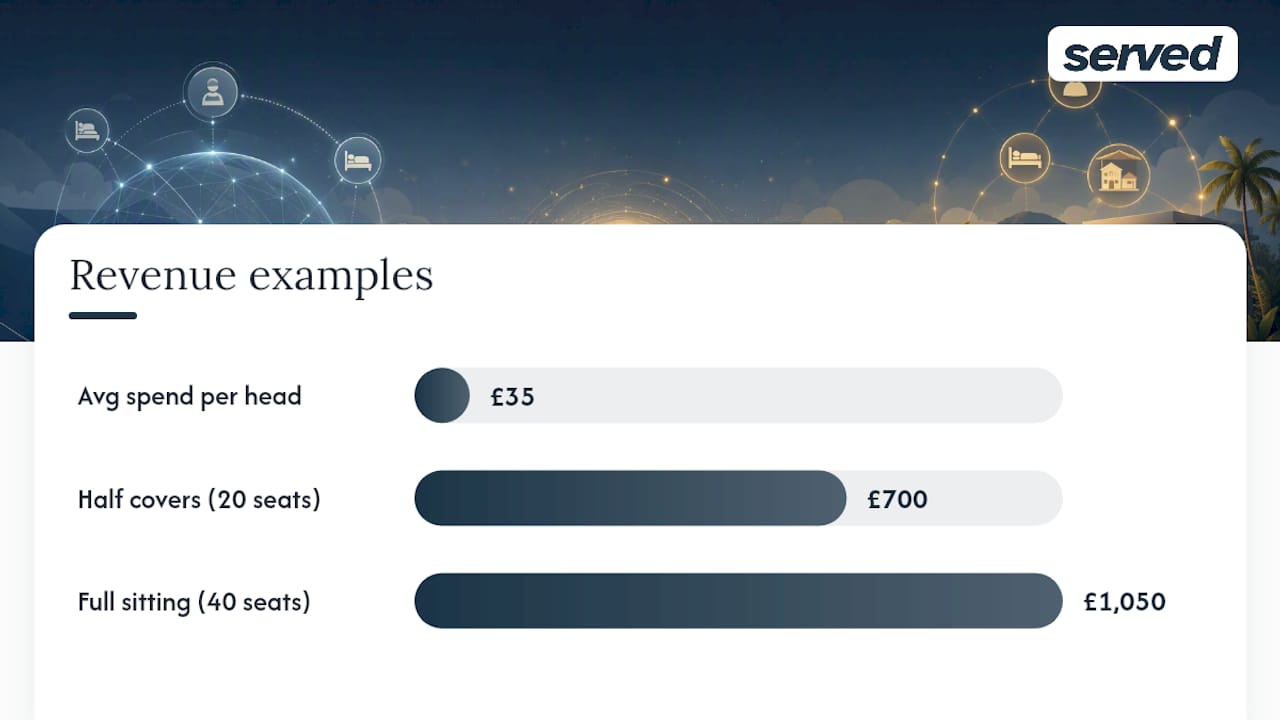
Here's the maths that trips people up. A venue seating 40 covers a night, with an average spend of £35 per head, generates roughly £1,050 in nightly revenue from a full sitting. If a marketplace charges even a modest per-cover fee, and you're filling half your covers through that channel, the fee comes straight off your margin before you've paid staff, rent, or food cost. Multiply that across a year and you're often looking at a five-figure sum that a flat subscription model would have replaced with a fixed, predictable line item. Benchmarking of restaurant booking platforms shows two prevailing pricing models across the industry, per-cover fees and flat subscriptions, and notes that published per-cover rates are often opaque, which makes side-by-side comparison genuinely difficult for operators.
That opacity is exactly what regulators have started targeting. The FTC's rule banning undisclosed junk fees forces hotel and ticketing platforms to show the true price upfront, and the Federal Register's trade regulation rule on unfair or deceptive fees extends that transparency pressure further. For you, this is an opportunity, not just compliance noise: transparent direct pricing becomes a genuine selling point once guests are primed to distrust marketplace "deals" that hide fees until checkout.
What should you weigh up before choosing a fee model?
- Per-cover or commission fees scale with your success, so growth quietly increases your cost base.
- Flat subscriptions reward volume: the more you book, the lower your effective cost per booking.
- A direct booking engine has upfront setup cost, but for venues doing meaningful volume, it often pays back that cost within months rather than years.
- Hidden fees erode trust exactly when regulators are pushing the opposite direction.
Marketplace commissions can consume a significant portion of covered revenue at busy venues once you tally fees across every booking that arrives through third-party channels.
When do marketplaces win, and when does direct win?
Neither channel is inherently better. Each does a different job, and the trick is matching the job to the channel rather than picking a side.
- Marketplaces win on discovery. A brand-new venue with zero reputation needs eyeballs before it needs loyalty, and a marketplace's existing traffic gets you found faster than any standalone website will in month one.
- Marketplaces win on demand smoothing. Quiet Tuesday nights or last-minute cancellations are exactly what a marketplace's broad reach can fill, often within hours.
- Direct wins on margin. Every booking that skips the marketplace fee keeps more of the bill in your account, and that difference compounds over a full year of trading.
- Direct wins on guest data. When someone books through your own engine, you get their email, their preferences, and their booking history. A marketplace guest belongs to the marketplace's database, not yours.
- Direct wins on pricing and loyalty control. You can run a repeat-guest discount, a birthday offer, or a members-only tasting menu without asking anyone's permission or matching someone else's rate parity clause.
The pitfalls tend to cluster around over-dependency. A venue that lets one marketplace supply 70% or more of its bookings has effectively handed a third party the power to set its margins, and renegotiating from that position is weak. Rate parity clauses, which stop you undercutting the marketplace price on your own site, are the other trap: read every contract line before signing, because some quietly restrict how you can price direct bookings.
New openings and highly seasonal venues generally lean on marketplaces early, then shift the mix as reputation builds. High-volume, established sites and local independents with a loyal base usually get more value pushing hard on direct, because they've already solved the discovery problem.
How do you grow direct bookings without losing discovery?
Treat this as a channel allocation problem, not a binary choice. Marketplaces handle discovery. Direct handles everything after the first booking.
Start with these tactics, roughly in order of effort required:
- Offer a best-rate guarantee on your own site, and say so clearly on every page a marketplace guest might land on.
- Reserve exclusive add-ons for direct bookers, such as a free drink, late checkout, or a chef's table upgrade that marketplaces never see.
- Segment your inventory, holding your best tables or rooms back for direct booking during peak periods.
- Capture an email address at first touch, even for marketplace guests who message you directly, so the relationship doesn't end when the booking does.
Conversion depends on the checkout experience just as much as the offer. Guests abandon slow, unclear, or overly long booking flows within seconds, and mobile checkout speed matters more than desktop design in 2026. Show your full price, including any service charge, and state your cancellation terms plainly rather than burying them in a policy page nobody reads. Strong visual presentation helps too: hotel booking website photo best practices is worth a look if your direct site still relies on stock imagery instead of your own space.
Pro Tip: Run one direct-only perk, like a free dessert or a room upgrade, for eight weeks before rolling it out permanently. Measure incremental bookings against the cost of the perk, and only scale it once the numbers hold up.
Three low-risk experiments worth running this quarter: a best-rate banner on your homepage, an exclusive perk tested against a control period, and an email capture prompt at the confirmation stage of every marketplace booking you receive. Each one is measurable within weeks, not months.
What technology stops bookings leaking between channels?
Multi-channel selling only works if every channel is reading from the same numbers in real time. The moment your marketplace calendar and your direct calendar disagree, you get double bookings, and double bookings cost you far more in guest trust than any commission ever did.
The essential stack has four parts:
- A property or reservation management system (PMS) that holds the master calendar.
- An integrated booking engine for your own website and social channels.
- A channel manager that pushes availability changes to every marketplace instantly.
- A payments layer, typically Stripe or similar, that handles deposits, no-show charges, and refunds without manual intervention.
One source of truth isn't optional once you're selling through more than one channel. Real-time synchronisation is what stops a table being sold twice, once through a marketplace and once through your own site, five minutes apart. Reconciliation should happen daily, not monthly: check that every marketplace booking landed in your PMS and that every payment matches what you expected. Build a clear refund workflow so staff aren't improvising policy at the till, and capture guest consent for marketing at the point of booking so the data you collect is actually usable later.
A direct booking engine that converts needs, at minimum, real-time availability, mobile-first checkout, transparent pricing, and a confirmation flow that captures contact details automatically. Anything less and guests will drift back to the marketplace they trust more than your website.
Which KPIs actually tell you the channel mix is working?
Five numbers matter, and you should be able to pull all of them from a single spreadsheet within ten minutes.
- Direct share: the percentage of total bookings or revenue arriving through your own channels.
- Commission as a percentage of revenue: industry benchmarks suggest treating anything above 8% as a signal to review your channel mix.
- Customer acquisition cost (CAC) by channel: what you actually spend to win a booking through each route.
- Lifetime value (LTV): repeat spend from guests you can actually contact again.
- Repeat rate: the share of guests who book a second time without a marketplace in between.
Research on hotel distribution puts direct channels at roughly 51% of bookings across a weighted European sample, a useful benchmark if you're wondering whether your own split is competitive.
Run weekly checks on booking volume by channel, and a monthly financial review of commission spend against revenue. To estimate payback on a direct booking engine, divide the setup cost by your average monthly commission saving. If that saving is £600 a month against a £3,000 setup cost, you've paid it back in five months.
How does Served fit this playbook?
A direct-first approach can remove per-cover fees entirely, include tools showing where online visibility is weak before investing, offer real-time menu updates to keep listings accurate, use payment processors like Stripe for payments, and provide human customer support for issues.
Before switching, check:
- How guest data migrates from your current system.
- Whether your existing calendar and payment flows integrate cleanly.
- What a short trial period actually shows about conversion and no-show rates.
What should you try first?
Start small: audit your current channel split this week, then run one direct-only perk for eight weeks. Measure before scaling. Expect iteration, not a single fix.
— Ignacy Jurkowski
Get your bookings, keep your margin
There are other ways to chase direct bookings, custom-built websites, generic reservation widgets, or sticking with a marketplace and eating the fees. Served takes a different route: a flat subscription with no commission on any booking, so a full Saturday night doesn't cost you more the busier you get.

You keep every guest's contact details, every booking, and every pound of margin that a per-cover fee would otherwise have taken. The Growth Scan shows you exactly where your visibility is weak before you spend a penny fixing it, and switching over is built to be simple whether you're coming from OpenTable or moving from TheFork. If you're ready to see where your venue currently stands, start with Served's switch page and check what a commission-free setup would actually save you this year.
Sources
- Federal Trade Commission: Federal Trade Commission announces bipartisan rule banning junk ticket & hotel fees
- Skift Research: Direct bookings vs OTAs — analysing the shift in U.S. travel booking trends
- Restaurant booking fee benchmark 2026
FAQ
Is booking directly with a hotel or venue cheaper than through a marketplace?
Often, yes, because venues that offer a best-rate guarantee price their direct channel to match or beat marketplace listings once fees are stripped out. Marketplaces sometimes show a lower headline price but add fees at checkout, which is exactly what the FTC's junk fee rule now requires them to disclose upfront.
Why do some marketplaces appear cheaper than booking direct?
Marketplaces sometimes absorb part of their commission to win volume, which can make their listed price look lower before fees are added. Skift's research shows travellers increasingly research on marketplaces but complete the booking directly, a pattern known as demand leakage that suppliers can reclaim with the right offer.
Is direct booking legitimate and safe for guests?
Yes, direct booking through a venue's own engine is standard practice and typically comes with the same payment security as any marketplace, provided the site uses a proper payment processor like Stripe. Confirmed bookings, clear cancellation terms, and transparent pricing are what make a direct channel trustworthy, and platforms like Served build those elements in by default.
What are the downsides of booking directly instead of through a marketplace?
The main downside is reduced comparison shopping. Guests can't easily see every local option side by side the way they can on a marketplace, so direct works best once a venue already has some reputation or repeat custom to draw on.
What direct-share target should a venue aim for?
European hotel data puts average direct share at around 51%, which is a reasonable benchmark for an established venue to measure against.