NAP consistency means your restaurant's name, address and phone number appear character-for-character identical everywhere online. Start today: write one canonical version, publish it on your website footer and Google Business Profile, then use it everywhere else. Every mismatch between listings chips away at the trust search engines place in your business.
TL;DR:
- Small differences in formatting or wording across listings, such as abbreviations or suite numbers, can lead search engines to treat them as separate businesses, harming visibility.
- Fixing website and primary directory listings first ensures authoritative updates are recognized quickly, saving effort when correcting downstream platforms later.
- Regularly auditing and updating your NAP information with a documented standard prevents drift and maintains consistency over time, especially after relocations or rebranding.
- Correcting duplicate or outdated listings on major platforms like Google, Yelp, and key reservation sites can significantly improve search ranking and customer trust within two to three months.
- Using tools like Serveds' Growth Scan helps streamline the process by automatically flagging inconsistencies, making ongoing maintenance less time-consuming.
Table of Contents
- What is NAP consistency for restaurants, and why does exact formatting matter?
- How NAP inconsistency harms your local visibility and customer trust
- Common NAP mistakes restaurants make
- How to audit your restaurant's NAP across the web
- How to fix NAP inconsistencies: the correct order of operations
- Deciding on your canonical NAP and formatting rules
- Which platforms and directories to prioritise for restaurants
- How long fixes take to propagate and when rankings improve
- Keeping NAP up to date: governance and cadence
- Served's view on NAP and bookings
- Why most NAP advice undersells the actual fix
- A practical way to keep your listings clean without the admin
- Authoritative resources and tools to consult
- Sources
- FAQ
What is NAP consistency for restaurants, and why does exact formatting matter?
NAP consistency is straightforward on paper. Your name, address and phone number should read identically on every platform where your restaurant appears. Search engines and AI assistants don't extend the same benefit of the doubt a human reader would.
Small variations get treated as genuinely different businesses. Character-for-character identical NAP across your website, Google Business Profile and citations is what allows automated systems to confirm you're one entity, not several.
Consider how easily this breaks down:
- "St." on one listing, "Street" on another
- "Suite 4" versus "Unit 4" versus no suite number at all
- "(020) 7946 0958" versus "020 7946 0958" versus "+44 20 7946 0958"
Your website footer and your LocalBusiness JSON-LD schema act as the authoritative source engines check against. Map services and AI assistants increasingly pull from structured data first, plain text second.
How NAP inconsistency harms your local visibility and customer trust
Search engines build confidence in a business listing through what's called entity verification. Every platform that shows your restaurant name, address and phone number consistently adds a confirming signal. Every mismatch subtracts one.
Duplicate or conflicting listings don't just confuse the algorithm. They split your reviews, your click data and your ranking prominence across multiple weaker entries instead of one strong one.
The impact is measurable at scale. Practitioner data on tourism and hospitality listings shows duplicate entries fragmenting visibility signals badly enough that a single, clean listing consistently outperforms several inconsistent ones covering the same venue.
For a diner deciding between three restaurants on a map, a wrong phone number or an address that doesn't match what their sat-nav shows is often enough to make them pick somewhere else. Trust erodes fast when the basic facts don't line up.
Common NAP mistakes restaurants make
Most inconsistencies aren't dramatic. They accumulate through small decisions made by different people at different times, usually without anyone noticing.
- Name variants and keyword stuffing. "Bella Roma" on your website, "Bella Roma Italian Restaurant & Pizzeria" on an old directory listing someone set up years ago.
- Address formatting drift. Abbreviations, missing suite numbers, or an old location that was never removed after you moved premises.
- Phone punctuation chaos. Spaces, brackets and country codes applied inconsistently across platforms.
- Call-tracking numbers on public listings. Placing tracking numbers on high-trust citations fragments your entity record and creates a discrepancy that never resolves on its own.
- Legacy duplicates. Old OTA profiles, a defunct delivery-platform listing, or a directory entry from a previous owner that's still indexed and still wrong.
How to audit your restaurant's NAP across the web
Start by writing your canonical NAP once, in a single document, before you touch a single listing. Copy and paste it every time. Never retype it from memory.
From there, work through the channels systematically:
- Google Business Profile, Apple Maps, Bing Places
- Yelp and major review platforms
- Reservation and delivery platforms (booking systems, ordering apps)
- Legacy directories and any aggregator-fed sites
- Your own website footer, contact page and schema markup
A simple spreadsheet works better than any specialist tool for this: one row per platform, columns for listed name, address and phone, checked against your canonical version. Search operators like site: combined with your restaurant name will surface citations you'd otherwise miss entirely.
Pro Tip: Set weekly checks on your highest-traffic listings (Google, your top reservation platform), monthly reviews of secondary directories, and a full quarterly audit covering everything. Drift happens quietly, so the cadence matters more than any single fix.
How to fix NAP inconsistencies: the correct order of operations
Fixing listings in the wrong order wastes effort. Search engines and directories look to certain sources before others, so sequence matters as much as accuracy.
- Fix your website first. Update the footer, contact page and LocalBusiness JSON-LD schema before touching anything else. Search engines treat your own site as the authoritative reference when they recrawl.
- Update Google Business Profile. This is your highest-visibility listing and the one most diners check first.
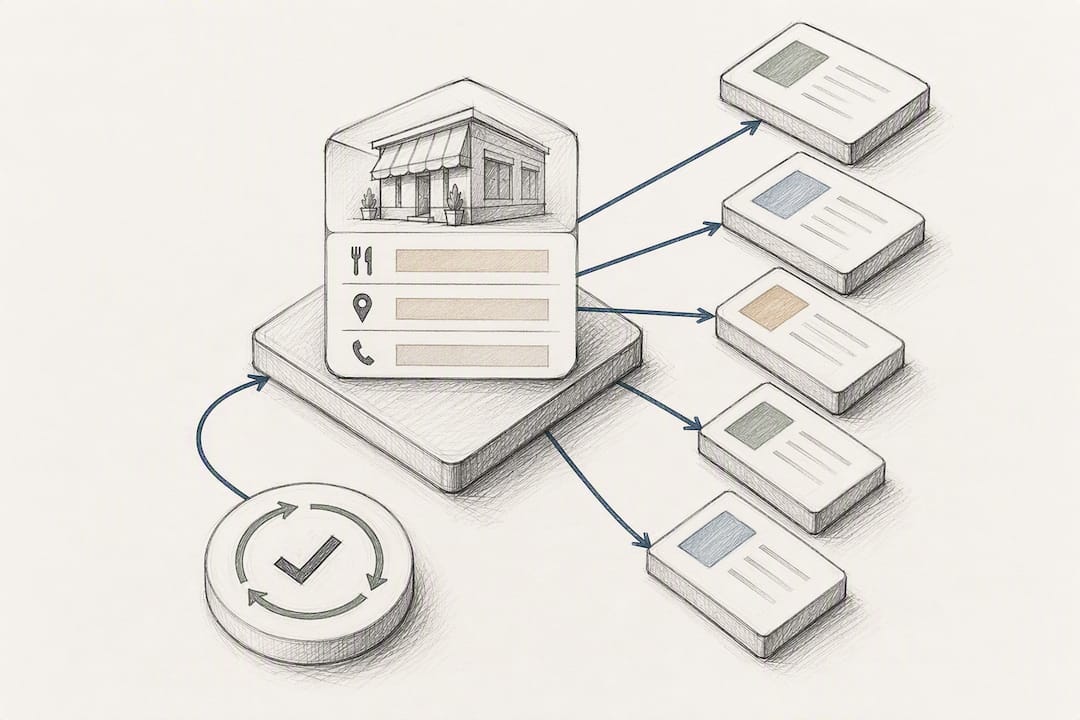
- Submit to major aggregators. Services like Data Axle, Acxiom and Foursquare feed data to hundreds of downstream directories, so correcting them early saves repeat work later.
- Manually fix tier-one directories and OTAs. These rarely pull from aggregators cleanly, so they need direct correction.
- Report and merge duplicates. Every platform has a process for this. Skipping it leaves a competing, wrong entry live indefinitely.
- Verify and follow up. Check back after a few weeks. Aggregator cascades in particular need a second look to confirm the correction actually propagated.
Deciding on your canonical NAP and formatting rules
Before you fix anything, decide the rules. Document them once so future edits don't quietly reintroduce the same drift.
- Use your legal or chosen DBA name exactly as you want customers to search for it, not a keyword-stuffed variant.
- Pick one address format and one phone format, and write both down.
- Decide your policy on suite numbers, punctuation and abbreviations (Street versus St.) in advance.
- Choose the canonical form of your website URL (with or without "www", trailing slash or not).
- Name one person who approves any change to the master record, and store that record somewhere the whole team can access.
Which platforms and directories to prioritise for restaurants
Not every listing carries equal weight, so fix in order of impact rather than working alphabetically down a list.
- Google Business Profile comes first. It's the listing most diners see before they decide whether to visit.
- Apple Maps and Yelp follow closely, given how heavily both influence local discovery for restaurants specifically.
- Reservation and delivery platforms matter for a different reason: these are where the booking or order actually happens, so an error here costs you a transaction, not just visibility.
- Major aggregators deserve early attention too, since correcting them once prevents dozens of smaller downstream errors from reappearing.
How long fixes take to propagate and when rankings improve
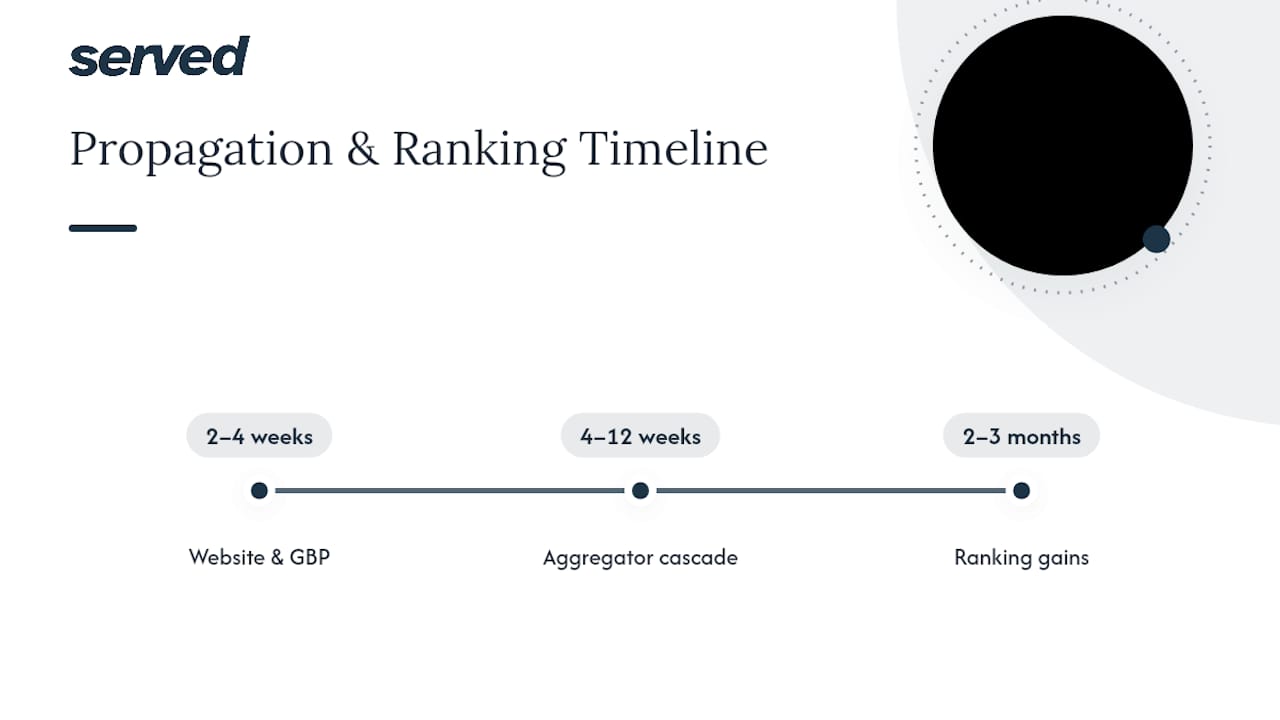
Patience matters here. Google Business Profile and website changes are often visible within 2 to 4 weeks. Aggregator cascades take longer, typically 4 to 12 weeks to filter through to every downstream directory.
Meaningful ranking improvements usually take longer still, often 2 to 3 months depending on how competitive your local market is. Don't judge a cleanup by week two.
Keeping NAP up to date: governance and cadence
Treat your listings as an operations function, not a one-off SEO project. Assign one owner, and route every change through them rather than letting whoever's on shift update a listing on the fly.
Keep a single source-of-truth document, or use a location-management tool if you run multiple sites. Schedule recurring checks, set alerts for unexpected changes, and never publish a call-tracking number as your primary public contact, since it creates a mismatch that lingers indefinitely.
Served's view on NAP and bookings
Running Served's Growth Scan across hundreds of venues, we consistently see the same pattern: NAP drift correlates directly with lost bookings. Venues that clean up their listings typically report better visibility and more foot traffic within weeks. Treat your listings like your floor plan or your menu: something you actively manage, not something you set up once and forget.
Why most NAP advice undersells the actual fix
Most guidance on this topic treats NAP consistency as a one-time technical fix: audit, correct, move on. That's the wrong model for a restaurant. Your listings change every time you move premises, add a second phone line for takeaway, rebrand slightly, or switch reservation platforms. Treating NAP as a project with an end date guarantees drift within a year.
The conventional advice also underweights ownership. Plenty of articles tell you what to check but not who should own the checking. In practice, the venues that stay clean are the ones where one named person, usually the general manager, holds the master record and approves every edit before it goes live anywhere.
If you take one thing from this guide, prioritise the canonical document over the audit itself. An audit without a documented standard just finds the same problems again in six months. Get the standard right first, then the audit becomes maintenance rather than firefighting.
— Ignacy Jurkowski
A practical way to keep your listings clean without the admin
Served exists to solve exactly this problem without adding another task to your week. Instead of chasing a dozen directories manually, Served's free Growth Scan checks your public listings against your canonical NAP and flags where they've drifted, giving you a clear starting point rather than a guessing game.

Beyond the scan, the platform offers a commission-free booking system with real-time menu updates and human support when something needs sorting quickly, without the hidden fees a traditional reservation system charges per cover. If you're already reconsidering your booking setup while cleaning up your listings, switching to Served consolidates both jobs into one place. Run the free scan first, see what it finds, and decide from there.
Authoritative resources and tools to consult
- NAP Consistency: Why Wrong Data Kills Local Rankings
- Restaurant Local SEO: A 2026 Guide
- SEO & GEO practices for location-aware search
Sources
- Restaurant Local SEO: A 2026 Guide - Tableview
- The truth about call tracking and local SEO
- Restaurant directory listings: How to keep your NAP consistent everywhere - TFG
FAQ
How do I check my restaurant's NAP consistency?
Write your canonical name, address and phone number in one document, then search each platform where your restaurant appears (Google, Apple Maps, Yelp, reservation and delivery apps) and compare every entry against it in a spreadsheet.
What does NAP mean in business?
NAP stands for name, address and phone number, the three core identity fields that search engines and directories use to confirm a business listing belongs to one real, verifiable venue.
What is the 30/30/30 rule for restaurants?
Definitions of this rule vary across the industry and it isn't a recognised local SEO standard, so treat any specific version you encounter with caution rather than as an established framework.
What are the 7 P's of marketing for restaurants?
The P's (product, price, place, promotion, people, process and physical evidence) are a general marketing framework rather than a restaurant-specific standard, and applying them usefully depends heavily on your particular venue and market.
How long does it take for NAP fixes to improve rankings?
Website and Google Business Profile changes are often visible within 2 to 4 weeks, while aggregator cascades typically take 4 to 12 weeks, with full ranking improvements often taking 2 to 3 months.