For most restaurants, Served is the strongest OpenTable alternative because it charges a flat subscription rather than per-cover fees, and it hands guest data back to you instead of locking it inside a marketplace. Eat App, Tablein, and Hostme provide options suitable for smaller independents with limited budgets; Resy, Tock, and SevenRooms fit upscale, multi-site, or ticketed operations; TheFork and Quandoo win on European discovery reach. Use the shortlist below, then the how-to-choose checklist, to match the platform to your booking mix and margin goals.
TL;DR:
- Platforms with strong marketplace presence, such as TheFork and Quandoo, tend to limit guest data ownership because bookings partly remain within the marketplace ecosystem.
- Flat-fee, direct-booking tools like Served, Tablein, and Eat App are ideal for independents primarily relying on repeat guests or their website traffic, as they do not depend on marketplace discovery.
- Multi-site groups or hotel F&B operations should prioritize SevenRooms or Served for advanced guest tracking across multiple locations, despite their higher cost tiers.
- Restaurants focusing on tasting menus, fixed-price events, or prepayment require platforms like Tock that are built around ticketing and deposit management, not standard reservations.
- When switching platforms, it is crucial to export all reservation data beforehand, run both systems in parallel for at least a week, and carefully test the import to prevent losing bookings or guest histories.
Table of Contents
- OpenTable alternatives compared: pricing, CRM, and marketplace reach
- Which OpenTable competitor actually fits your venue?
- How to choose the right OpenTable alternative
- Switching from OpenTable without losing a single booking
- Why we built Served around a flat subscription
- Ready to move off OpenTable? Here's where to start
- Sources
- FAQ
OpenTable alternatives compared: pricing, CRM, and marketplace reach
Every reservation platform makes one of two bets: charge you per cover and hand you diner traffic, or charge you a flat fee and hand you the relationship. That single distinction explains almost every pricing model on this list, and it's the first thing to check before you look at floorplan tools or waitlist features.
Served's flat subscription model sits at the predictable end of that spectrum. There's no per-cover surcharge and no commission on the bookings you take, which means a busy Friday night doesn't quietly cost you more than a slow Tuesday. The platform bundles guest CRM, floorplan and waitlist management, a Growth Scan that audits your online visibility, and human support, all under one price. It's built for operators who've done the maths on marketplace fees and decided they'd rather own the guest relationship outright.
Here's how the alternatives compare on pricing and data ownership:
- Served: Flat subscription pricing without per-cover fees. Offers guest CRM and data export, Growth Scan visibility tools, floorplan and waitlist management, and payment support.
- Eat App: Flat tiered pricing with a free starter plan for very small venues. Basic CRM and a simple floorplan widget. Minimal marketplace presence, so most bookings come through your own site. Best for cost-conscious independents just starting to formalise reservations.
- Resy: Flat-fee structure rather than per-cover billing, but pricing sits higher than budget tools. Strong CRM for guest preferences and VIP tracking. Marketplace presence is significant in major metros, particularly for reservation-driven fine dining. Best for upscale restaurants competing for visibility in dense urban markets.
- Tock: Built around ticketing and prepayment rather than standard walk-in bookings. CRM exists but is secondary to the ticketing engine. Marketplace visibility is moderate. Best for tasting menus, prix fixe nights, and any format where you take payment upfront.
- SevenRooms: CRM is the centrepiece, with detailed guest profiles designed to travel across multiple locations. Pricing tends toward enterprise tiers, which can be steep for a single site. POS integrations are broad. Best for multi-site groups and hotel F&B operations that treat guest intelligence as a strategic asset.
- Tablein: Flat, straightforward pricing with no per-cover surprises. CRM and email marketing tools are functional without being deep. Marketplace presence is minimal, it's a direct-booking tool first. Best for small independents who want simplicity over features they'll never use.
- TheFork: Marketplace-first model with wide European reach. Guest data typically stays partly within the platform's ecosystem. Floorplan and POS support vary by market. Best for restaurants prioritising discovery across European diners rather than owning the full guest record.
- Quandoo: Similar marketplace structure to TheFork, with regional strength across Europe and parts of Asia-Pacific. CRM capability is limited compared with dedicated booking tools. Best for venues operating specifically in markets where Quandoo has real diner penetration.
- Yelp Guest Manager: Reservation tool tied to Yelp's local search and review ecosystem. CRM is basic. Its real value is the built-in discovery layer for businesses that already rely on Yelp traffic. Best for operators whose guests already search and review on Yelp.
- Hostme: Practical table management aimed at small to mid-size venues. CRM is present but not the headline feature. Marketplace presence is minimal. Best for operators who want solid host-stand tools without marketplace complexity.
- Table Agent: A lightweight, low-cost booking widget with limited extras. CRM capability is thin. No meaningful marketplace presence. Best for very small independent venues that just need a functional booking button and nothing else.
- NowBookIt: Standard reservation features with regional adoption in specific markets. CRM and POS support are workable rather than deep. Best for venues in the regions where NowBookIt has an established local presence.
- Eveve: A reservation and floorplan platform with established use among independent restaurants seeking core booking functionality without marketplace overhead.
Notice the pattern: the platforms with strong marketplace presence (TheFork, Quandoo, Resy) tend to have weaker guest-data ownership, because the diner relationship partly belongs to the marketplace, not you. The platforms with strong CRM and flat pricing (Served, Tablein, Eat App) tend to have little to no marketplace discovery, because you're trading diner-side traffic for margin control. SevenRooms and Tock sit apart from that trade-off entirely, built for specific operational needs (multi-site CRM, ticketed events) rather than general-purpose booking.
Which OpenTable competitor actually fits your venue?
The shortlist tells you what each platform does. This section tells you who actually benefits, because "best for" labels only mean something once you match them against your real booking mix.
Independent restaurants with steady local demand gain the most from flat-fee, direct-booking tools: Served, Eat App, Tablein, and Hostme. If most of your covers already come from repeat guests, your own website, or word of mouth, you're not paying for a marketplace, you're paying for a booking button, and there's a real cost difference between those two things. OpenTable's per-cover fees run at a per-cover rate on entry plans, according to vendor pricing pages, and that adds up quickly for a restaurant seating many covers a week from its own website traffic, covers that never needed a marketplace to find you. A 2026 buyer's guide lists commission-free starter tiers for comparable tools ranging from $0 to $139 a month, which is the flat-fee end of the market you should be comparing against that per-cover math.
Multi-site groups and hotel F&B operations should weight SevenRooms and Served's own multi-location capability heavily, because the operational question isn't "can this take a booking," it's "can this recognise the same guest across five properties and surface their preferences to every host stand." SevenRooms was purpose-built for that, and its guest-profile depth is genuinely difficult to replicate on a single-site tool. The trade-off is price: enterprise CRM tiers are rarely cheap, and a five-table bistro doesn't need the machinery a nine-property hospitality group does.
Restaurants running tasting menus, prix fixe nights, or ticketed events are better served by Tock than by a general reservation tool, full stop. Prepayment and ticketing aren't bolted on, they're the core of the product, and trying to force a standard reservation platform to handle deposits and no-show protection for a $150-a-head tasting menu usually means duct-taping a payment processor on top of a tool that wasn't designed for it.
Restaurants leaning on European marketplace visibility get real value from TheFork and Quandoo, but that value comes with a cost worth naming plainly: guest data from marketplace bookings often stays partly inside the marketplace's ecosystem rather than flowing cleanly into your own CRM. One migration guide covering restaurants moving off comparable marketplace platforms notes that switching to direct booking tools improves guest ownership over time, precisely because the restaurant stops renting the relationship and starts owning it.
Pro Tip: *Before signing with any marketplace-style platform, ask what percentage of your bookings currently come through direct channels versus the marketplace itself.
One limitation worth flagging for every category: platforms built around marketplace discovery (TheFork, Quandoo, Resy, Yelp Guest Manager) generally make it harder to export a complete guest history if you decide to leave, because part of that history was never fully yours to begin with. Enterprise CRM tools like SevenRooms, meanwhile, can carry pricing that punishes a single-site restaurant for functionality it doesn't need. Flat, direct-booking tools like Served, Tablein, and Eat App avoid both problems but offer little to no organic diner discovery, so you're responsible for driving your own traffic through your website, Google Business Profile, and social channels.
How to choose the right OpenTable alternative
Run every serious candidate through seven questions before you sign anything:
- Cost predictability: Does pricing scale with your covers, or stay flat regardless of how busy you get?
- Guest ownership and export: Can you download a full guest CSV, including visit history and preferences, at any time, with no restrictions?
- Integrations: Does it sync with your existing POS, and does that sync run both ways?
- Floorplan and waitlist: Can hosts manage table turns and walk-ins from the same screen they take reservations on?
- Deposits and ticketing: If you run prepaid events, does the platform handle deposits natively, or will you need a separate processor?
- Reporting and analytics: Can you see no-show rates, average party size, and repeat-guest percentage without exporting to a spreadsheet first?
- Support and SLA: Is support human, and is there a stated response time, or are you filing a ticket into a queue?
National Restaurant Association research for 2026 points to sustained cost pressure across the industry, which is exactly why predictable operating costs and direct customer relationships matter more now than they did when marketplace fees felt like a rounding error.
During any demo, ask the sales rep to run through this script live rather than describe it: export a sample guest list on the spot, run a test import into a spreadsheet to confirm the fields are usable, confirm POS sync in front of you rather than taking their word for it, and ask directly what percentage of their bookings come from marketplace discovery versus direct links. If they can't answer that last question with a number, treat it as a red flag.
Watch for three contract traps specifically: per-cover fees disguised inside a "platform fee" line item that isn't broken out clearly, no guaranteed data export on cancellation, and minimum contract terms longer than 12 months with no exit clause. Trustpilot reviews of OpenTable show a recurring pattern of operator frustration around billing clarity and support responsiveness, which is worth remembering the next time a rep promises "full transparency" without putting it in writing.
Switching from OpenTable without losing a single booking
Migrating platforms goes wrong when restaurants treat it as a single weekend event rather than a two-week overlap. Follow this order:
- Export everything first. Pull your full reservation and guest history as CSV or JSON, and check character encoding and required fields before you touch the new system, garbled guest names or dropped phone numbers at this stage cause real service problems later.
- Run both systems in parallel for one to two weeks. Keep OpenTable live while you configure Served (or whichever tool you've chosen) alongside it, and re-point your booking channels gradually, website widget first, then Google Reserve, then any Instagram or social links.
- Rebuild your deposit and no-show rules exactly as they were. Don't assume default settings match your old policy.
- Test the import before you rely on it. Import a small batch of guest records first and check that visit history, allergies, and preferences all transferred correctly.
- Train hosts on the new interface before cutover night, not during it.
- Check for calendar conflicts between the old and new systems during the overlap window, especially for bookings taken more than a few weeks out.
That dual-run window is the single lowest-risk part of the migration process, and skipping it to save a week is the most common reason restaurants report lost bookings during a switch.
- Export reservations and guest data as CSV/JSON, verify encoding
- Run old and new systems together for one to two weeks
- Re-point booking channels one at a time
- Preserve deposit and no-show rules exactly
- Test-import a small batch before full migration
- Train host staff before go-live
- Watch for calendar conflicts during overlap
Why we built Served around a flat subscription
We built Served on a simple bet: restaurants do better when they own their guest data and know exactly what their booking software costs every month, regardless of how busy the dining room gets. The Served model reflects that directly, no commission, no per-cover surcharge, a Growth Scan that shows you where your visibility gaps actually are, and human support when something needs a real answer. Operators who've moved over report more bookings arriving through their own channels and a guest list that stays theirs. If you're evaluating a switch, our migration resources walk through the practical side of it.
— Ignacy Jurkowski
Ready to move off OpenTable? Here's where to start
If cost predictability and guest-data ownership are priorities when considering alternatives, some platforms are designed to address these issues by avoiding per-cover fees and allowing export of guest records. Tools like the Growth Scan provide insights into current online visibility, and migration resources detail the steps for switching platforms securely.
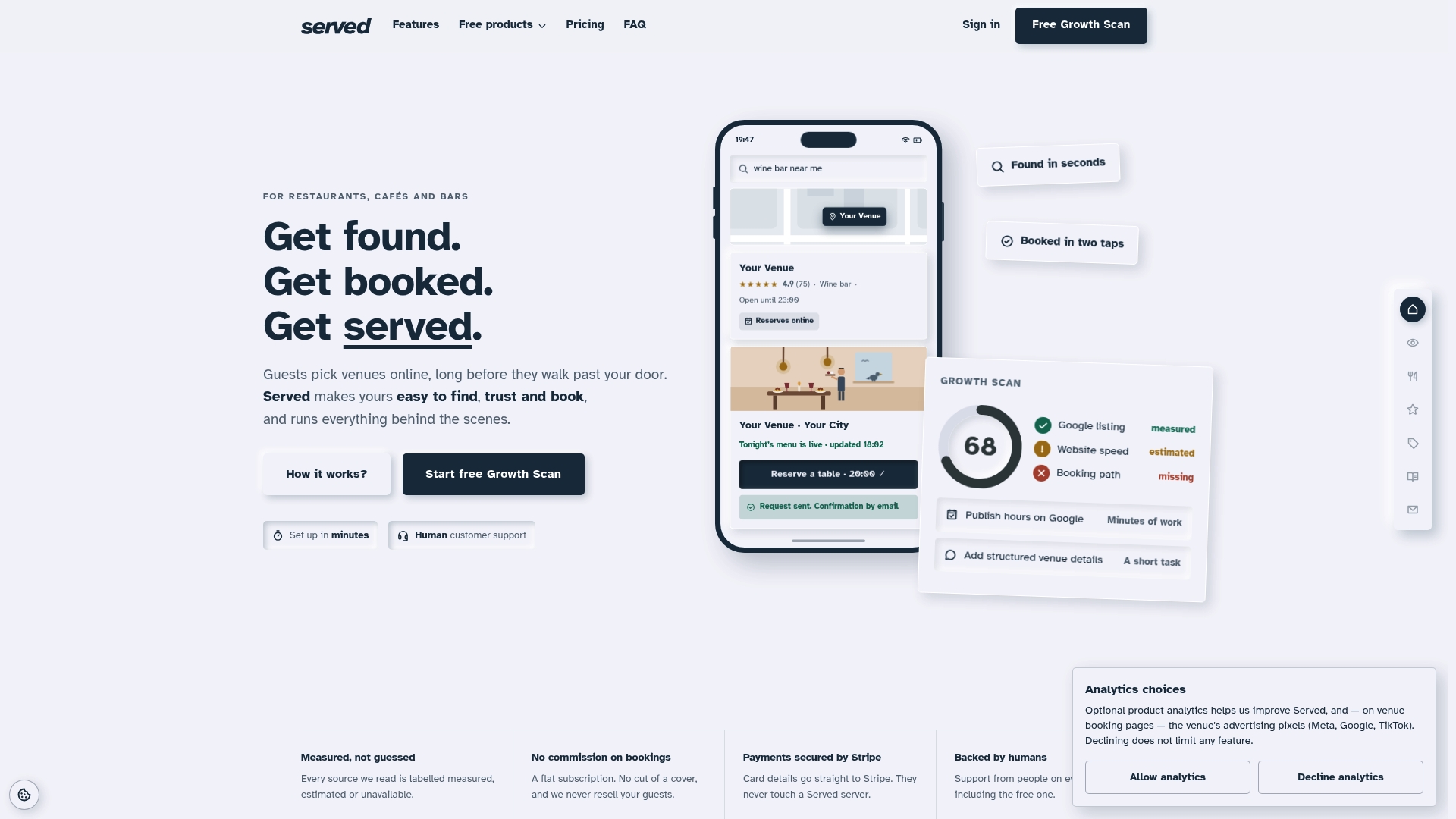
Restaurants coming specifically from OpenTable can use Served's dedicated switching guide to map their existing bookings and guest history across without gaps. If TheFork is your current platform instead, there's a matching switching guide for that migration too. Whichever platform you're leaving, start by running the free Growth Scan to see where your visibility currently stands, then compare what you find against the seven criteria in the checklist above. If Served looks like the right fit for your booking mix, our team can talk you through migration timing before you commit to a switch date.
Sources
- OpenTable for Restaurants | Capterra
- OpenTable reviews | Trustpilot
- State of the industry | National Restaurant Association
FAQ
Which is better, OpenTable or SevenRooms?
They serve different operators: OpenTable offers broader marketplace discovery, while SevenRooms focuses on deep CRM for multi-site groups and hotels that prioritise guest intelligence over diner-side traffic. Neither is universally "better," the right choice depends on whether you need discovery or guest-data depth more.
What's a booking service that competes with OpenTable?
Served, Eat App, Resy, Tock, SevenRooms, Tablein, TheFork, Quandoo, Yelp Guest Manager, Hostme, Table Agent, NowBookIt, and Eveve all compete directly with OpenTable, each with a different balance of pricing model, marketplace reach, and CRM depth.
What is the best free restaurant reservation app?
Eat App offers a genuine free starter tier for very small venues, and Served's Growth Scan is free to run regardless of which booking platform you currently use. Most other alternatives on this list charge a flat monthly fee from the outset rather than offering a permanently free tier.
What is the best restaurant booking system for cost control?
For operators focused on predictable monthly costs rather than per-cover charges, Served's flat subscription model avoids the network fees that platforms like OpenTable apply per booking. Tablein and Eat App also offer flat, budget-friendly pricing for smaller independents with similar priorities.