If you need discovery, call OpenTable first. If you want operator control and lower per-cover cost at scale, call Resy first. If you want to keep every booking commission-free on a flat subscription, Served is the alternative worth testing before you sign anything. New restaurants and multi-site groups sit somewhere in between, so get written quotes before you commit.
TL;DR:
- OpenTable's large diner network is most effective for new restaurants aiming to attract unknown customers, but it incurs per-cover fees that add up with volume.
- Resy's operator-focused tools and growing demand from cardmembers make it suitable for established fine dining venues in major cities, with lower reported per-cover costs than OpenTable.
- Served offers a flat subscription model with no commission fees, making it ideal for venues that want predictable costs and complete ownership of guest data regardless of reservation volume.
- Restaurants should request written quotes on fees, data export schemas, and disbursement timing, then run staged tests before full platform switch to avoid booking disruptions.
- The reservation market shifted rapidly through 2024 and 2026, so venues must stay flexible and verify current claims rather than relying on past figures.
Table of Contents
- OpenTable vs Resy: the shortlist and how they compare
- What discovery, pricing, data and floor tools actually mean for your bookings
- How to run the vendor calls and the cutover without losing bookings
- Where Served fits if you want to skip the per-cover maths entirely
- Which platform should you actually call first?
- Served: a different route if you'd rather skip commissions altogether
- Sources
- FAQ
OpenTable vs Resy: the shortlist and how they compare
Four names come up in almost every conversation about restaurant reservations: Served, OpenTable, Resy, and Tock. Each one solves a slightly different problem, and picking wrong costs you either money on every cover or visibility you can't get back.
Served is a commission-free booking and visibility platform sold on a flat subscription. You keep every reservation you take, whatever the volume, and you get a Growth Scan that shows where your online presence is leaking bookings before you pay for anything.
OpenTable is a marketplace-first platform built around its diner-discovery network. Its core value to restaurants is that large network, which matters most if your venue isn't yet a known name in your city.
Resy positions itself as the operator's tool. It's the platform most fine-dining rooms in major metros mention first.
Tock built its reputation on prepaid experiences and ticketed events, things like tasting menus, wine dinners, and holiday prix fixe bookings that need money down before the guest walks in. In 2026, Resy absorbed Tock's venues into its own network, folding that ticketing heritage into Resy's broader offering.
Here's how the four stack up on the dimensions that actually affect your bottom line:
| Platform | Pricing model | Per-cover fees | Discovery reach | Guest data ownership | Standout feature |
|---|---|---|---|---|---|
| Served | Flat subscription | None, commission-free | Growing, via Growth Scan and listings | Full, exportable | Growth Scan, human support for switching |
| OpenTable | Tiered plans, publicly listed | Publicly reported per network booking | Large diner network | Limited on network bookings | Wide consumer app adoption |
| Resy | Subscription plus per-cover, quote-based | Reported lower than OpenTable's, but confirm in writing | Smaller raw network, growing after Tock | Stronger, operator-focused exports | Floor tools and Amex cardmember demand |
| Tock | Now part of Resy's network | Folded into Resy's pricing structure | Now reflected in Resy's expanded reach | Inherited by Resy's data model | Prepaid ticketing heritage |
A note on those numbers: OpenTable has historically published its plan tiers and per-cover charges outright, while Resy often requires a sales call for a quote. That difference alone should shape how you negotiate. Never take a verbal estimate as the final figure from either vendor.
What each platform suits depends heavily on where you are in your restaurant's life:
- New restaurants with no reputation yet: OpenTable's diner network gets you in front of people who've never heard of you.
- Established fine dining in major cities: Resy's operator tools and its post-Tock cardmember demand tend to fit better.
- High-volume casual dining: Watch per-cover fees closely here. Volume is exactly where those charges compound fastest.
- Multi-site groups: Consistency across locations matters more than any single feature. Ask both vendors how pricing and data exports scale across your sites.
- Venues that want to own every booking without paying a cut: this is where Served's subscription model changes the maths entirely.
One thing worth flagging before you go further: the restaurant reservation market moved fast through 2024 and 2026. Some restaurants have shifted platforms more than once as pricing and network strength changed, so don't assume today's numbers hold for the next three years.
What discovery, pricing, data and floor tools actually mean for your bookings
The headline numbers only tell half the story. What matters is how discovery volume, pricing mechanics, and data ownership play out once you're actually running service.
Discovery converts to covers, but only past a certain volume. OpenTable's diner network genuinely fills seats for restaurants without an existing following. But that network booking usually carries a per-cover fee, so you need enough incremental covers from the app to outweigh what you're paying for them. A rough example: if OpenTable's network brings you 40 extra covers a month that you wouldn't have got otherwise, and each of those carries a small per-cover charge, you're still ahead if those diners spend enough to cover the fee many times over on food and drink. The crossover point depends entirely on your average cheque and your existing walk-in volume.
Pricing mechanics hinge on one distinction: network booking versus direct booking. A network booking, someone finding you through the app itself, typically costs you a per-cover fee. A direct booking, someone who typed your name in because they already knew about you, often costs less or nothing extra, depending on the vendor's plan structure. This distinction gets blurred in sales conversations, so ask explicitly: does a fee apply if a guest finds us by name versus browsing the app's recommendations?
Guest data ownership separates the two platforms more than anything else. Several independent reviews of Resy versus OpenTable note that Resy leans harder into operator control and data ownership than OpenTable does. In practice, this means asking for specifics before you sign:
- Can you export guest email addresses, not just names?
- Does the reservation ID travel with the export, so you can match it against your POS later?
- Is dietary or allergy information retained and exportable, or does it live only inside the platform's own CRM?
- What happens to guest history if you cancel your subscription?
Floor management is where day-to-day pain either disappears or multiplies. Waitlist behaviour matters most for high-turnover casual venues: how quickly can a host mark a table turned and pull the next party in? Notify-style features, alerting guests when their table's nearly ready, save real labour on a Friday night. Drag-and-drop seating charts matter more for larger floor plans with multiple sections and a rotating list of servers. A 40-cover bistro with one room barely notices the difference between platforms here. A 200-cover multi-room restaurant with a private dining area notices immediately.
POS integration has a ceiling on both platforms. Neither OpenTable nor Resy natively automates what happens after the reservation closes. The booking data rarely leaves the platform on its own; if you want automated pre-arrival texts pulling from your POS spend history, or post-visit follow-up sequences tied to what a guest actually ordered, you need a middleware layer bridging the two systems. That orchestration gap is one of the most overlooked costs in this decision. Budget for it separately, whichever platform you pick.
No-show rates fall substantially when venues require a card on file or a deposit before confirming the booking, according to industry surveys referenced by both major reservation platforms' own guidance to operators.
Pro Tip: Track no-shows by channel for 60 days before and after you switch on card-on-file requirements. Compare the rate for network bookings against direct bookings separately. Most venues discover the two behave very differently.
If you take deposits or prepaid tickets (a Tock legacy feature now inside Resy), timing matters too. Resy's own transaction guidance states that disbursement timing varies by payment type, with prepaid amounts typically landing in 3 to 5 business days and cancellation fees taking up to 14 business days. Build that lag into your cash flow planning, not just your booking calendar.
How to run the vendor calls and the cutover without losing bookings
Get these six things in writing before you sign anything:
- The full cover-fee schedule, including what counts as a "network" booking versus a direct one.
- The export schema, specifically whether it includes reservation ID, guest email, party size, and reservation history, not just guest names.
- Disbursement timing for any prepaid deposits or cancellation fees, in writing, not a verbal estimate from a sales rep.
- SMS and notification costs, since these are often billed separately from the core subscription.
- Hardware requirements, including whether existing tablets or terminals work or whether you're buying new kit.
- Contract length and cancellation terms, including any early termination penalty.
Once you've got answers, run a staged cutover rather than a hard switch on a Saturday night:
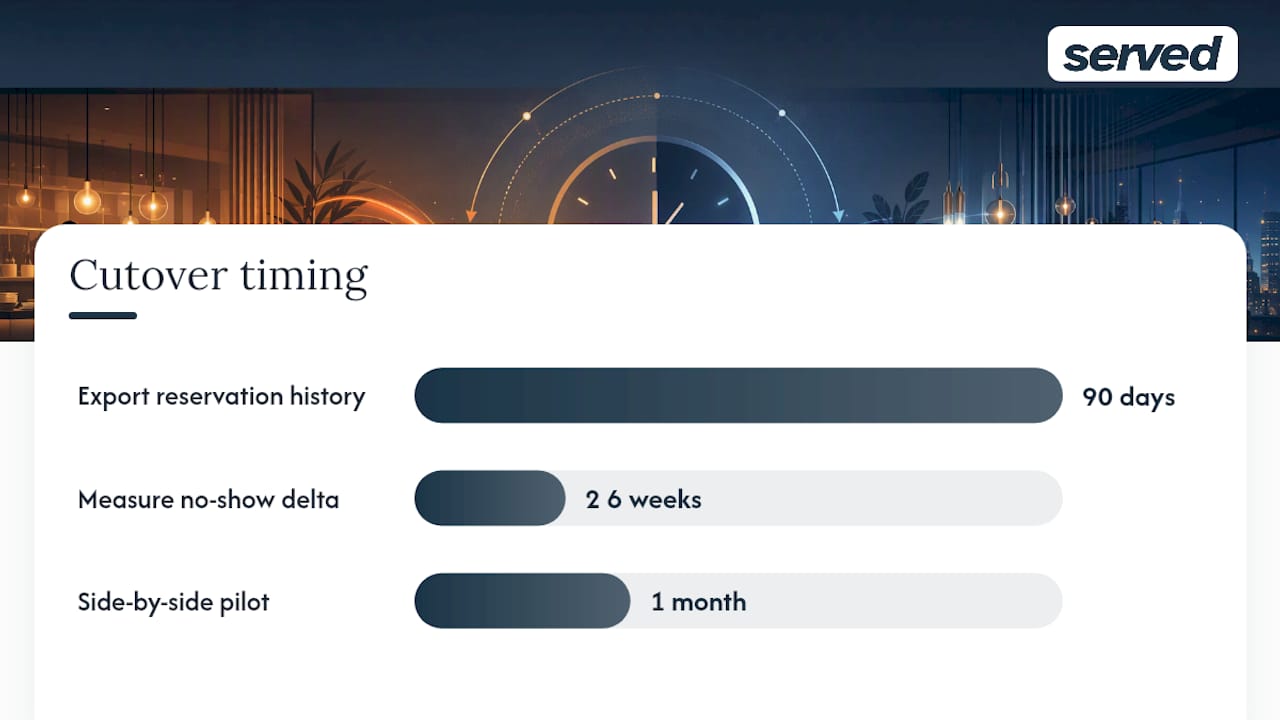
- Export 90 days of reservation history from your current system, including reservation IDs, guest contacts, and party sizes, before you touch anything else.
- Train hosts during low-service lunches, never during a Friday dinner rush, so mistakes happen when the stakes are low.
- Enable diner-app inventory gradually, opening only a portion of your book to the new platform's network at first.
- Measure the no-show delta by channel for at least two to four weeks before flipping the whole book over.
- Only then complete the full cutover, once the numbers from step four look acceptable.
When you're on the phone with sales, ask these questions directly and note down the answers word for word:
- "Will you put the per-network cover fee in writing, itemised by plan tier?"
- "Can we export reservation ID and guest email for every network booking, not just direct ones?"
- "What do SMS notifications cost per message, and what hardware do we need to buy?"
- "What's the exact disbursement timing for deposits and cancellation fees?"
Walk away, or at least pause, if you hit any of these red flags: blocked API access to your own reservation data, a refusal to commit to disbursement timing in writing, or no written fee schedule at all. A vendor unwilling to publish or verify pricing for venues like yours is telling you something about how negotiable those numbers really are.
Pro Tip: Run a genuine side-by-side pilot if you can, one section of your dining room on the new platform, the rest on your current one, for a full month. Measure actual covers and actual no-show rates, not what either sales team promises you on the call.
If you're also weighing whether to expand your booking channels beyond a single reservation widget, some venues are experimenting with WhatsApp-based reservation flows that sit alongside a primary platform rather than replacing it outright.
Where Served fits if you want to skip the per-cover maths entirely
Everything above assumes you're choosing between fee structures. Served removes that calculation. It's a commission-free booking and visibility platform sold on a flat subscription, so you keep every reservation regardless of volume, with no per-cover charge creeping into your margins during a busy month.
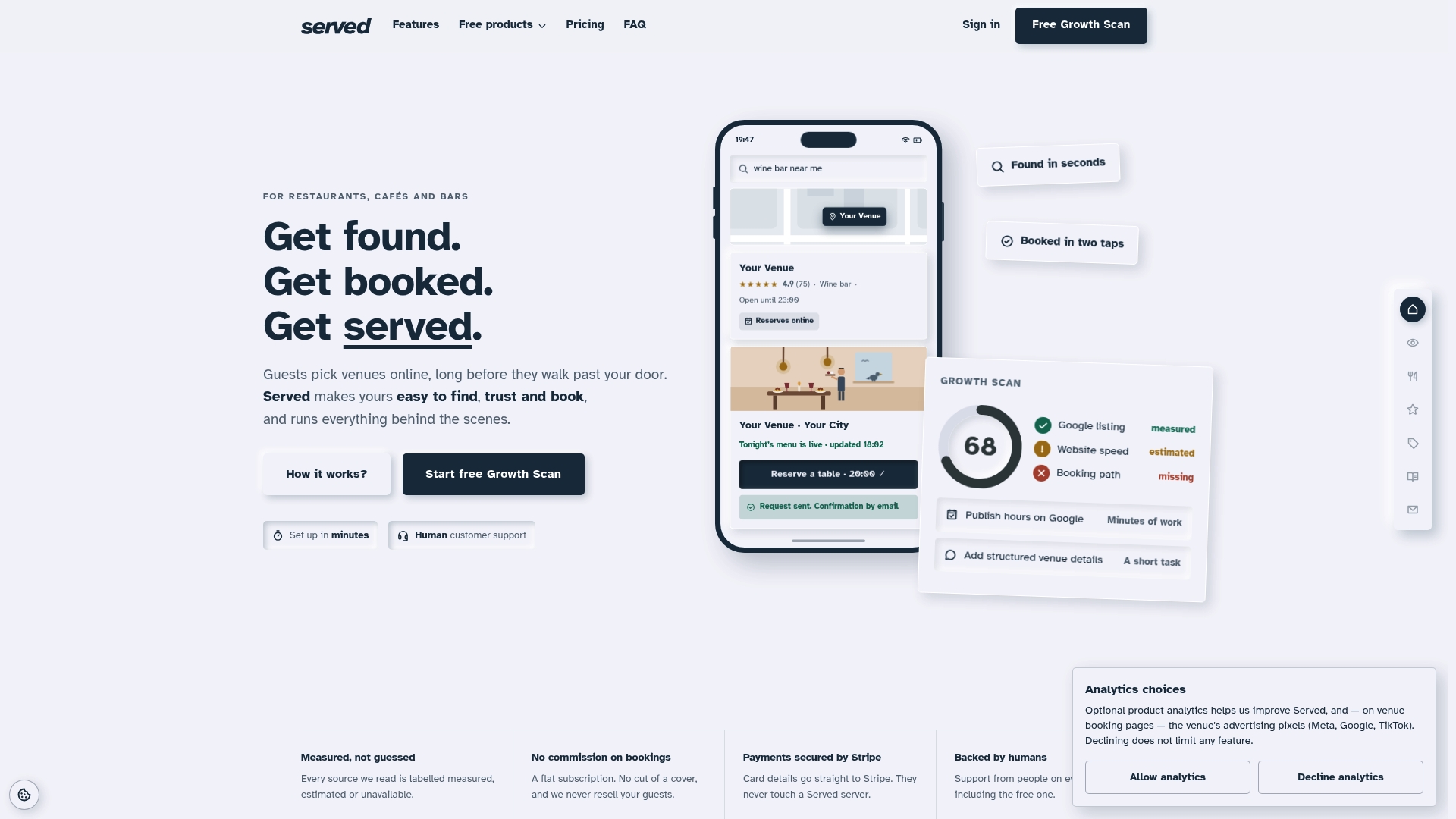
What you actually get: real-time menu updates so your listing never shows a dish you dropped last week, a calendar and floorplan seating view built for day-to-day host use, Stripe-integrated payments, and human customer support when you're switching systems or something breaks mid-service. The Growth Scan is the entry point most owners use first: a free check of your current online visibility that flags exactly where you're losing bookings before you commit to anything paid.
| Venue type | Why Served fits |
|---|---|
| Venues tired of per-cover fees eating margin at volume | Flat subscription means cost doesn't scale with covers |
| Owners who want full guest data ownership and export | Data stays exportable, not locked inside a network |
| Restaurants switching from OpenTable specifically | Dedicated migration guidance and human support |
| Managers who want a visibility diagnostic before spending | The Growth Scan is free to run first |
Served suits venues that want commission-free bookings and clearer ownership of their own guest data, without giving up a cut of revenue to a marketplace model. If you're currently on OpenTable and weighing a move, the switching guide built specifically for that transition walks through what changes and what doesn't. Start with the free Growth Scan to see where your visibility stands today.
Which platform should you actually call first?
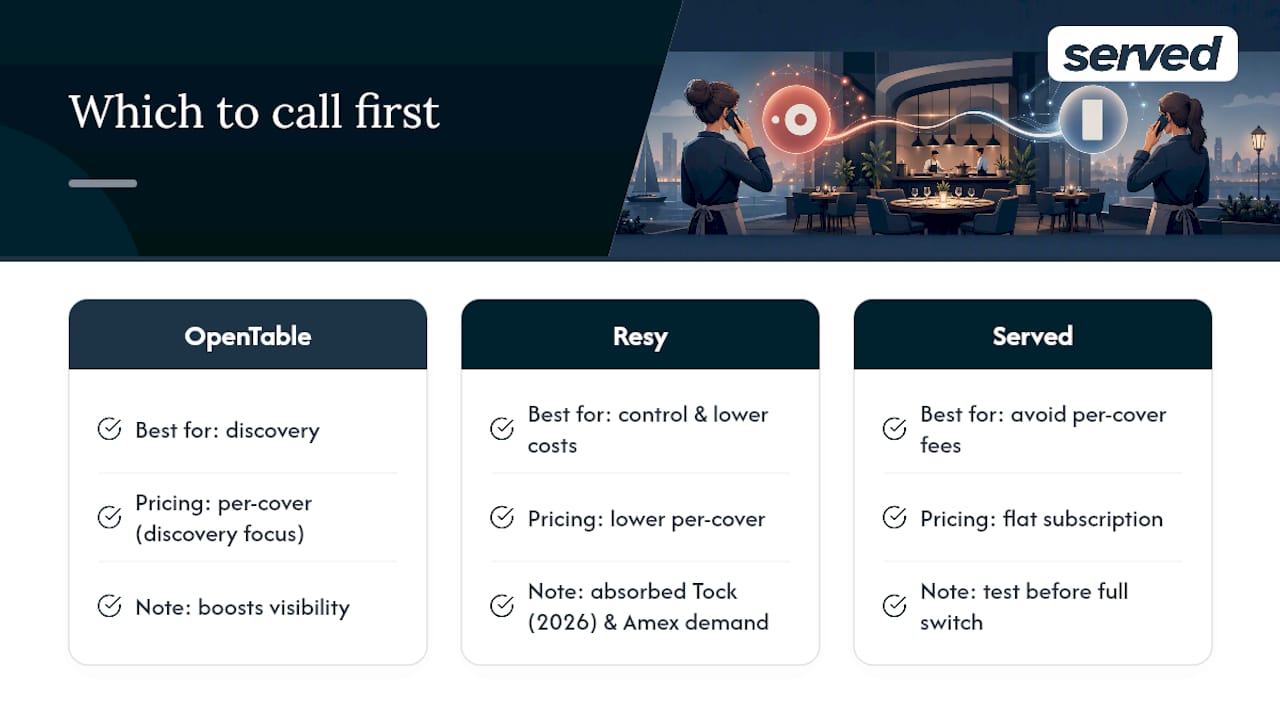
The decision rule hasn't changed since the top of this article, and it won't change until your booking volume does. If discovery is your biggest gap, that's OpenTable's job. If you already have the reputation and need tighter operator control with lower per-cover costs, that's Resy's lane, particularly since it absorbed Tock's ticketing venues in 2026 and picked up Amex-driven cardmember demand along with them. If you'd rather sidestep the per-cover question entirely and keep every booking on a flat subscription, that's the case for testing Served.
Whichever direction you lean, request the written quote before the demo call ends. Run the 90 day export and the staged cutover before you flip your whole book over. And if your venue is doing fewer than 20 reservations a week right now, hold off on switching platforms altogether. Fix your visibility and covers first; the platform decision gets easier once volume justifies it.
— Ignacy Jurkowski
Served: a different route if you'd rather skip commissions altogether
OpenTable, Resy, and Tock all solve discovery or floor management in their own way, but every one of them ties part of your cost to booking volume, whether through per-cover fees or network commissions. Served takes a different route: a flat subscription with no commission on any reservation, however busy your week gets.
It suits venues that want predictable costs, full ownership of their guest data, and a straightforward path to better visibility without negotiating fee schedules on a sales call. Where OpenTable and Resy are marketplaces you plug into, Served is a platform you run on your own terms, backed by human support when you need help switching over.
Start by running the free Growth Scan to see exactly where your current visibility stands, then look at the switching guide when you're ready to move your booking system over properly.
Sources
Before you rely on anything above, verify it against the primary sources. Resy's own transactions FAQ covers processor fees and disbursement timing directly from the vendor. Reporting on OpenTable's strategy shifts and CNBC's coverage of the Resy, OpenTable and DoorDash competitive landscape both track how market positioning shifted through 2026. For the pricing crossover mechanics referenced in the comparison section, independent operator-focused reviews model per-cover cost scenarios in more detail than either vendor publishes directly.
- OpenTable restaurant reservations made easy — HBS platform digit submission
- How OpenTable is luring hot restaurants back to ... — The Philadelphia Inquirer
FAQ
Does Resy actually charge a fee?
Yes. Resy charges a subscription plus reportedly lower per-cover fees than OpenTable, though the exact schedule is typically quote-based rather than publicly listed, so get it confirmed in writing before signing.
Is Resy better than OpenTable for fine dining?
For established fine-dining venues in major metros, Resy's operator-first tools and post-Tock cardmember demand tend to fit better, while OpenTable's larger diner network usually helps newer restaurants more.
How long does it take to receive payments through Resy?
According to Resy's own transactions FAQ, prepaid amounts are typically disbursed in 3 to 5 business days, while cancellation fees can take up to 14 business days.
What happened to Tock in 2026?
Resy absorbed Tock's venues and ticketing features into its own network during 2026, expanding Resy's reach and folding Tock's prepaid-experience heritage into Resy's broader platform.
Does Served charge a commission on bookings?
No. Served runs on a flat subscription with no commission on any reservation, which is the core difference between it and marketplace platforms like OpenTable or Resy.