
Post this now: "Hi [Name], I'm sorry we missed the mark on [specific issue]. Please DM us or email [manager email] with your order/reservation number so we can make this right." That covers the immediate move. It works because the review isn't really a conversation with the unhappy guest anymore; it's a public audition for every future customer reading it. The detailed fix, the apology, the compensation talk all belong offline, in a private follow-up you send within the hour.
TL;DR:
- Respond to bad reviews within 24 to 48 hours with a specific, well-structured reply that acknowledges, owns, offers a fix, and redirects to private follow-up.
- Use a four-part response formula: address the reviewer and issue, take responsibility, detail concrete corrective actions, and direct all sensitive communication offline.
- Avoid public negotiation of compensation, blaming the customer, or revealing private information; keep detailed resolutions a private matter.
- Track internal fixes and publicly update reviews when operational improvements are made to demonstrate genuine responsiveness and build trust.
- Tailor responses to platform norms, especially on Google, Yelp, or TripAdvisor, to maximize visibility and avoid content policy violations.
Table of Contents
- How Do You Respond to Bad Reviews the Right Way?
- The Response Formula: Acknowledge, Own, Fix, Redirect
- Editable Reply Templates for Common Review Scenarios
- What Do Good Restaurant and Hotel Review Replies Look Like?
- Do Google, Yelp, TripAdvisor, and Facebook Need Different Replies?
- How Should You Handle Fake or Abusive Reviews?
- Turning a Bad Review Into an Actual Fix
- How Do You Train Staff to Respond to Reviews Consistently?
- How Do You Get More Positive Reviews to Balance Out the Negative Ones?
- How Do You Know If Your Review Responses Are Actually Working?
- What Legal Risks Come With Responding to Reviews?
- What the Reviews Actually Tell You (and What They Don't)
- Manage Your Reviews and Visibility Without the Guesswork
- Sources
How Do You Respond to Bad Reviews the Right Way?
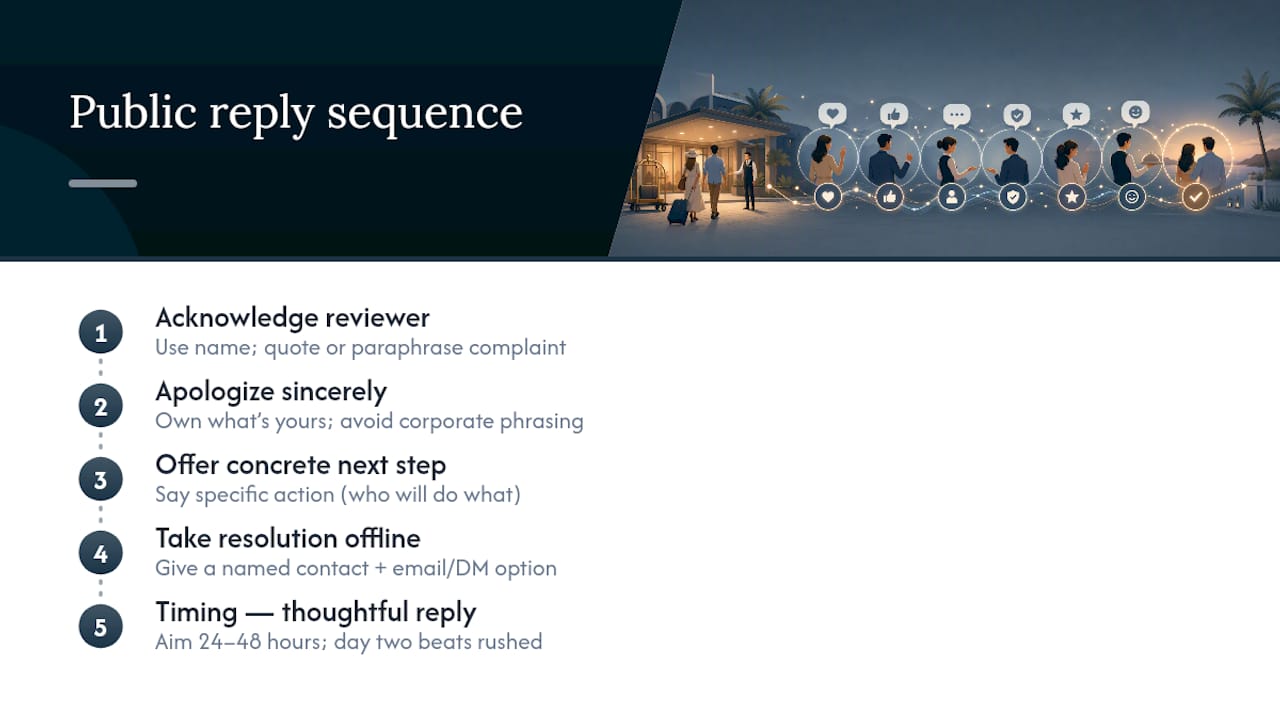
Every solid public reply follows the same short sequence, whether it's a one-star Google review or a scathing paragraph on TripAdvisor. Skip a step and the reply reads hollow. Rush it and it reads worse than no reply at all.
Acknowledge the reviewer by name and name the specific complaint. Generic replies ("We're sorry you had a bad experience") signal you didn't actually read what they wrote. Quote or paraphrase the actual issue: the cold entrée, the double-booked room, the thirty-minute hold time.
Apologize sincerely and own the part that's actually yours. You don't need to grovel, and you shouldn't admit fault for something outside your control. But a flat "we apologize for any inconvenience" reads as corporate deflection. Say what went wrong in plain language.
Offer a concrete next step, not a vague promise. "We're looking into it" satisfies nobody. "I've flagged this with our kitchen manager and we're adjusting Thursday's prep schedule" does.
Redirect the detailed resolution offline, to a named person. Give an email address or a direct message option, and attach it to an actual name or title when you can. "Message our GM, Dana" builds more trust than "contact us."
On timing: don't sit on a bad review for a week, but don't fire off a two-line non-apology in the first five minutes either. Roughly 21% of customers expect a reply within 24 hours, and most industry guidance settles on a 24 to 48 hour window as the sweet spot. A specific, well-considered reply that lands on day two beats an empty, rushed one posted an hour after the review went live. Late and specific outperforms fast and hollow, especially when the person replying actually has the authority to fix things.
Two things to avoid every time: don't blame the customer, even subtly ("we've never had this complaint before"), and don't negotiate compensation in public. Offering a refund amount or a free entrée in the comments invites every future reviewer to angle for the same deal.
Pro Tip: Draft your reply, then read it out loud before posting. If it sounds like a form letter to your own ear, it will sound like one to the reviewer's followers too.
The Response Formula: Acknowledge, Own, Fix, Redirect
Practitioners across hospitality and retail keep landing on the same four-part spine for a reason: it's short enough to use under pressure and structured enough to keep junior staff from freelancing a reply that makes things worse. It isn't a script to copy verbatim. It's a checklist for what a reply needs to contain.
- Acknowledge. Name the person and the issue in one clause. Example: "Hi Maria, I saw your note about the delayed checkout on Saturday."
- Own. State plainly what part is on you. Example: "That wait was on us. Our front desk was short-staffed that morning."
- Fix. Point to the concrete corrective action, present or future. Example: "We've added a second person to weekend mornings starting this week."
- Redirect. Move anything requiring detail, compensation, or verification to a private channel. Example: "Please email gm@[venue].com with your confirmation number so I can follow up directly."
Partial ownership language works when the complaint is mixed ("the noise from the street wasn't something we could control, but we should have offered you a quieter room"). Full ownership works when the failure is entirely internal. Never blend the two into a mushy, ambiguous "we're sorry this happened" that dodges the question of who's responsible.
Keep the public reply to two or three sentences for anything above two stars, and slightly longer, four sentences at most, for a one-star review where more context helps future readers understand your side. Anything longer starts to look defensive no matter how reasonable the content is. The reply formula outlined by ReviewGlow treats this brevity as a feature, not a limitation: a short, structured public reply plus a thorough private follow-up covers both audiences without over-explaining to either.
Editable Reply Templates for Common Review Scenarios
These are starting points, not scripts to paste verbatim. Templates that read like obvious fill-in-the-blanks can backfire, since reviewers and readers both spot a canned response fast. Swap in real details: the actual dish, the actual date, the actual staff member's role (not necessarily their name, unless they're comfortable being named).
1. Valid complaint about food or service quality Public: "Hi [Name], you're right, the [dish/service] didn't meet our standard that night, and I'm sorry. We're addressing it with the team directly. Please reach out at [email] with your visit date so I can follow up personally." Private follow-up (email): "Thanks for flagging this, [Name]. Can you share the date and rough time of your visit? I want to trace exactly what happened and make it right, whether that's a credit toward a future visit or something else that works for you."
2. Vague complaint with no specifics Public: "Hi [Name], sorry to hear your visit fell short. We'd love to know more so we can fix the right thing. Could you email [manager email] with a bit more detail?" Private follow-up (DM): "Hi, thanks for the message. Could you tell me more about what happened? Even small details help us track down the issue."
3. Review contains an incorrect fact Public: "Hi [Name], thanks for the feedback. Just to clarify, we've been open on Sundays since [month], though I'm sorry if that wasn't communicated clearly when you visited. Happy to talk through what happened at [email]." Private follow-up: Correct the record calmly, once, without arguing. Offer to update them if their information was outdated.
4. Abusive or hostile language in the review Public: "Hi [Name], I'm sorry you had a frustrating experience. I'd like to understand what happened and make it right. Could you email [manager email]?" Private follow-up: Stay measured regardless of tone. Document the exchange in case escalation becomes necessary later.
5. Price or expectation mismatch Public: "Hi [Name], I appreciate you sharing this. Our pricing reflects [brief, factual reason], but I hear that it didn't match what you expected going in. I'll pass this along to see how we can set clearer expectations." Private follow-up: Ask what specifically felt misaligned, menu description, website copy, staff explanation, and note it for correction.
6. Delivery or order error Public: "Hi [Name], that's on us, wrong item shouldn't have gone out. Please message [email/DM] with your order number so we can fix this fast." Private follow-up: Confirm the correct item, offer a remedy (redo, credit, refund per policy), and note the packing or ticketing step that failed.
7. Mixed review (some praise, some criticism) Public: "Hi [Name], glad the [positive aspect] worked well for you, and sorry the [negative aspect] didn't. We're working on that specifically. Thanks for the balanced feedback." Private follow-up: Not always necessary for mixed reviews unless the negative portion involves a safety, billing, or service failure worth tracking.
A few universal rules across every template: never state a specific refund amount, discount percentage, or compensation figure in the public reply. Never name a staff member for disciplinary purposes in public, even if the reviewer names them first. Both belong strictly in private channels or internal documentation.
What Do Good Restaurant and Hotel Review Replies Look Like?
Abstract advice is easy to nod along to and hard to apply at 11 p.m. after a bad shift. Here's what the formula looks like against real scenarios.
- Restaurant, cold food complaint: "Hi Jordan, I'm sorry the salmon came out cold Friday night, that's not the plate we want going out. I've talked to our kitchen lead about ticket timing during the dinner rush. Please email us at manager@[venue].com so we can make your next visit right." Naming the dish and the shift signals you actually read the review, and the promise (talking to the kitchen lead) is something that was genuinely assigned, not invented for the reply.
- Restaurant, slow service on a busy night: "Hi Priya, a 45-minute wait for entrées isn't the pace we aim for, especially on a Saturday. We were short-staffed that night and have since adjusted our weekend floor schedule. Would love the chance to host you again, on us for dessert, if you email [manager email]." Note the compensation offer is mentioned generally in the public reply but the actual amount and logistics move to email.
- Restaurant, wrong order delivered: "Hi Sam, that's a mistake on our end and I'm sorry it happened. Please reach out at [email] with your order number so we can sort out a redo or refund." Short, owns it fully, redirects immediately.
- Hotel, room condition issue: "Hi Alex, a room that wasn't fully ready at check in isn't the standard we hold ourselves to, and I'm sorry for the frustration. I've spoken with housekeeping about the turnaround process for that floor. Please contact our front desk manager at [email] so we can address your stay directly." Booking and room-readiness complaints benefit from naming the operational area (housekeeping, front desk) rather than a specific person, which builds credibility without exposing an individual employee. Hotels juggling multiple room types and turnover schedules often lean on tools built for hospitality booking management to catch readiness gaps before a guest ever complains.
- Healthcare practice, appointment or wait time complaint: "Hi [Name], I'm sorry your visit took longer than expected. Patient care and privacy matter deeply to us, and I'd like to understand what happened. Please call our office directly at [phone] so we can discuss your visit." Healthcare replies need extra restraint: never confirm, in public, that someone is a patient, what they were treated for, or any detail tied to their visit. Even a well-meaning public reply that confirms a person visited your practice can create a privacy problem, so keep these replies generic on specifics and move everything substantive to a phone call, not even email if avoidable.
- Retail, shipping delay or wrong item: "Hi Taylor, sorry the order arrived late and with the wrong size, that shouldn't have happened. Please message us at [email] with your order number and we'll get a replacement shipped right away." Retail replies benefit from speed since shipping issues are usually simple to verify and fix, unlike food quality complaints that require more internal digging.
Do Google, Yelp, TripAdvisor, and Facebook Need Different Replies?
Platform norms shape both what you should say and how much of it should be public. Treating every platform identically is one of the more common mistakes operators make.
- Google: Google reviews carry outsized weight in local search visibility, so replies here get read by far more people than the reviewer alone. Keep replies concise, natural, and specific, don't stuff keywords or venue names awkwardly. A TripAdvisor Business Insights piece on platform handling notes that visibility differences between platforms should shape how much care goes into each reply, and Google's search prominence puts it near the top of that priority list.
- Yelp and TripAdvisor: Both platforms have policies against soliciting reviews in exchange for incentives, and both moderate aggressively for perceived manipulation. Never offer a discount or freebie contingent on a review, publicly or privately, on either platform. Flag reviews for removal only when they violate stated content policies (fake accounts, competitor sabotage, off-topic rants), not simply because they're negative.
- Facebook: Comments on a review are public and visible in the thread; Messenger is private. Use comments for the short acknowledge-and-redirect reply, and let Messenger carry the detailed back-and-forth. Watch the thread afterward. Other commenters sometimes pile on or defend you, and either can shift the tone if left unmanaged.
- When to flag instead of reply: If a review contains hate speech, threats, clearly fabricated details (wrong location, wrong dates that don't match any records), or comes from an account with no history, flag it through the platform's reporting tool rather than engaging. A calm public reply plus a private report often works better than either alone.
How Should You Handle Fake or Abusive Reviews?
Not every one star review deserves the full acknowledge-own-fix-redirect treatment. Some are fabricated, some are competitor sabotage, and some are just abusive. The instinct to fight back publicly is understandable and almost always the wrong move.
A single calm public reply is enough: "Hi, we don't have a record of this visit under this name. If you did visit us, please email [address] so we can look into it." Say it once, don't repeat it in the comments, and don't escalate the tone even if the reviewer does. Experts consistently advise against public arguing; correcting an inaccurate or malicious review once, calmly, and then disengaging protects your credibility far better than a drawn-out public back-and-forth.
Before requesting removal, build a documentation file:
- Order or reservation number matched against your booking system, if one exists for the date claimed.
- Timestamps from your POS or reservation software showing no matching transaction.
- Screenshots of the review, the reviewer's profile, and any suspicious posting patterns (multiple negative reviews posted the same day, generic language matching other flagged reviews).
- Any prior communication with the person, if they're a real but dissatisfied customer rather than a fabricated account.
Most platforms have a takedown process for reviews that violate content policies, but it usually requires this kind of evidence, not just your word that the review is false.
Pro Tip: If a malicious review clearly won't come down and clearly won't be believed by most readers (obvious spam account, nonsensical complaint), sometimes the better use of your time is generating more genuine positive reviews rather than fighting the one bad one. Volume and recency both dilute a single outlier.
Turning a Bad Review Into an Actual Fix
The public reply is the visible half of the job. The invisible half, whether the underlying problem actually gets fixed, is what determines whether the same complaint shows up again next month.
Route every substantive complaint into an internal ticket, not just a mental note. Assign it a priority level and an owner, whether that's a shift lead, kitchen manager, or front desk supervisor. Complaints that repeat across multiple reviews (slow service on weekends, a specific menu item consistently undercooked) deserve a checklist update on the floor, not just a one-off apology to the person who happened to write a review about it.
When a real fix has been made, say so publicly, briefly. A short follow-up comment or an updated reply, "Update: we've adjusted our weekend staffing since this review", shows every future reader that complaints here actually lead somewhere. This matters more than most operators assume: nearly 89% of customers read business responses to negative reviews as part of deciding whether to trust a business, and a visible track record of follow-through reads very differently than a graveyard of unanswered one-star reviews.
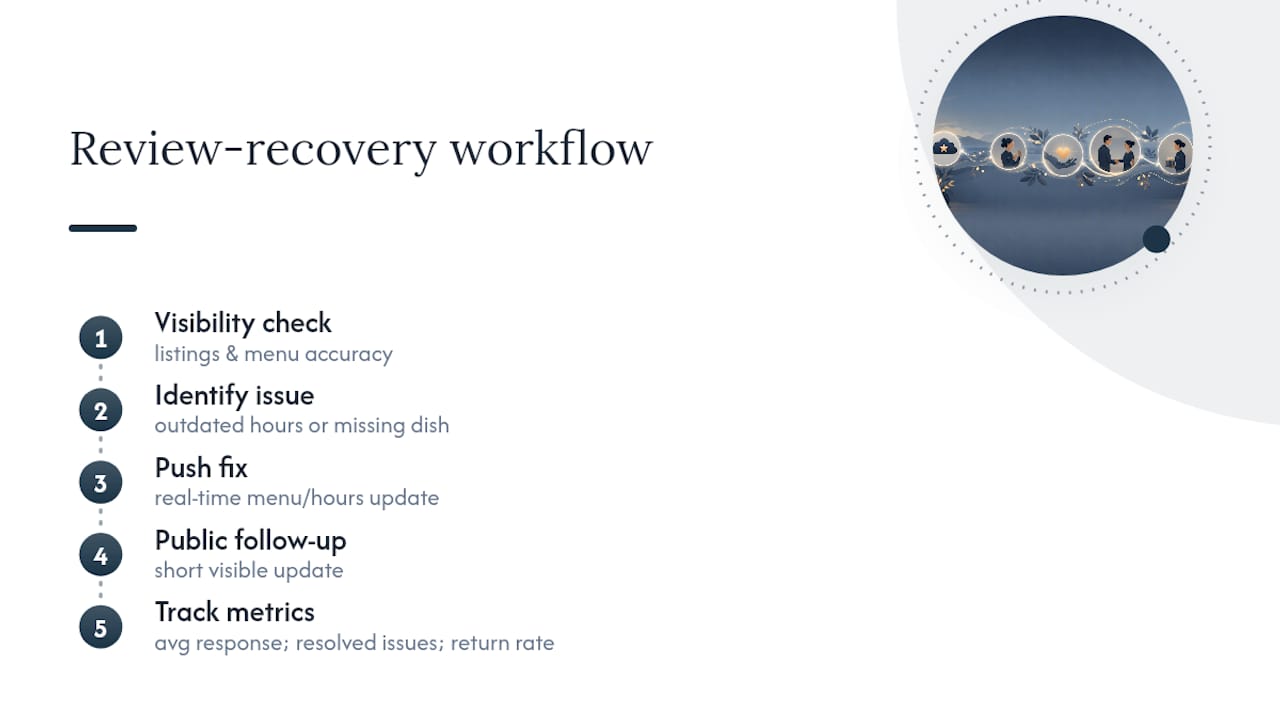
A simple workflow: run a visibility check on your listings and menu accuracy, catch the outdated hours or missing dish that's driving complaints, push the fix through a real-time menu update, then post the one-line public follow-up. Track three numbers over time: average response time, number of flagged issues actually resolved (not just acknowledged), and how often a reviewer who left a negative review later returns or updates their rating. That last metric is the hardest to move and the most telling one when it shifts.
How Do You Train Staff to Respond to Reviews Consistently?
Consistency breaks down fast when five different people are replying to reviews with five different instincts. Fix that with a short, specific playbook rather than a vague instruction to "be nice."
Give the team the four-part spine (acknowledge, own, fix, redirect) as a laminated card or a shared doc, not a one-time training session they'll forget. Include two or three real examples from your own reviews, not generic ones, so staff see exactly how the formula applies to your venue's actual complaints.
Set a clear approval threshold: who can reply without sign-off (most reviews), and what needs a manager's eyes first (anything involving safety, a legal threat, or a named staff member accused of misconduct). Ambiguity here is what causes either paralysis (nobody replies for days) or damage (someone replies defensively under pressure).
Run a short monthly review of actual replies posted, five minutes, not a formal audit. Flag the ones that nailed the tone and the ones that didn't, and talk through why. This catches drift before it becomes a pattern, and it's far more effective than a one-time onboarding document nobody revisits.
Finally, make sure whoever handles reviews knows the two or three topics that always get escalated: anything mentioning illness, injury, discrimination, or legal language. Those aren't standard-template situations, and treating them like one is how a bad review turns into a bigger problem.
How Do You Get More Positive Reviews to Balance Out the Negative Ones?
A steady flow of genuine positive reviews doesn't erase a bad one, but it puts it in proportion. A single one-star review sitting next to two reviews looks damning. The same review sitting among fifty looks like an outlier, which is usually closer to the truth.
Ask at the right moment, right after a visibly good experience, not through a generic blanket email blast to your entire customer list. A server mentioning "if you enjoyed tonight, we'd really appreciate a review" as a guest is paying works better than any automated request, because it's tied to a specific positive moment rather than sent cold days later.
Make leaving a review genuinely easy: a QR code on the receipt or table tent linking directly to your Google listing, not a multi-step process requiring an account creation. Friction kills intent even when the customer genuinely wants to help.
Never offer anything of value in exchange for a review, discounts, free items, entries into a drawing. Beyond violating most platform policies, it also produces reviews that read as transactional rather than genuine, which readers can often sense.
Timing matters at the aggregate level too: a business that asks for reviews consistently, week over week, builds a natural buffer against any single bad review's visibility. A business that only thinks about reviews after a bad one lands is always playing catch up.
How Do You Know If Your Review Responses Are Actually Working?
Measuring the effect of your replies means looking past the star rating average alone, which moves slowly and hides a lot of what's actually happening.
Track reply rate and response time first, since customers who expect a reply within 24 hours notice when that expectation isn't met, and a growing backlog of unanswered negative reviews is a visible, searchable record of neglect. Watch for reviewer re-engagement: does the person who left a negative review ever update it, add a comment thanking you for the follow-up, or return and leave a new review later? That's a stronger signal than almost anything else, since it means your private follow-up actually worked, not just your public reply.
Compare conversion or booking rates on listings with active, thoughtful reply histories against ones with silence. This is hard to isolate perfectly, but directional patterns tend to be visible over a few months. Also track how often the same complaint recurs across multiple reviews. A dropping recurrence rate for a specific complaint (slow weekend service, a specific dish) is direct evidence that your operational fixes, not just your reply wording, are working.
Finally, watch overall review volume alongside sentiment. A business generating a steady stream of new positive reviews while maintaining prompt replies to occasional negative ones is building a compounding trust asset. A business with reply gaps and stagnant review volume is standing still while competitors move.
What Legal Risks Come With Responding to Reviews?
Two legal concerns come up repeatedly, and both are avoidable with reasonable caution rather than legal expertise.
Defamation. You're generally safe stating verifiable facts (order records, dates, what your policy says) and expressing your own opinion or apology. You get into risky territory if you publicly accuse a reviewer of lying, fraud, or criminal behavior without solid documentation, since a false factual accusation posted publicly can itself become a defamation claim against you, not just them. If a review contains claims you believe are false, correct the record calmly and factually once, and avoid language that asserts the reviewer is lying rather than simply mistaken.
Confidentiality and privacy. This applies with particular force in healthcare, but it matters for any business handling sensitive personal information. Never confirm in a public reply that someone is a patient, client, or customer tied to a specific service, especially in a medical or health adjacent context, where doing so publicly can create a privacy exposure regardless of what the reviewer themselves disclosed. The safest pattern for regulated or sensitive industries is a fully generic public reply ("please contact our office directly") with zero specifics, moving every detail to a private, verified channel.
Neither of these points is a substitute for legal advice specific to your situation and jurisdiction. When a review involves threats, alleged illegal activity, or a demand for money in exchange for a better rating, that's worth a conversation with an actual attorney rather than a template.
What the Reviews Actually Tell You (and What They Don't)
Most advice on this topic treats every negative review as a customer service failure to be smoothed over with the right words. That's backwards. A review is data before it's a PR problem, and businesses that treat the reply as the whole job miss the more valuable half of the exercise.
The overrated piece of conventional wisdom is speed above all else. Plenty of guides push for lightning-fast replies as the primary metric of good reputation management. Speed matters, but a fast, generic reply from someone with no authority to fix anything reads as hollow the moment a reader compares it against a specific one posted a day later. The specificity does more work than the timestamp.
What gets underestimated is the operational loop. Writing a great reply and never fixing the underlying issue is worse than not replying at all, because now you've publicly promised improvement and quietly failed to deliver it. If you take one thing from this guide, prioritize building the internal routing (who owns the fix, how it gets tracked, when it gets confirmed done) before you spend more time polishing reply language. The words matter less than whether the next guest has a different experience.
— Ignacy
Manage Your Reviews and Visibility Without the Guesswork
Reviews are one piece of a bigger visibility puzzle, and most venue owners are flying blind on the rest of it: outdated menus, incomplete listings, booking friction that never shows up in a review but quietly costs you covers every week. Served gives you a commission-free way to close those gaps under one flat subscription, so you're not paying a cut on every reservation while also trying to keep your Google listing accurate.
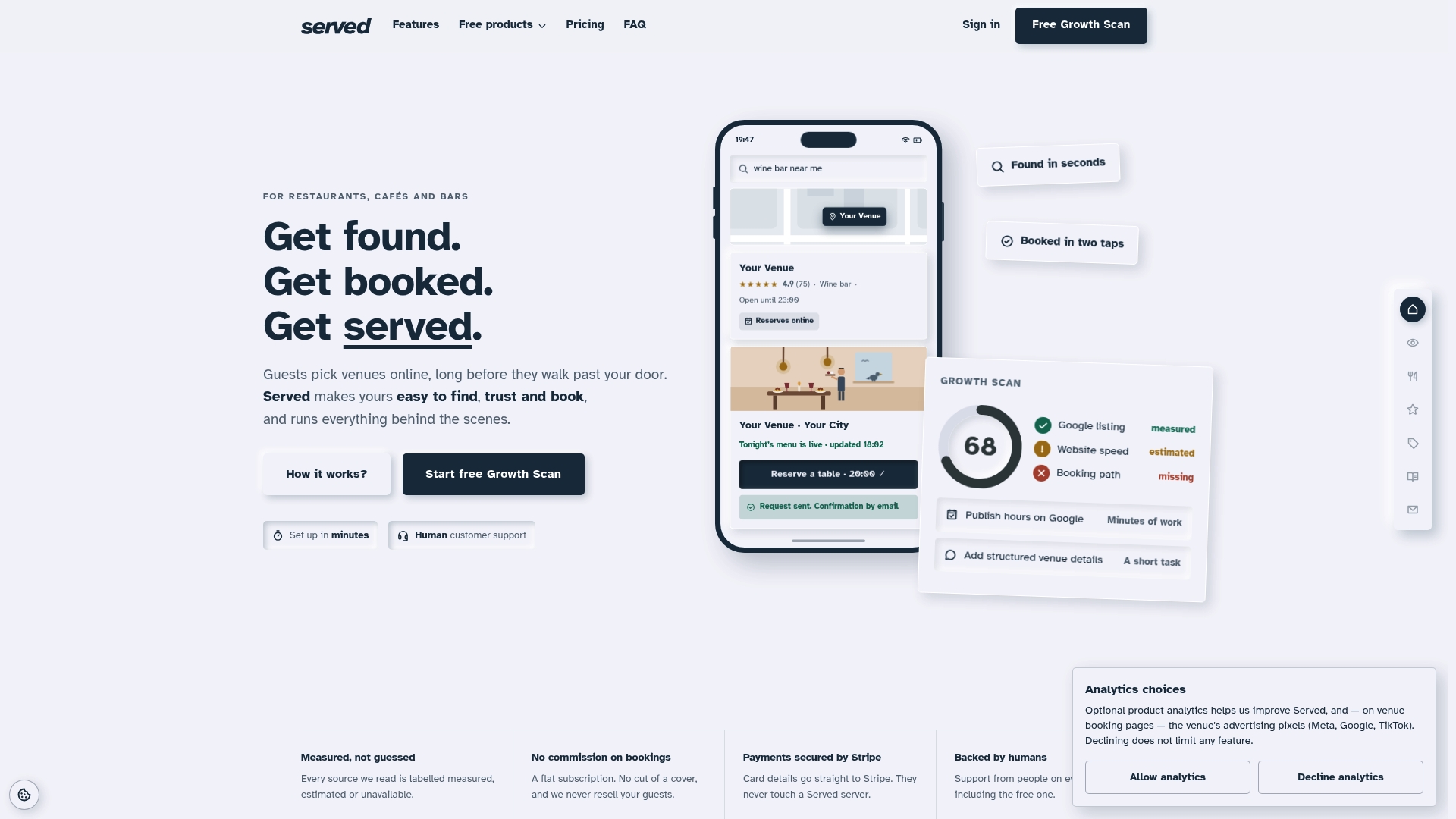
The Growth Scan flags exactly where your online presence is leaking trust, missing hours, stale photos, an outdated menu, before a guest ever leaves a review about it. Real-time menu updates mean the dish someone complained about last week can actually be fixed and reflected everywhere guests look, and human customer support means you're not troubleshooting a booking glitch alone at 9 p.m. on a Friday. If review replies are the visible half of your reputation, switching to Served handles the operational half, so your next public follow-up is backed by something that's actually changed.
Sources
How to respond to negative reviews: Examples and tips — Bazaarvoice
Common pitfalls to avoid when responding to bad reviews — Thrive Agency
How to Respond to a Negative Restaurant Review (Real Examples, 2026) — Replio
How to Respond to a Bad Review: Playbook + Templates — ReviewGlow
Powerful examples of how to respond to negative reviews — ReviewTrackers
How to respond to negative reviews — TripAdvisor Business Insights
- How to respond to negative reviews: Examples and tips — Bazaarvoice
- Common pitfalls to avoid when responding to bad reviews — Thrive Agency
- How to Respond to a Bad Review: Playbook + Templates — ReviewGlow