Restaurant foot traffic is the count of customers physically walking through your door, and it's the clearest early signal of revenue health you have. Trade data shows traffic has been declining more often than not for over a year, so waiting to measure it is the costliest mistake you can make. Pick one method today, whether that's a door sensor, POS timestamps, or a manual tally at busy hours, and track it weekly from this point forward.
TL;DR:
- Measuring foot traffic accurately helps distinguish between demand changes and conversion issues, especially when footfall declines despite rising sales from price increases.
- Combining internal sensors with external mobile panel data over two weeks improves reliability and reveals measurement gaps rather than real traffic shifts.
- Urban venues rely more on exterior signage and impulse visits, while suburban venues depend heavily on online presence and pre-decided destination visits.
- Improving online visibility through accurate Google listings, reviews, and clear menus is more effective in increasing foot traffic than solely investing in paid advertising.
- Focusing on enhancing capture rate and booking paths before increasing paid reach ensures more efficient growth and prevents wasting effort on broken storefronts.
Table of Contents
- What restaurant foot traffic is and why it matters
- How to measure foot traffic: choosing the right method
- Reading foot-traffic numbers without being misled
- Tactics that reliably increase restaurant foot traffic
- Measuring whether your tactics actually work
- Where a visibility and booking platform fits into this picture
- Why traffic patterns differ by venue type and location
- Where to dig deeper on foot-traffic data
- The measurement mistake most operators make
- Sources
- FAQ
What restaurant foot traffic is and why it matters
Foot traffic and footfall get used interchangeably, but the useful distinction sits one layer deeper: visits count how many people entered, capture rate tells you what share of nearby passers-by actually walked in, and dwell time shows how long they stayed once inside. Together, these numbers explain far more than a single headcount ever could.
Revenue follows visits, but not in a straight line. A venue with fewer visits and a higher average check can still outperform a busier one, which is exactly what's happening across the sector right now. Thirty-five percent of operators reported rising customer traffic between June 2025 and June 2026, up from 29% the previous month, yet that same month marked the 16th net decline in customer traffic in 17 months. Some brands are growing sales purely on price increases while visits keep sliding, and that gap is worth watching closely.
What this metric tells you, in practice:
- Whether your marketing is reaching new people or just reshuffling existing ones
- Where your staffing is under or overcooked relative to actual demand
- Whether a slow Tuesday is a traffic problem or a conversion problem
How to measure foot traffic: choosing the right method
Not every measurement tool answers the same question, so match the method to the decision you're actually trying to make.
- In-store sensors or door cameras work best for labour planning and understanding flow inside your own four walls. They're accurate for your venue but tell you nothing about the market around you.
- POS-derived counts and manual tallies add value when you need to segment by daypart or party size, something sensors alone can't do. A host tallying walk-ins during lunch service is low-tech but genuinely useful.
- Mobile GPS panel platforms measure foot traffic at market level, comparing your catchment against competitors, streets, or entire regions. Placer, for instance, shows year-over-year visit changes by geography, which is exactly what you need before deciding whether a slow month is a you-problem or an everyone-problem.
- Combine internal and external sources whenever you can. Your own sensor count validates against a mobile panel's estimate, and discrepancies usually point to a measurement gap rather than a real trend.
Pro Tip: Run your in-store count alongside a mobile panel benchmark for just two weeks before trusting either number on its own. Big gaps usually mean one tool is miscounting, not that reality changed overnight.
Reading foot-traffic numbers without being misled
Every measurement method carries some margin of error, and the busier or more enclosed your venue, the wider that margin tends to be. Dense urban blocks, indoor shopping centres, and countries with thinner mobile-data panels all reduce the precision of GPS-based estimates, because the underlying signal has more noise to filter out.
The fix isn't chasing a perfect number, it's trusting trends over totals. Footfall analytics providers generally agree that relative accuracy, this week versus last week, this site versus a comparable one, matters more than any single absolute count.
A quick reality check: if your traffic tool says you had exactly 412 visits on Saturday, treat that as "roughly 400, up from last week" rather than a precise fact.
Three checks worth running before you act on any traffic report:
- Run a short manual audit during one lunch and one dinner service to sanity-check your tool's numbers
- Cross-reference against POS transaction counts for the same window
- Smooth your data over 30 to 90 days so one rainy weekend or local festival doesn't distort your read
Tactics that reliably increase restaurant foot traffic
Most of what drives new visits costs less than a paid ad campaign and takes longer to build, which is precisely why so many operators skip it.
Get found before you try to get chosen. Your Google Business Profile is often the first, and sometimes only, thing a hungry searcher sees. Keep hours, photos, and menu accurate, and make sure your menu exists as readable HTML rather than a photographed PDF, since search engines can't index an image.
Build proof before you build hype. A steady flow of recent reviews, and photos that show real plates rather than stock imagery, does more to convert a browser into a booking than most paid campaigns.
- Ask every satisfied table for a review before they leave, not weeks later by email
- Post fresh photos weekly, focusing on dishes and atmosphere rather than logos
- Respond to every review, good or bad, within 48 hours
Go local and specific with paid social. A 5 to 10 mile radius around your venue, paired with a GBP-first content plan, tends to produce visible traffic uplift within two to six weeks, far faster than broader brand advertising.
Create reasons to walk in, especially on slow days. Ticketed events, chef collaborations, and partnerships with nearby businesses pull in audiences who wouldn't otherwise think of you. Loyalty programmes and referral perks then turn those first-timers into regulars.
Fix what's visible from the street. Window signage, a clearly priced lunch special, or a sandwich board naming tonight's dish often converts more passers-by than any digital spend, particularly during dead dayparts when a venue looks empty from outside.
Pro Tip: Operators who run at least three tactics together, local search, loyalty, and social, consistently outperform those pouring a large budget into a single channel.
Measuring whether your tactics actually work
Vanity metrics feel good and tell you nothing. Track these five instead:
- Visits – total footfall over a defined period
- Capture rate – the share of nearby foot traffic that actually enters
- Revenue per visitor – total revenue divided by visits
- Repeat rate – the percentage of visitors returning within a set window
- Dwell time – average minutes spent per visit, a useful proxy for satisfaction and upsell opportunity
The maths behind incremental revenue is simple: if a campaign adds 40 extra visits in a month and your average check is £22, that's roughly £880 in incremental revenue before accounting for cost.
| Metric | What it tells you | Suggested check frequency |
|---|---|---|
| Visits | Raw demand reaching your door | Weekly |
| Capture rate | Marketing/signage effectiveness | Monthly |
| Revenue per visitor | Menu and upsell performance | Monthly |
| Repeat rate | Loyalty and satisfaction | Quarterly |
Run any local campaign for at least two to four weeks before judging it, and compare against a similar prior period rather than a single day.
Where a visibility and booking platform fits into this picture
Improving discovery only pays off if the booking path that follows is frictionless. That's the gap Served is built to close, with a transparent, commission-free subscription that means venues keep every reservation they take rather than losing a cut to a booking fee.
The platform pairs real-time menu updates with human customer support, so the details a diner sees online match what's actually on the pass tonight. For owners unsure where their online presence is weakest, the free Growth Scan flags specific gaps, whether that's an incomplete Google listing or a menu that isn't readable by search engines, before a single pound gets spent fixing them.
What operators consistently report after tightening this path:
- Faster conversion from Google search to confirmed booking
- Fewer no-shows thanks to automated reminders
- More visible listings following Growth Scan fixes
| Feature | What it solves |
|---|---|
| Commission-free bookings | Venues keep 100% of reservation revenue |
| Growth Scan | Identifies visibility gaps before they cost bookings |
| Real-time menu updates | Keeps online and in-venue information aligned |
| Human support | Faster fixes when something breaks |
Venue owners switching from commission-based systems have reported increased foot traffic alongside stronger visibility, largely because fixing the booking path removes the friction that quietly costs bookings before a customer even calls.
Why traffic patterns differ by venue type and location
A quick-service counter near a transit hub and a fine-dining room in a suburban strip mall are playing entirely different games, and applying one traffic playbook to both is a common mistake.
Urban venues tend to see traffic driven by proximity and impulse. Someone walking past at lunchtime decides in seconds, which makes exterior signage and a fast, visible menu disproportionately powerful. Suburban venues rely more on destination visits, meaning customers decide before they leave home, so your Google listing and online menu matter more than your window display.
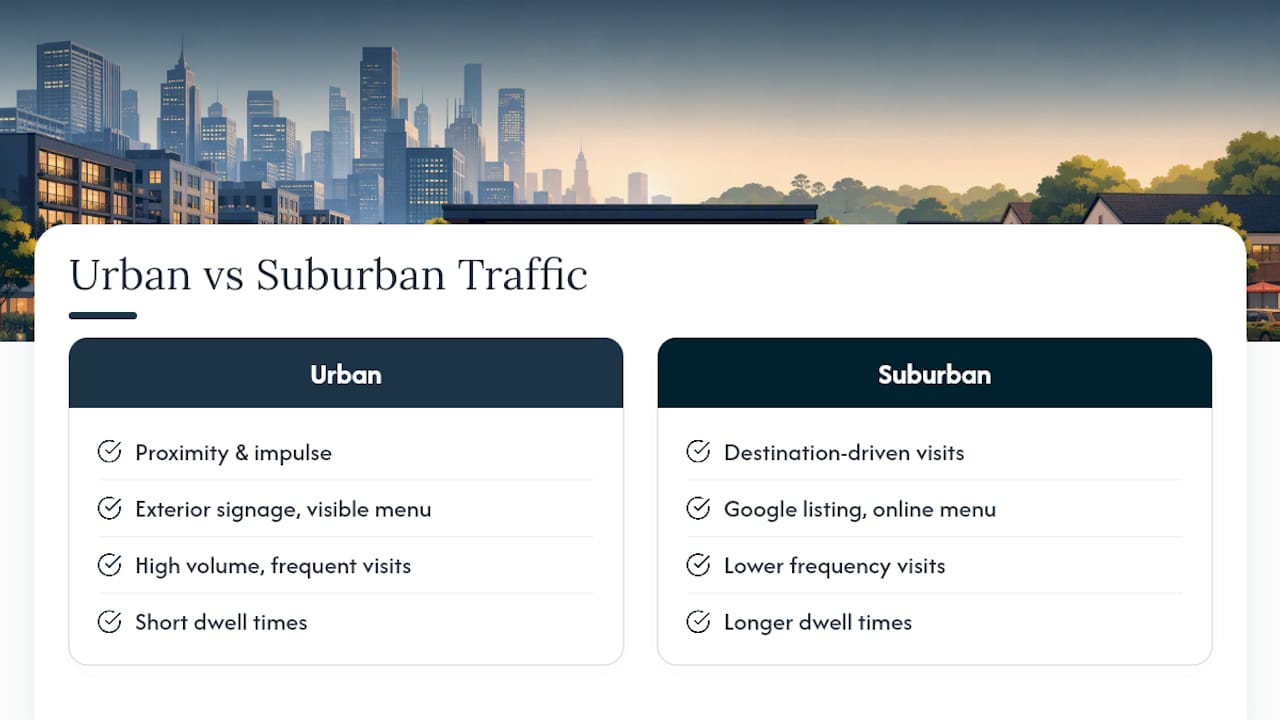
Quick-service formats live on volume and frequency, with dwell time deliberately kept short. Fine dining venues see the opposite: lower visit counts but far higher revenue per visitor and dwell time, so a capture-rate dip matters less than a drop in repeat bookings from high-value guests.
Broader shifts are also reshaping the competition for the same visits. Some grocery and retail formats have been gaining visit share at restaurants' expense, particularly for convenience-driven occasions, which makes differentiating on experience rather than competing purely on convenience increasingly important. Brands investing in service and staffing quality have managed to sustain or grow traffic even as the wider sector experiences declines.
Where to dig deeper on foot-traffic data
- The National Restaurant Association's tracking survey for monthly industry traffic trends
- Placer for market-level footfall benchmarking against competitors
- Black Box Intelligence and Food Institute for sector-wide monthly trend analysis
The measurement mistake most operators make
Most restaurant owners treat foot traffic as a vanity number, something to glance at and forget, rather than the leading indicator it actually is. That's backwards. Revenue and covers lag behind traffic by weeks; traffic itself moves first, which makes it the earliest warning system you have for a problem building before it hits your bank account.
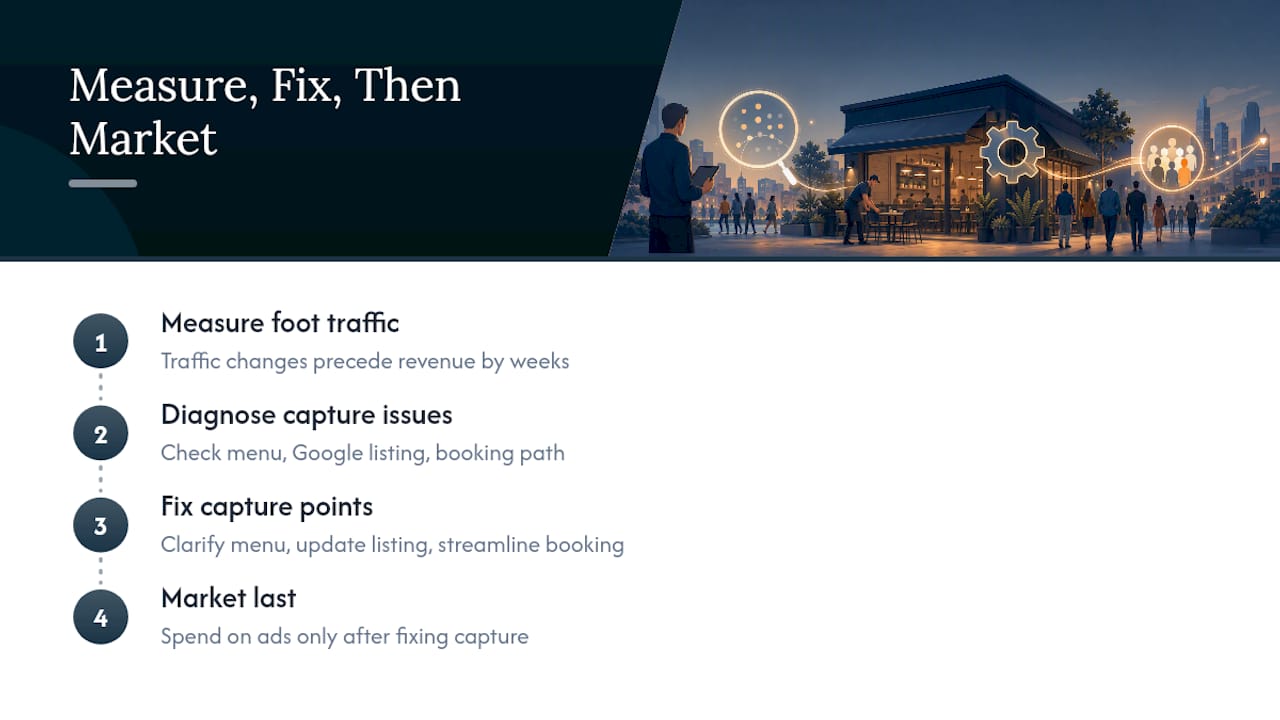
The conventional advice, "just run more ads," falls short because it treats every traffic dip as a demand problem. Often it's a capture problem: people are walking past, seeing an unclear menu or an outdated Google listing, and choosing somewhere else. Trade data backs this up. Same-store sales have improved lately while comp traffic keeps softening, meaning venues are extracting more from fewer visits rather than genuinely growing.
If there's one priority to take from all this, it's sequencing. Fix your capture rate, the online listing, the menu, the booking path, before you spend a pound on paid reach. Bringing more eyes to a broken storefront just wastes the traffic you already have. Measure first, then market.
— Ignacy
Sources
- Same-store sales and customer traffic
- Restaurants Industry Trends
- Foot traffic data explanation
- 2026 restaurant traffic offers clues for 2027
FAQ
What is the 30/30/30 rule for restaurant traffic?
There's no single agreed definition of a "30/30/30 rule" specific to restaurant foot traffic; where the term appears, it typically refers to budgeting splits (such as food, labour, and overhead costs) rather than a traffic measurement standard, so treat any specific version cautiously.
What are the three C's in a restaurant?
Definitions vary by operator, but a common version refers to Concept, Consistency, and Customer experience, the three pillars that determine whether foot traffic converts into repeat visits rather than one-off trials.
How often should I check my foot-traffic numbers?
Check visits weekly and smooth the data over a 30 to 90 day window so single events like weather or local festivals don't distort your read of the real trend.
Is footfall the same as foot traffic?
Footfall and foot traffic are used interchangeably in most restaurant contexts, both referring to the number of people physically entering a venue over a given period.
How quickly can local marketing tactics increase visits?
Google Business Profile optimisation and consistent review generation typically show visible uplift within two to six weeks, faster than most broader brand campaigns.