Missed calls cost restaurants a significant amount of revenue annually, much of which is recoverable. Fixing it does not require a big budget. It requires four things, in order: measure your call losses, tighten your process, get staffing right, and only then consider technology. This guide walks you through the maths, the causes, and a plan you can start this week.
TL;DR:
- Restaurants typically miss between 33% and 40% of incoming calls during peak hours, leading to thousands of dollars in potential monthly revenue loss.
- Most missed calls occur during rush periods due to unclear phone ownership, simultaneous ringing, or staff multitasking, not bad luck.
- Measuring call loss and phone-order value before investing in technology ensures that fixes target actual problems and provide measurable ROI.
- Implementing process changes like assigning a dedicated phone owner and establishing callback protocols can recover revenue with minimal or no cost within weeks.
- Digital channels, such as online booking links and messaging, significantly reduce call volume and further protect against missed opportunities.
Table of Contents
- What restaurant missed calls actually cost you
- Why restaurants miss calls in the first place
- How to measure missed calls and calculate the revenue at risk
- Practical solutions to reduce missed calls
- Your 30/60/90-day rollout and the metrics that prove it worked
- Practical priorities: why phone recovery is worth fixing properly
- How Served helps you capture the bookings you'd otherwise lose to the phone
- Sources
- FAQ
What restaurant missed calls actually cost you
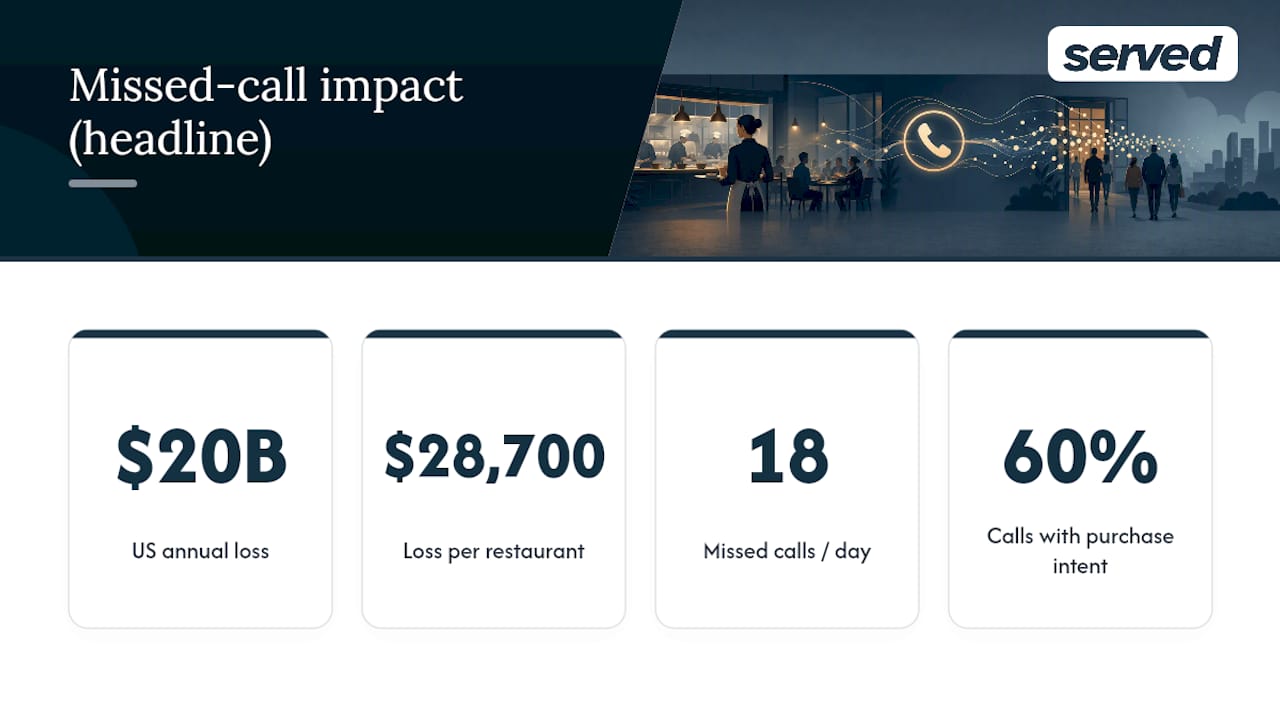
The numbers are bigger than most owners guess. An industry analysis of 700,000 US locations estimated the sector loses $20 billion annually from unanswered calls, working out to roughly $28,700 per restaurant per year under conservative assumptions: about 18 missed calls a day, with 60% of those calls carrying genuine purchase intent.
That figure is not an outlier. Maple's review of 1.2 million calls across more than 1,000 merchant locations found restaurants miss about 33% of incoming calls during peak hours, and merchants who fixed the problem recovered an average of $2,800 a month. Revmo's State of Calls report, built from over 12,000 call recordings, puts the missed-call rate for quick-service restaurants at closer to 40%.
Here is why it matters beyond the raw call count. Phone callers spend more and come back more often: one analysis found phone-order customers spend about 18% more per order and are 2.3 times more likely to become repeat customers than customers acquired through other channels. Losing a phone call is not losing one order. It is losing a customer who was likely to spend more and return.
The headline number: industry-wide, restaurants miss between 33% and 40% of incoming calls during peak service, according to Maple and Revmo. For a single venue taking 100 calls a day at peak, that is 33 to 40 missed opportunities before you even open the door in the evening.
Take a mid-sized independent doing many calls a day, average phone order of around £22, and a miss rate near one third. That results in a significant number of missed calls daily and several lost orders, which over a year may translate to tens of thousands of pounds in lost revenue, before considering repeat visit value.
Why restaurants miss calls in the first place
Most missed calls are not bad luck. They follow predictable patterns tied to how a kitchen and floor actually run during service.
Peak hours are the biggest culprit. Call volume spikes exactly when your team is busiest plating food, seating guests, and running food to tables. Revmo's data shows rings-to-abandon thresholds drop sharply during rushes. A caller who hears four or five rings with no answer tends to hang up and try somewhere else, or order through an app instead.
The operational causes tend to repeat across venues:
- No clear phone owner — when everyone is responsible for answering, nobody actually is.
- Simultaneous ringing during rushes — two calls at once, one gets ignored by default.
- Staff multitasking — a server answering while running plates gives callers a rushed, low-conversion experience even when they do pick up.
- After-hours calls going nowhere — no voicemail, no callback, no capture of the missed opportunity.
- No visibility into the problem — most venues have never pulled a report on answered versus unanswered calls.
A German industry review of restaurant phone habits found the same pattern outside the US: guests who cannot get through during dinner rush simply book elsewhere, often without ever calling back.
How to measure missed calls and calculate the revenue at risk
You cannot fix what you have not measured. Before spending on any solution, spend an hour pulling the data that tells you how big your specific problem is.
- Pull your phone report. Most business phone lines and VoIP systems log answered versus unanswered calls. If yours does not, your provider almost certainly has a setting to enable it.
- Break calls down by hour. You want to see exactly when the misses cluster, usually lunch service and the first hour of dinner.
- Check your POS for phone-order value. Pull average order value specifically from phone orders, not blended across all channels, since phone orders tend to run higher.
- Run the calculation. Missed calls × phone-order conversion rate × average phone order value = revenue at risk. Using Maple's benchmark of a 33% peak-hour miss rate as your starting assumption is reasonable if you have no data of your own yet.
- Validate with a short mystery-call audit. Have someone call your venue 10 to 20 times over three peak-hour shifts across three days and log what happens: answered, missed, wait time, and whether the person who answered could actually take an order.
Working figure to use: if your venue has no phone-report data yet, start with the 33% peak-hour miss rate as a baseline and adjust once your own numbers come in. It is close enough across the segments Maple and Revmo studied to be a reasonable starting assumption.
The audit step matters more than most owners expect. It is the only way to confirm that your assumptions about caller intent match reality, rather than guessing.
Practical solutions to reduce missed calls
Fix the cheapest, fastest problems first. Technology is the last lever you pull, not the first.
Process fixes, no cost, this week:
- Assign one named phone owner per shift, written on the rota, not left to whoever is nearest the handset.
- Run a "phone hour" 30 minutes before service starts, when a manager checks voicemail and returns any missed calls before the rush.
- Set a standard callback protocol: any missed call gets a return call within 15 minutes, logged so nothing slips.
Staffing adjustments: A part-time phone role during lunch and dinner peaks makes sense once your data shows consistent losses at those windows. Cross-training a host or expediter to take calls between tasks works for smaller venues that cannot justify a dedicated role.
Reduce call volume with digital channels: A clear online booking link on your website and Google listing, plus a messaging channel for simple queries, takes routine questions off the phone entirely. Fewer low-value calls mean your team has more capacity for the calls that matter.
Technology options, roughly in order of cost and complexity:
- Voicemail-to-text routing — cheap, fast to set up, but does not recover an order in real time.
- IVR menus — useful for large venues with high call volume, poor fit for a single independent site.
- Outsourced human answering services — solid coverage, ongoing per-call or per-minute cost.
- AI phone answering for restaurants — can take orders and bookings around the clock; vendor studies report meaningful monthly revenue recovery, though these are merchant-reported figures rather than independent audits.
Pro Tip: Turn on voicemail-to-text or a simple after-hours message this week and track how many calls come in after closing. Most venues have no idea how much volume they are losing overnight until they actually look.
Your 30/60/90-day rollout and the metrics that prove it worked
Roll the fix out in stages, and measure at every stage so you know it is actually working.
- Days 1 to 30: Run the phone report audit and the mystery-caller test. Assign phone ownership per shift and set the callback protocol.
- Days 31 to 60: Pick one primary fix based on what the audit revealed, staffing change, digital booking link, or a technology trial, and train the team on it.
- Days 61 to 90: Test under real peak conditions, monitor daily, and compare against your baseline missed-call rate.
Track four numbers throughout: missed-call rate, recovered orders per week, average phone order value, and staff interruption minutes during service. Yelp's guidance for restaurants points to the same core metrics as the ones operators should watch before and after any change.
Revmo's research suggests the real win with automated answering often is not just capturing more calls; it is freeing staff from interruptions during service, which improves table turns independently of call volume recovered.
Estimate ROI by comparing recovered order value against the cost of whatever fix you deployed. If a £50-a-month process change recovers even a fraction of your calculated revenue at risk, it has paid for itself. Only scale up to paid technology once a cheap fix has proven the size of the opportunity in your own numbers.
Practical priorities: why phone recovery is worth fixing properly
Guests who cannot get through by phone do not usually complain. They just order somewhere else, and you never see the loss on any report unless you go looking for it. That is what makes this problem easy to ignore and expensive to leave unfixed.
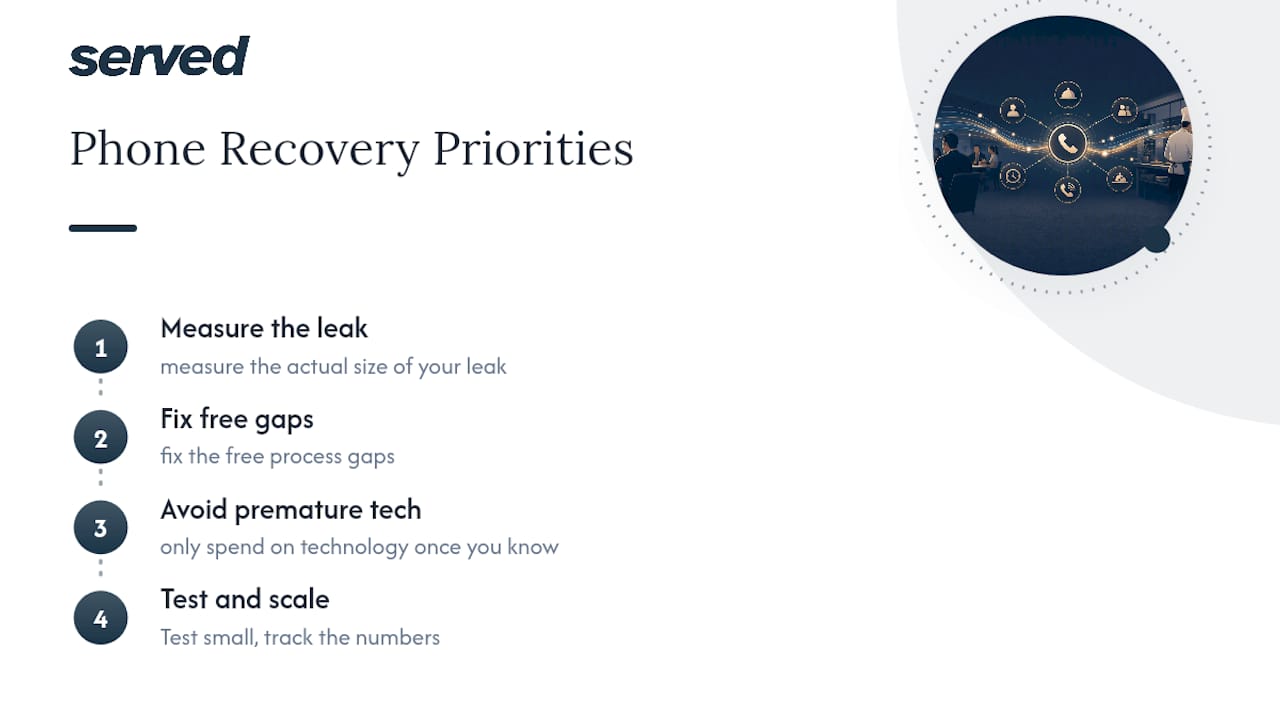
Prioritise in order: measure the actual size of your leak, fix the free process gaps, then only spend on technology once you know what you are solving for. Skipping straight to a paid tool without measuring first is how owners overspend on a problem that a rota change might have solved. Test small, track the numbers, and let the data decide when it is time to scale.
— Ignacy Jurkowski
How Served helps you capture the bookings you'd otherwise lose to the phone
Every fix above reduces missed calls. Served removes a chunk of the phone dependency altogether by giving guests a booking path that works when nobody can pick up.

Served is the alternative to a commission-hungry booking system for venues trying to cut phone reliance: you keep 100% of every reservation under a flat subscription, with no per-cover fee eating into the recovered revenue you just worked out how to calculate. Real-time menu updates mean guests checking your listing before calling get accurate information first time, and human support means you are never stuck troubleshooting a booking issue alone during service. The free Growth Scan shows you exactly where your online visibility is leaking bookings, the same way the call audit above shows you where your phone is leaking orders.
It suits owners and managers already running the process fixes in this guide who want the digital side, bookings, listings, menu accuracy, working just as hard as the phone side. If you're currently on a commission-based platform, switching to Served is straightforward, and if you're moving specifically from OpenTable, there's a dedicated switching guide that walks through it. Run your Growth Scan and see what it turns up.
Sources
- Restaurant AI phone ordering: missed calls cost $20 billion industry-wide
- The state of restaurant phone communication: insights from 1 million calls
- State of Calls Report 2026: Restaurant Phones | Revmo AI
FAQ
Is it rude not to return a missed call from a customer?
For a restaurant, yes, effectively. A guest who calls and gets no answer or no callback usually assumes you are closed, too busy, or uninterested, and will book or order elsewhere without telling you why.
How can I find out how many calls my restaurant is missing?
Pull the answered versus unanswered call report from your phone or VoIP provider, broken down by hour, and cross-check it with a short mystery-caller audit across a few peak shifts to confirm the pattern.
Should staff always ring back a missed call?
Yes, ideally within 15 minutes, using a standard callback protocol so a missed booking or order enquiry does not go cold before someone gets back to the caller.
How does a missed call affect my restaurant's revenue?
Each missed call that carried genuine order or booking intent represents lost revenue, and industry data suggests those calls also tend to come from higher-spending, more loyal customers than other channels.
Can AI phone answering actually reduce missed calls for restaurants?
Vendor-reported data suggests automated answering can capture a meaningful share of calls that would otherwise go unanswered, though the bigger operational win is often freeing staff from interruptions during service rather than the raw number of calls captured.