SMS marketing works for restaurants, and it works fast: texts get read within minutes, not days, which makes the channel a fit for last-minute seats and slow Tuesday nights. If you do nothing else, launch one automation first: a reservation or order confirmation paired with a welcome offer for new subscribers. That single sequence, built around CTIA messaging standards and TCPA consent rules, is the foundation everything else in this guide builds on.
TL;DR:
- Sending reservation, order, and loyalty reminders within a few hours before service offers the highest no-show and wait-time reduction, leveraging real-time data.
- Use a mix of transactional and relationship-building texts, with two to four messages per month, to maintain engagement without causing opt-outs.
- Build your SMS list through low-friction opt-in points like checkouts, receipts, QR codes, and online forms, with clear consent language and immediate incentives.
- Automate triggers like reservation confirmation, reward expiration, and win-back sequences based on data from your POS, reservation, and loyalty systems for better effectiveness.
- Measure success through redemption, revenue per message, click-throughs, and opt-outs, and ensure your automation tools sync real-time data to prevent manual errors.
Table of Contents
- Why SMS Marketing Works for Restaurants
- High-Impact SMS Campaign Types Restaurants Should Prioritize
- How to Build and Grow Your SMS Subscriber List
- Timing and Frequency: When to Send and How Often
- Message Templates and Copy Rules That Actually Convert
- Automation and Triggers: What to Set Up First
- Measuring ROI: The KPIs That Tell You It's Working
- Integrations and the Tool Checklist That Matters
- How Served Supports SMS-Driven Results
- Your Practical First 60 Days
- Pair SMS With a Booking Platform That Doesn't Take a Cut
- Sources
Why SMS Marketing Works for Restaurants
Text messages get opened. Industry data indicates SMS open rates are very high, and most people read a text within minutes of it landing, a gap that no other channel closes the same way (Mailchimp). Email sits in an inbox for hours or gets buried by promotions. A text sits on a lock screen until someone looks at it.
That speed matters because restaurant decisions happen in narrow windows. Someone deciding where to eat lunch is making that call between roughly 10:30am and 11:30am, not browsing a newsletter the night before. A push notification that lands at 10:45am with a same-day lunch deal catches a real decision in progress. An email sent at 9am the same day gets skimmed and forgotten by noon.
The gap that matters: SMS read rates and read speed dwarf email, but that doesn't make email obsolete. Email still wins for longer content, menus, and stories that need more than 160 characters. Use SMS for the moment of decision and email for everything that needs room to breathe.
The two channels aren't competitors. Email builds the relationship and tells the bigger story. SMS closes the gap when the decision window is measured in minutes.
High-Impact SMS Campaign Types Restaurants Should Prioritize
Not every campaign type deserves equal attention. Start with the ones tied to a transaction already in motion, then layer in promotional sends once your list has grown.
- Reservation confirmations and reminders. A text sent right after booking, plus a reminder two to three hours before the table, cuts no-shows more reliably than email ever will, because the guest sees it in time to act.
- Order-ready and table-ready alerts. For counter-service or bar-seating restaurants, a "your table is ready" or "your order's up" text keeps the front-of-house line moving and cuts perceived wait time.
- Flash and limited-time promotions. A same-day "20% off tonight, 5 to 7pm only" message fills a slow shift in a way a scheduled email campaign can't match for urgency.
- Welcome offers and win-back sequences. New subscribers get an incentive to make a first move; guests who haven't visited in 30 to 45 days get a nudge back before they forget you exist.
- Loyalty and reward reminders. A text saying a reward expires in three days converts far better than a passive point balance sitting in an app nobody opens.
- Post-visit review and feedback requests. Sent an hour or two after the check closes, these catch guests while the meal is still fresh in memory, which is when they're most likely to leave a review or answer a quick survey.
Operator guides consistently rank confirmations, order-ready alerts, flash deals, and loyalty reminders as the highest-converting campaign types for restaurants specifically (Olo). Build the operational messages first. The promotional ones perform better once guests already trust the channel.
How to Build and Grow Your SMS Subscriber List
You need explicit opt-in before you can send a single promotional text, so the sign-up moment has to work at every touchpoint where a guest is already paying attention.
- Point-of-sale terminals. A simple prompt at checkout ("Want table-ready alerts and exclusive deals? Text JOIN to 55555.") catches guests when they're already engaged.
- Digital receipts. A one-line opt-in link at the bottom of an emailed or texted receipt costs nothing to add and reaches every guest who already transacted.
- Table QR codes. A small tent card with a QR code that opens a pre-filled opt-in text removes any typing friction.
- Online ordering checkout. A checkbox during checkout, unchecked by default, keeps the list compliant and the sign-up meaningful.
- Social bios and website footers. A link to a short-code opt-in page catches followers who never set foot in the restaurant yet.
Incentives that work best are immediate and specific: "10% off your next visit" beats a vague "exclusive perks." Set expectations up front. Tell people roughly how often you'll text and what kind of content to expect, so the first promotional message doesn't feel like a surprise.
Consent language needs to be explicit under TCPA rules: something like "By texting JOIN, you agree to receive recurring automated marketing texts from [Restaurant Name]. Msg & data rates may apply. Reply STOP to opt out." covers the legal requirement in one sentence.
Pro Tip: Put the opt-in prompt on the receipt itself, not just at the counter. Guests who already paid are in a low-friction moment and more likely to say yes than someone mid-transaction.
Timing and Frequency: When to Send and How Often
Sending at the wrong hour wastes a good offer. Restaurant SMS performs best inside specific decision windows tied to when people actually choose where to eat.
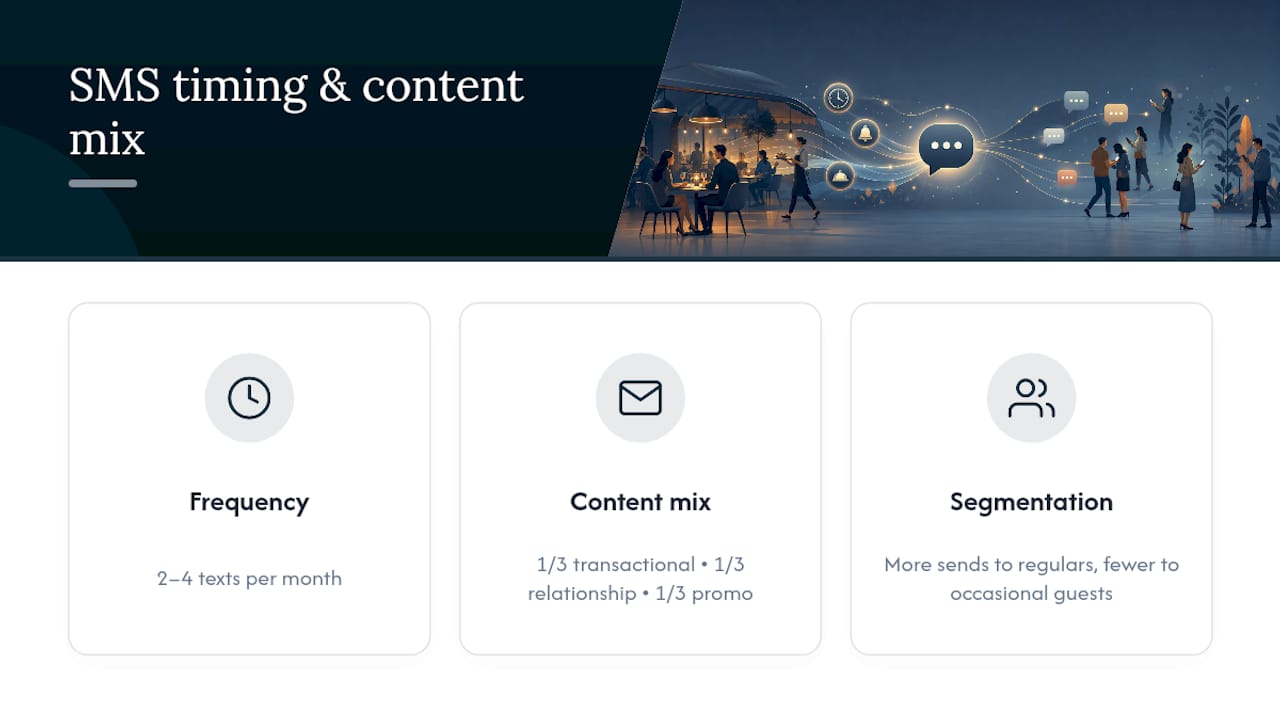
On frequency, restaurant-specific guides consistently land on two to four texts per month as the range that keeps engagement high without triggering opt-outs (ChowNow). A useful mental model borrowed from broader SMS strategy: split your sends roughly into thirds. Roughly a third transactional (confirmations, order-ready), a third relationship-building (welcome, loyalty), and a third promotional (flash deals, events). Segmenting your list by visit frequency lets you send more to your regulars without fatiguing occasional guests.
Message Templates and Copy Rules That Actually Convert
Every restaurant text should carry one idea, one call to action, and one link. Cramming a menu update and a promo and a survey link into a single text guarantees none of them land. Stay under roughly 160 characters when possible, since that's the standard single-segment SMS length, and always include an opt-out line.
- Welcome offer: "Welcome to [Restaurant]! Here's 15% off your first order this week: [link]. Reply STOP to unsubscribe."
- Same-day flash deal: "Tonight only: 20% off dine-in from 5 to 7pm. Show this text at checkout. Reply STOP to opt out."
- Reservation reminder: "Reminder: your table for 2 at [Restaurant] is booked for 7pm tonight. Reply C to confirm or call us to change. Reply STOP to opt out."
- Reward expiring: "Your $10 reward expires Sunday. Use it before it's gone: [link]. Reply STOP to opt out."
- Feedback request: "Thanks for dining with us tonight! Mind leaving a quick review? [link] Reply STOP to opt out."
MMS, the image-enabled version of texting, can lift engagement for menu photos or new-dish announcements, but it costs more per send and has more deliverability variance across carriers, so CTIA guidance recommends testing before scaling it (CTIA).
Pro Tip: Write your text, then cut it by a third. If you can say it in fewer words, you probably should. Restaurant texts that ramble get skimmed and ignored just like a cluttered email subject line.
Automation and Triggers: What to Set Up First
Manual blasts are fine for a one-off announcement, but the real return comes from automations tied to actual guest behavior rather than a calendar.
- Welcome plus incentive. Fires the moment someone opts in, delivering a small offer while attention is highest.
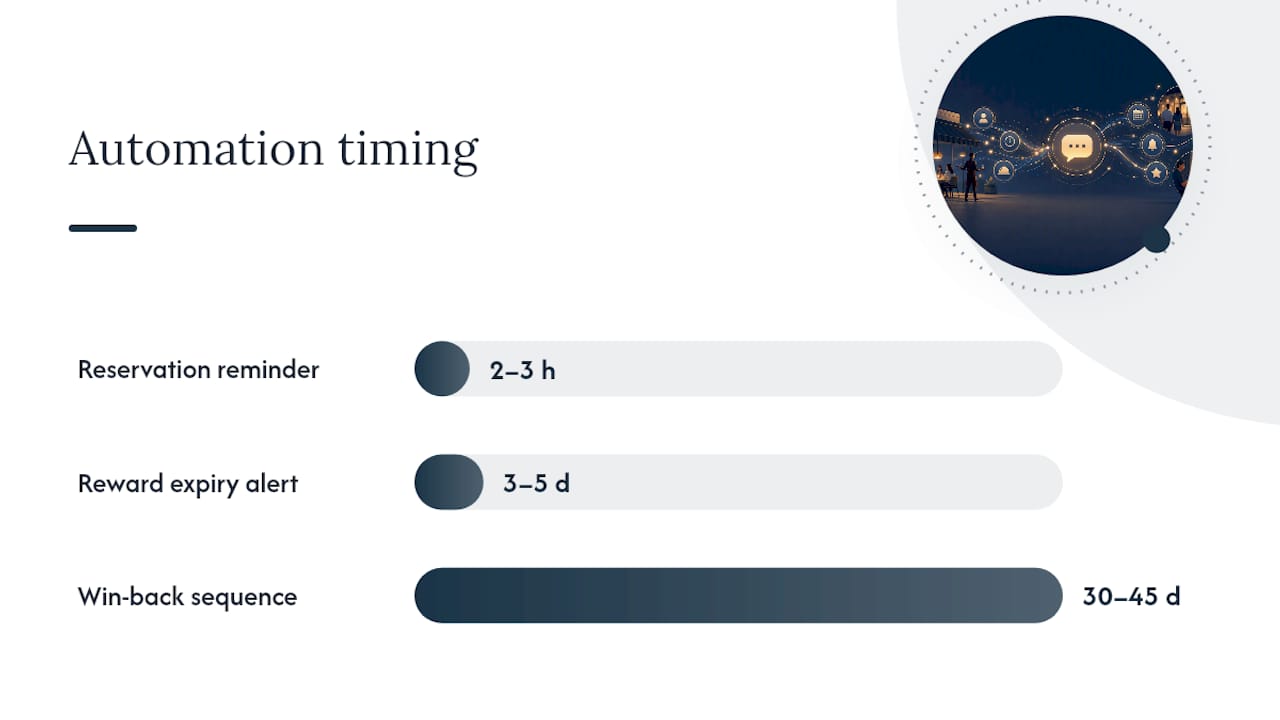
- Reservation confirmation and reminder. Pulls booking time directly from your reservation system and fires a confirmation instantly, then a reminder two to three hours out.
- Reward expiry alert. Triggers automatically three to five days before a loyalty reward lapses, using point-balance data from your loyalty platform.
- Win-back sequence. Fires when a guest hits 30 to 45 days since their last visit, pulled from POS visit-history data.
Each automation needs a data field to trigger on: visit date from your POS, booking time from your reservation system, reward balance from your loyalty platform. Without that data flowing automatically, you're back to manual sends.
Once the base automations run, test one variable at a time: send time, offer amount, or message length, across two-week windows before calling a winner. Automations tied to real behavior, like an unredeemed reward or days since a guest's last visit, consistently outperform scheduled blasts sent to the whole list at once (DoorDash Commerce).
Measuring ROI: The KPIs That Tell You It's Working
SMS is easy to send and easy to under measure. Track these numbers monthly, not just after a single campaign:
- Redemption rate — the percentage of recipients who actually used a promo code or link.
- Revenue per send — total attributed revenue divided by messages sent, your cleanest efficiency number.
- Click-through rate — how many recipients tapped the link at all.
- Opt-out rate — a rising number here signals you're sending too often or the offers feel irrelevant.
- Uplift versus a control group — compare guests who received a campaign against a small holdout group who didn't, to see the actual lift SMS creates.
Attribution gets simple with unique promo codes or dedicated landing pages per campaign. Tag each SMS-driven order in your POS if it supports it, so you can track whether that segment's lifetime value grows over time, a technique restaurant commerce platforms recommend for exactly this reason (DoorDash Commerce). Build a simple monthly checklist: sends, redemptions, revenue per send, opt-outs. If revenue per send is trending down while opt-outs climb, you're sending too much or too generically.
Integrations and the Tool Checklist That Matters
SMS platforms are only as good as the data feeding them. Your point-of-sale system tells you what someone ordered and when they last visited. Your reservation system tells you who's coming and at what time. Loyalty and CRM data tells you who's close to a reward or going quiet. Without that data synced automatically, every automation above turns into manual guesswork.
When evaluating a platform, whether it's an entry-level tool for a single location or an enterprise system for a multi-unit group, require these four things:
- Two-way sync with your POS and reservation system, not a one-time import.
- API or webhook support so triggers fire in near real time.
- Scheduled data export for reporting without manual downloads.
- Transparent pricing with no hidden per-message markups that balloon as your list grows.
How Served Supports SMS-Driven Results
Served doesn't send text messages, but it removes the friction that makes SMS campaigns work in the first place. Confirmed bookings feed straight into your reminder triggers. Real-time menu updates give you accurate details for MMS sends, so a photo promo never advertises a dish that's off the menu that night. Running a free Growth Scan before a big campaign push shows you exactly where your online visibility has gaps, so the traffic your SMS campaign drives actually finds a bookable page when it lands. A typical flow looks like this: a guest opts in at checkout, books through Served for restaurants, gets a confirmed reservation instantly, and receives an automated reminder text a few hours before arrival.
Your Practical First 60 Days
Month one is about plumbing, not promotions. Get opt-ins flowing at checkout and on receipts, launch the welcome automation, and connect reservation confirmations so every booking triggers a text automatically. Month two is where you add a same-day flash promo, build the 30 to 45 day win-back sequence, and start watching redemption rate and revenue per send closely enough to adjust.
The most common mistake I see is skipping straight to promotional blasts before the transactional messages are even running. Fix it by building the boring automations first. They're the ones guests actually want, and they're what makes the promotional texts land later.
— Ignacy
Pair SMS With a Booking Platform That Doesn't Take a Cut
An SMS campaign that drives someone to call for a table, only to hit a busy line or an outdated hours listing, wastes the exact urgency that made the text work. Served is built for the moment right after that text gets a reply: a commission-free booking platform where every reservation stays yours, with no per-cover fee eating into the table you just filled.
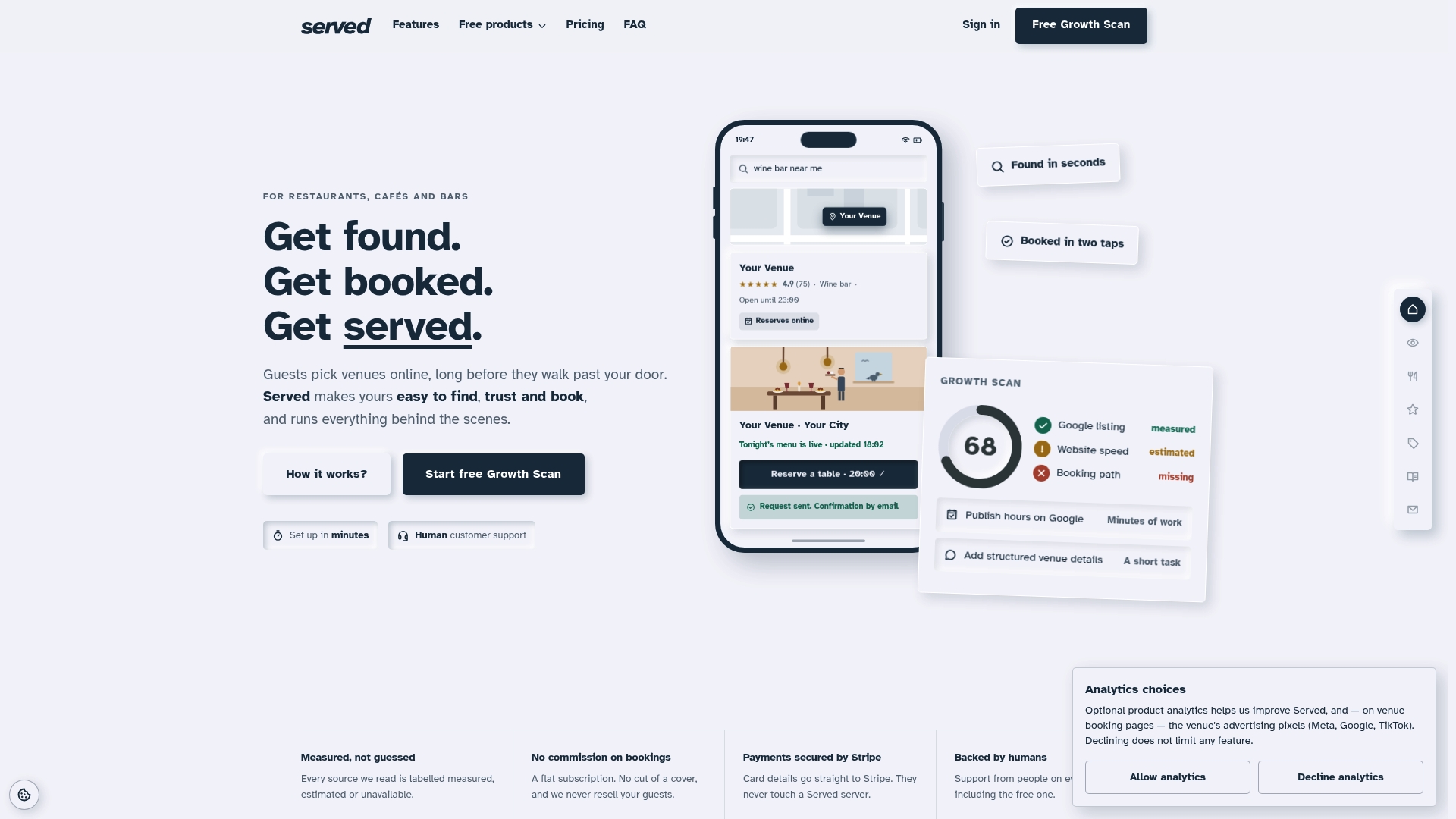
Pairing an SMS automation with a flaky booking setup is how restaurants lose the guest they just re-engaged. Served keeps real-time menu updates synced so your MMS promos never show a dish that's off the menu, gives you a calendar and floorplan view so a confirmed text reminder actually matches a held table, and backs it all with human support instead of a chatbot when something breaks mid-service. If you're not sure where your booking and visibility gaps are before you start texting guests, run the free Growth Scan first. It takes a few minutes and tells you exactly what to fix before your next campaign goes out. Ready to see it on your own listings? Start at Served.
Sources
- FCC — TCPA rules
- CTIA — messaging interoperability
- Mailchimp — SMS marketing for restaurants
- ChowNow — restaurant SMS marketing
- DoorDash Commerce — restaurant SMS marketing