Measure your average table turn time this week, then set a single target: cut it by 10 to 15 minutes without shortening the guest's actual meal. Track turn time and covers per seat as your two core KPIs. Casual dining benchmarks range from 75 to 90 minutes per turn, and some platforms can help you track bookings and no-shows while you test changes.
TL;DR:
- Reducing average table turn time by 10 to 15 minutes can significantly increase daily covers and revenue without rushing guests, especially in casual dining settings.
- Optimizing layout, establishing nesting rules, and standardizing service flow are effective ways to speed up turnover without compromising guest experience.
- Implementing technology such as digital floor plans, integrated POS and kitchen display systems, along with automated reminders, cuts communication delays and reduces no-shows.
- Conducting regular audits of invisible service gaps, demand forecasting, and table-mix adjustments can maximize efficiency and adapt to changing booking patterns.
- Using data and specific scripts allows staff to make discretionary decisions that maintain service quality while tightening the turnover process.
Table of Contents
- What is table turn time and how do you calculate turnover?
- Tactical changes that speed table turns without rushing guests
- How table mix and seating strategy affect your revenue
- Which technology actually shortens the invisible gaps?
- An 8-week checklist to test and embed table-turn improvements
- How do health and safety rules affect table turnover?
- Managing peak times with better demand forecasting
- Turning no-shows and cancellations into recovered covers
- Marketing and promotions beyond the timed discount
- Balancing speed with the guest experience
- How Served helps you act on these numbers
- Sources
- FAQ
What is table turn time and how do you calculate turnover?
Table turn time is the average length a table stays occupied from seating to reset, covering the meal itself plus clearing and resetting for the next guest. Turnover rate, sometimes called table turns, is simply how many times a table gets reused during a service period. The formula is straightforward: divide your total service hours by average turn time to get turns per table, then multiply by your seat count for total covers.
Some restaurants use "table turnover" and "table turns" interchangeably with turn time itself, causing confusion in staff meetings. Turn time measures duration, while turnover rate reflects frequency; both are important for understanding service dynamics.
Benchmarks vary sharply by concept. Bistro and café turns typically run 45 to 75 minutes, casual dining sits at 75 to 90 minutes, and fine dining stretches to 120 to 180 minutes. A table turn is formally defined as the full cycle from seating to reset, and it's the figure that determines your practical ceiling on covers per night regardless of how many reservations you take.
Worked example: A 40 seat casual restaurant running a 5 hour dinner service at 85 minute average turns delivers roughly 3.5 turns per table. Shave 10 minutes off that average and turns rise to nearly 4. At a $32 average check, that difference is worth an extra $16,000 or more across a typical month, without adding a single seat. This is close to what hospitality researchers call revenue per available space hour, or VPASH, and it's a small turn-time gain that compounds fast across a service night.
Tactical changes that speed table turns without rushing guests
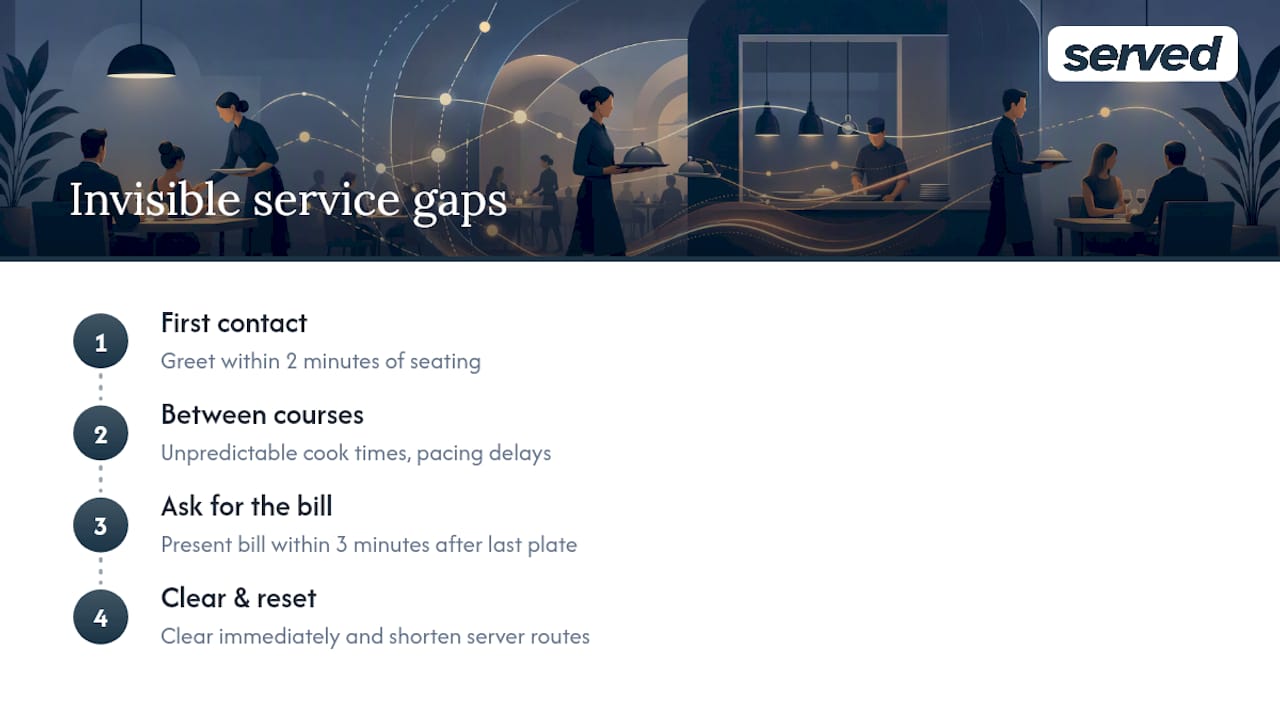
Faster turns don't come from rushing the guest through their meal. They come from removing invisible dead time, the minutes nobody notices individually but that add up across a shift. Restaurants that audit their floor typically find the biggest losses sit in four spots: time to first contact, time between courses, time to ask for the bill, and time to clear and reset.
1. Fix your layout before you touch anything else. Flexible tables that combine and split quickly beat fixed four-tops for handling unpredictable party sizes. Station your service stands so servers cover the shortest possible route between the kitchen pass, their section, and the till. A server walking an extra 30 seconds per trip loses minutes across a shift that never show up as one obvious problem.
2. Set clear seating and nesting rules. Nesting means seating smaller parties at tables slightly larger than they need, so you always have flexibility to combine two two-tops into a four-top when a bigger group arrives. Set a walk-in quota for peak hours so you're not holding four tables open on the chance a party of eight walks in. Decide in advance how long you'll hold a reserved table past its booking time, typically 10 to 15 minutes, and train hosts to say so at the door.
3. Engineer your menu and kitchen prep for pace, not just flavour. Dishes with long, unpredictable cook times slow every table behind them. Identify your two or three slowest items and either pre-batch components or flag them clearly to servers so they can manage guest expectations. Predictable plate times let your kitchen display system pace tickets instead of firing them all at once.
4. Standardise service flow with specific timing rules. Give servers concrete triggers rather than vague instructions to "keep things moving." For example: greet within 2 minutes of seating, present the bill within 3 minutes of the last plate being cleared unless a guest signals otherwise, and clear plates the moment a table finishes rather than waiting for a lull. Standardising these micro moments recovers minutes that no single policy change alone will touch.
5. Speed up payment without making it feel transactional. Contactless payment at the table, pre-authorisation for larger parties, and a clear staff script for splitting bills all shave minutes off the slowest part of most turns: the wait between "can I get the bill" and the card actually being processed. Train staff to offer to split evenly by default rather than itemising unless asked, which is usually faster for both sides.
6. Give hosts and servers actual scripts, not just intentions. A host at the door needs a specific line for holding tables ("we can hold your table for 15 minutes past your booking time"), and a server needs a specific trigger for bill presentation rather than waiting to be asked. Vague instructions produce inconsistent results; specific scripts produce measurable ones.
Pro Tip: Run a single "invisible gap" audit this week: time four random tables from last plate cleared to bill dropped, and again from bill dropped to payment processed. Most venues find 8 to 12 minutes sitting in that gap alone, more than any layout change will recover.
None of this requires rushing anyone. Guests rarely notice a kitchen that fires predictably or a server who clears plates on time. They do notice being chased out, so pace changes should tighten the gaps between service moments, not the meal itself.
How table mix and seating strategy affect your revenue
Restaurants rarely lose revenue because they're too slow. They lose it because their table mix doesn't match the parties actually walking through the door. A room full of four-tops turns away pairs and singles all night while two-tops sit empty next to a queue of families waiting for the exact same four-top that never frees up.
The Restaurant Table-Mix Optimizer, developed through Cornell hospitality research, formalises this problem using four inputs most managers already have: the distribution of party sizes you actually serve, average dining duration by party size, average check by party size, and total floor space. Run those numbers and you get an estimate of revenue per available space hour, which tells you whether your current table mix is costing you covers.
Academic work on seating optimisation backs this up with harder evidence. Integer programming and approximate dynamic programming models can meaningfully outperform simple first-come-first-served seating by making smarter real-time decisions about when to seat a party and where. Separate research on daily table-mix adjustments found gains that sound modest in isolation but add up fast:
- Daily table-mix optimisation added roughly 1.1% additional revenue compared with a static weekly layout.
- In specific high-variance scenarios, optimised table mixes approached far larger gains against poorly matched fixed layouts.
- The gains compound because the same fix applies every single service, not just on busy nights.
You don't need software to start. Run a lightweight audit: log party sizes and table assignments for one typical week, then simulate two scenarios by hand, your current mix versus a version with two extra flexible two-tops that combine into fours. Compare estimated VPASH between them.
One caution: don't let yield optimisation override fairness. Holding tables purely to chase a hypothetical bigger party punishes the walk-in couple who arrived first. Keep nesting rules flexible for regulars and special occasions, and be transparent with waiting guests about hold times rather than seating decisions they can't see the logic behind.
Which technology actually shortens the invisible gaps?
The stack that matters is smaller than most vendors suggest: a digital table plan linked to your point of sale, a reservation system, a kitchen display system, guest CRM, waitlist tool, and payment processing. What matters isn't owning all six pieces, it's whether they talk to each other, because every handoff between disconnected systems is where minutes leak.
Digital table plans with occupancy heatmaps and predictive no-show scoring measurably reduce waiting times and improve staff planning, because managers can see which slots run hot before the rush starts rather than reacting once the queue forms. Automated reminders sent ahead of a booking cut down last-minute no-shows, which otherwise sit as dead, unturned tables during your busiest hour.
- A digital floor plan synced to your reservation book shows real-time table status to hosts without a walk to the dining room.
- Automated booking reminders reduce no-shows and give kitchen and floor staff more accurate demand forecasts for the shift.
- KDS to POS integration removes the verbal relay between servers and kitchen, cutting communication delays during peak load.
Served's floor-staff tools give hosts real-time table status without commission fees eating into every booking, and its Growth Scan flags where your booking path is losing potential covers before you spend on anything bigger. Start small: link reminders and a basic POS/KDS connection before committing to a full platform overhaul.
An 8-week checklist to test and embed table-turn improvements
Don't overhaul your floor overnight. Run this as a series of short, measured experiments so you know which change actually moved the numbers.
- Week 0, baseline: Log turn time, covers per seat, and no-show rate for two full weeks before changing anything. This is your comparison point for everything that follows.
- Week 1, quick wins: Introduce a host script for table holds, switch to contactless or pre-authorised payment where possible, and add a 10 to 15 minute buffer rule between bookings.
- Weeks 2 to 3, table-mix trial: Test one layout tweak, such as two extra flexible two-tops, against your baseline mix on matched weekday slots. Keep the staff rota unchanged during the trial so you're isolating the layout's effect rather than a stronger shift team.
- Week 4, menu and pacing tweak: Adjust your two slowest kitchen items or introduce a timed early-evening promotion, then compare turn time against the same weekday the previous month.
- Weeks 5 to 6, review and adjust: Compare covers per seat and turn time across all trials. Keep what worked, drop what didn't, and brief the whole team on the winning changes.
- Weeks 7 to 8, embed and train: Fold the successful changes into standard training material and set a recurring weekly KPI review, ten minutes at a pre-shift meeting is usually enough.
Pro Tip: Record covers per seat by section, not just venue-wide. A layout change often helps one zone and does nothing for another, and averaging the two hides which fix actually worked.
How do health and safety rules affect table turnover?
Regulations shape how many covers you can physically seat, which changes the maths behind every turnover target. Fire and occupancy codes set a hard ceiling on total covers regardless of how fast you turn tables, so any turnover plan has to work within that number, not around it. Local licensing and food safety rules also dictate spacing and table density in many jurisdictions, and these vary significantly by country and even by municipality, so check your local authority's current guidance rather than assuming a neighbouring venue's layout is compliant.
The COVID-19 period left a lasting mark on how many operators think about density. Venues that adapted seating for reduced-capacity rules often discovered their revised layouts, wider aisles, fewer cramped four-tops, actually improved service speed once restrictions lifted, because staff could move faster and clear tables without squeezing past neighbouring guests. Some kept elements of that spacing permanently for exactly this reason.
Allergen and food safety obligations also affect turn time indirectly. Clear allergen communication at the point of order prevents the far slower disruption of a dish being sent back or a guest reaction mid-service. Build allergen checks into your greeting script rather than treating them as a separate step, and you avoid a delay that costs far more time than the extra 30 seconds up front.
Whatever your local rules require, treat compliance as the floor your table-mix planning sits on top of, not a separate concern. A seating plan that's fast but noncompliant isn't a plan you can actually run.
Managing peak times with better demand forecasting
Most venues lose more covers to poor peak planning than to slow service. A kitchen that's perfectly paced at 6pm can collapse at 8pm if nobody forecast that Friday's volume would be 40% above Tuesday's, and that gap is entirely predictable if you're logging the right data.
Start with your own booking history rather than generic industry patterns. Pull covers by hour and day of week over the past two months and you'll typically find one or two windows that consistently run far hotter than the rest, often a specific 90 minute stretch rather than the whole evening. That's the window worth building a dedicated plan around: extra prep staff, pre-batched components for your slowest dishes, and a host briefed to manage table holds more tightly.
Occupancy heatmaps make this forecasting far less guesswork-dependent. Seeing which slots run hot before the rush starts lets you schedule staff and timed offers to flatten peaks rather than scrambling for last-minute capacity once the queue has already formed at the door.
Weather, local events, and payday cycles all shift demand in ways worth logging manually if your software doesn't already flag them. A restaurant near a stadium or theatre should treat event nights as a distinct forecasting category, not a variation on a normal Friday. Build a simple spreadsheet noting date, weather, local events, and actual covers for a few months, and patterns emerge that pure gut instinct usually misses.
Turning no-shows and cancellations into recovered covers
A no-show doesn't just cost one lost booking, it costs the entire turn that table could have delivered instead, which is often the more expensive part of the problem. A table held for a 7:30pm reservation that never arrives isn't just an empty seat, it's a missed 7:30 turn and possibly the 9pm turn behind it if you don't release the table in time.
Automated reminders sent a day ahead and again a few hours before the booking are the single highest-leverage fix here, because predictive reminder systems measurably reduce no-show rates simply by giving guests an easy prompt to cancel if their plans changed, rather than letting the table sit reserved and unused. Pair reminders with a simple, low-friction cancellation link rather than requiring a phone call, since friction is often why guests don't bother cancelling at all.
For larger parties or peak slots, consider pre-authorisation or a modest deposit that's waived on arrival. This isn't about penalising guests, it's about filtering out the bookings least likely to show. Clear communication and simple deposit structures reduce no-show losses without making the booking process feel punitive for guests who genuinely intend to come.
Build a short buffer into your release policy too: if a table isn't claimed within 10 to 15 minutes of its booked time, release it to walk-ins or your waitlist rather than holding it indefinitely. Track your no-show rate as its own KPI alongside turn time, because a venue that fixes its no-show problem often recovers more covers per week than one that only focuses on service pacing.
Marketing and promotions beyond the timed discount
Timed promotions, discounting early tables to shift demand into quieter windows, get most of the attention in table turn conversations. But marketing's role in turnover runs wider than pushing early diners through the door.
Booking channel choice matters more than most managers assume. Guests who book directly through a venue's own site or listing tend to show up more reliably than those routed through a crowded third-party marketplace, partly because the booking feels more deliberate and partly because reminder systems tied to a direct booking are easier to personalise. Reviewing where your bookings actually originate, and steering guests toward your most reliable channel, is a quieter but effective turnover lever.
Guest CRM data lets you target communication by real behaviour rather than blanket offers. A regular who always books a two-top on Tuesday can be nudged toward a slightly different time slot that fits your table mix better, without ever feeling like a discount pitch. Segmenting your marketing this way protects margin better than a blanket percentage-off promotion that attracts price-sensitive bookings you didn't need.
Loyalty and repeat-visit messaging also shape turnover indirectly by making demand more predictable. A venue with a strong base of regulars can forecast peak nights with more confidence than one relying entirely on new footfall, and predictable demand is what makes every tactic in this article easier to plan around. Review requests sent after a visit, timed a day or two later rather than at the table, build the kind of visibility that keeps your booking pipeline fuller and steadier without touching your seating rules at all.
Balancing speed with the guest experience
A change I've seen work well in practice: a venue struggling with a Friday bottleneck simply moved bill presentation earlier, offering it proactively rather than waiting to be asked, and picked up nearly half a turn per table across the night without a single guest complaint. The fix wasn't speed for its own sake. It was removing a wait nobody wanted to be sitting in anyway.
The trade-off that actually matters isn't turning tables versus treating guests well, it's rigid rules versus judgement. A regular who lingers over coffee on a slow Tuesday shouldn't be nudged along by a policy built for Friday's rush. Keep your fastest rules for peak hours and let staff use discretion the rest of the time.
Data tells you where the minutes are going. Staff on the floor tell you when to ignore the data. Both are needed, and neither works well alone.
— Ignacy Jurkowski
How Served helps you act on these numbers
Everything above depends on knowing your actual booking reliability, and that's the piece most venues can't see clearly without the right tools. Served gives you a commission-free booking system, so every reservation you take stays yours without a per-cover fee eating into the margin you just worked to protect.

The Growth Scan checks your current online visibility and booking path in minutes, flagging where potential covers are dropping off before they even reach your reservation book. Served's floor-staff tools give hosts real-time table status without a walk to the dining room, which matters directly for the hold-time rules and nesting decisions covered earlier in this article. Real-time menu updates and human customer support round out the platform, so changes to your offering reach guests immediately rather than sitting stale on a booking page.
If you're currently on a commission-based system, the switching guide walks through what moving over actually involves. Otherwise, start with the free Growth Scan, see where your booking path is losing covers, and decide from there whether the full platform fits how your venue runs.
Sources
- The Restaurant Table-Mix Optimizer (RTMO) — Cornell hospitality research
- Restaurant revenue management models (integer programming, ADP) — MIT / academic paper
- Table mix optimisation experiments and heuristics (Sherri Kimes / academic report)
- Table Turn Time — Black Box Intelligence restaurant glossary
- Tischmanagement: optimisation workflow and benchmarks — Gastro Master
FAQ
What is a table turn?
A table turn is one complete cycle of a table being seated, served, cleared, and reset for the next guest. Turnover rate measures how many of these cycles happen per table across a service period.
What is the 30/30/30 rule for restaurants?
Definitions of this rule vary by source and aren't consistently documented in hospitality research, so treat any specific version cautiously. Focus instead on measuring your own turn time against concept benchmarks like the 75 to 90 minute casual dining range rather than a fixed formula.
What does "3 turns" mean at a restaurant?
Three turns means each table was occupied, cleared and reseated three times during a single service period. A 40 seat restaurant achieving three turns across dinner service seats roughly 120 covers that night, before accounting for no-shows or walk-ins.
What are the main types of table service?
Common service styles include table service, counter service, buffet, family style, banquet, cafeteria and fine dining silver service, each with different implications for turn time. Full table service with courses plated individually generally runs slower per cover than counter or family-style formats.
How can I increase table turnover without rushing guests?
Focus on removing invisible gaps rather than shortening the meal itself: faster bill presentation, contactless payment, standardised clearing duties and clear seating hold rules. Platforms like Served support this by giving floor staff real-time table status and giving managers a clearer view of booking reliability through tools like the Growth Scan.