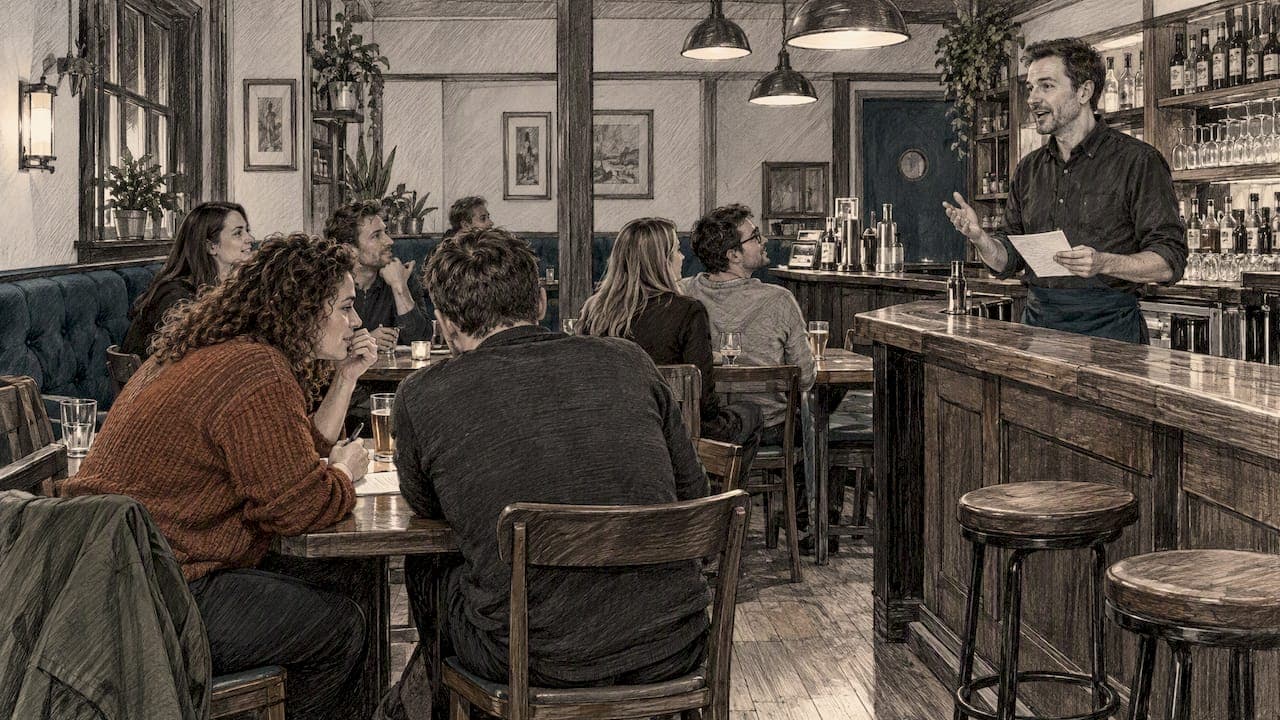
Trivia nights, live-acoustic sets and themed tasting evenings move the needle fastest for bars because they give guests a reason to show up on a specific night and a story to share afterwards. Slower-tempo live music alone can lift dwell time and spending compared with faster-tempo nights. Pick one format below and book your first date within the next two to six weeks.
TL;DR:
- A weekly quiz with a reliable host can build a steadier crowd than a one time spectacle; run it for six weeks and collect contacts.
- For tastings, book a supplier about four weeks ahead and sell tickets in advance; four to six guided pours can cover stock costs upfront.
- For sports screenings, confirm broadcast rights before promotion, then tie a fixed food and drink bundle to kickoff to raise spend without complicating service.
- A landing page and direct company outreach can bring 15 to 40 corporate enquiries per season, with bookings confirmed six to eight weeks ahead.
- Compare covers, average spend, and new contacts with a typical night; track repeat visits over 90 days and follow up within 48 hours.
Table of Contents
- A top-10 shortlist of events you can book this week
- Event ideas by category, with execution notes that actually work
- How to promote happy hour, live music and every event without hiring an agency
- Your 6-week event timeline and on-the-night checklist
- Measuring success and bringing guests back
- What actually keeps guests coming back
- Why the usual advice on bar events misses the point
- Making event bookings easier with Served
- FAQ
- Sources
A top-10 shortlist of events you can book this week
Some of these need almost no lead time. Others need a supplier booked or a licence checked, so flag that early and move on.
- Pub quiz night (low-prep): runs on a host and a prize budget; revenue lever is a drinks-and-snacks bundle sold at the door. Suits regulars and small groups; book in one week.
- Acoustic open mic (low-prep): needs a PA system and a sign-up sheet; revenue lever is extended dwell time from slower-tempo sets. Suits a mixed weekday crowd; book in one to two weeks.
- Covers band night (requires booking): needs a contracted act and a deposit; revenue lever is a cover charge plus higher bar spend. Suits weekend crowds; book four to six weeks out.
- Themed costume night (low-prep): needs decor and a playlist; revenue lever is a themed cocktail menu at a premium price. Suits younger, social-media-active guests; book two weeks out.
- Beer or wine tasting flight (requires booking): needs a supplier rep and ticketed pours; revenue lever is pre-sold tickets covering stock cost upfront. Suits enthusiasts and date-night pairs; book three to four weeks out.
- Trivia league (low-prep, recurring): needs a consistent weekly host; revenue lever is repeat footfall across a season. Suits loyal regulars; book two weeks out, then repeat.
- Sports screening party (low-prep): needs a confirmed broadcast licence and extra screens; revenue lever is a food-and-drink bundle tied to kick-off time. Suits groups and walk-ins; book one to two weeks out.
- Cocktail masterclass (requires booking): needs a guest bartender or supplier partnership; revenue lever is a fixed ticket price covering ingredients. Suits small private groups; book four weeks out.
- Comedy or spoken word night (requires booking): needs contracted talent and seating changes; revenue lever is a door charge plus a two-drink minimum. Suits an evening crowd seeking something different; book four to six weeks out.
- Seasonal drink launch (low-prep): needs a new recipe and menu update; revenue lever is a limited-time price point that drives urgency. Suits existing regulars and social sharers; book one week out.
Choose one, put a date in the diary, and work backwards from there.
Event ideas by category, with execution notes that actually work
Live music gives you the most flexible format range. An open mic needs only a PA, a sign-up sheet and a host with a light touch on timing, the lowest-prep option on this list. A covers night needs a contracted act, usually booked four to six weeks ahead, and a sound check slot before doors open. A small jazz set works well in a quieter back room or corner, where slower tempo music has been shown to increase both dwell time and spending in bar settings. Check your space for sound bleed into neighbouring units before committing to a regular slot.
- Prep level: open mic is low-prep; covers bands and jazz sets need booking and a deposit.
- Revenue tactic: bundle a "gig night" cocktail or pitcher deal that's only available during the set.
- Minimal staff plan: one extra bar staff member during peak set times covers most small venues.
Games and quizzes are the easiest recurring format to run well. A classic pub quiz needs a confident host, a question set and a simple scoring sheet. Team-format trivia with rotating categories keeps regulars coming back weekly, and a small entry fee or a "pay what you can, winner takes the pot" model works in most markets. Add a raffle or spot prizes from a local supplier to stretch your prize budget without stretching your margin.
- Prep level: low, once you have a host and a question bank.
- Revenue tactic: a food-and-pitcher combo priced slightly below ordering items separately, which nudges group spend up.
- Minimal staff plan: the host can double as a server in a small venue; larger venues need one dedicated runner.
Themed nights and cultural events reward a clear concept carried through decor, menu and music together. A decade-themed night, a festival tie-in or a seasonal celebration gives you a reason to change the playlist, introduce a limited cocktail list and set up one obvious photo spot near the bar. Sensory coherence between lighting, music and menu has been shown to outperform price-led promotions when it comes to revisit intention, so a well-designed theme can do more for repeat business than a discount ever will.
- Prep level: medium, mostly decor and menu planning rather than bookings.
- Revenue tactic: a themed cocktail priced at a small premium, promoted as limited-time only.
- Minimal staff plan: brief existing staff on the theme and any new drink recipes the week before.
Pro Tip: Pick one visual detail per themed night, a backdrop, a prop, a lighting colour, and build your social content around that single image rather than trying to capture everything.
Tastings and masterclasses convert well because tickets can be sold in advance, which covers your stock cost before the night starts. Reach out to a local brewery, distillery or wine importer: most will send a rep to pour samples and talk through the range in exchange for featuring their product. Price tickets to cover ingredient cost plus a margin, typically with four to six guided pours. A cocktail masterclass with a guest bartender works the same way and suits smaller private groups well.
- Prep level: requires booking a supplier or talent four weeks ahead.
- Revenue tactic: pre-sold tickets that lock in attendance and cash flow before the event.
- Minimal staff plan: the supplier rep or guest bartender leads, with one staff member supporting service.
Screenings and viewing parties work best around major sporting fixtures or film releases. Confirm your broadcast licence covers the screening before promoting it, and plan seating around your largest screen. Bundle a set menu or a drinks pitcher around kick-off time to lift average spend without complicating service.
- Prep level: low-prep but licence-dependent; confirm coverage rights before announcing dates.
- Revenue tactic: a fixed food-and-drink bundle tied to the fixture's start time.
- Minimal staff plan: standard weekend staffing usually covers it, plus one extra runner for peak bundle orders.
How to promote happy hour, live music and every event without hiring an agency
A six-channel mix covers most of what a bar needs, and running all six consistently works better than relying on one, as detailed in how to promote Australian nightlife on social.
- Guest list and email: send a save-the-date three to four weeks out, then a reminder the week of the event.
- Social posts and reels: short video content and behind-the-scenes clips perform well with Gen Z audiences, who often discover venues through friends' feeds rather than search.
- Event listings: list on local what's-on sites and community boards, which cost nothing and reach people actively looking for something to do.
- Partnerships: cross-promote with breweries, distillers or local promoters who bring their own following.
- Corporate outreach: a short LinkedIn message to nearby offices works well for midweek private hire or after-work events.
- Paid search or ads: worth switching on seasonally, around holidays or major local events, rather than running year-round.
A multi-channel promotion system that includes a dedicated landing page and direct outreach to companies can bring 15 to 40 additional corporate enquiries per season, with many bookings confirmed six to eight weeks in advance. That timeline matters: start corporate and group outreach early, and leave social posts and last-call reminders for the final week before the event.
Keep the tactics simple. Early-bird pricing on tickets rewards guests who commit sooner, which helps you plan stock and staffing. Group pricing (a table of six or more at a slightly reduced rate) encourages bigger bookings rather than several smaller ones. A referral incentive, a free round or a discount code shared between friends, turns your existing guest list into a recruitment channel. None of this needs a professional photographer: a phone, decent lighting and a consistent editing style is enough for most bars.
Your 6-week event timeline and on-the-night checklist
A simple week-by-week plan keeps events from becoming last-minute scrambles.
- Weeks 6-5: Lock the concept, date and budget; confirm any talent, supplier or licence requirement.
- Weeks 5-4: Book suppliers, finalise the menu or drinks list, and set ticket or entry pricing.
- Weeks 4-2: Launch promotion across your channels; open ticket sales or RSVPs if relevant.
- Week 2: Push group and corporate outreach; follow up on early enquiries.
- Week 1: Send reminder emails, post last-call content, confirm final headcount with suppliers.
- Day of: Brief staff, set up decor and signage, run final equipment checks before doors open.
On the night, a few habits make the difference between a fun evening and a profitable one:
- Greet guests at the door and direct them clearly to seating, bar or ticket collection.
- Give staff a short welcome script that mentions the one or two upsell items for the night.
- Capture a few photos early, before the crowd builds, for next week's promotion.
- Collect guest contact details at the point of booking or payment, not as an afterthought.
- Keep the payment flow simple: one clear way to pay, whether that's at the bar or by card at the table.
For events prone to no-shows, a small deposit or prepaid ticket keeps capacity planning realistic rather than guesswork based on RSVPs that rarely all arrive.
Measuring success and bringing guests back
Four numbers tell you most of what you need to know: covers on the night, average spend per head, net new contacts captured, and how many of those guests return within 90 days. Compare these against a normal night to see whether the event earned its place in your calendar.
- Track covers and average spend against a comparable non-event night, not just in isolation.
- Count new contacts captured through sign-ups, bookings or loyalty sign-ins, not just total attendance.
- Follow up within 48 hours: send a short email or text with event photos and a simple review request.
- Offer a modest return incentive, a discount on their next visit or early access to the next event, to convert a one-off visit into a second one.
- Use what you learn, which nights sold out, which upsell worked, to shape the next event rather than starting from scratch each time.
What actually keeps guests coming back
Running dozens of bar events over a season tends to surface the same few patterns. First, consistency beats novelty: a weekly quiz with a reliable host builds a more loyal crowd than a string of one-off spectaculars. Second, the room's sensory details, music tempo, lighting, how the space feels, tend to matter more to repeat visits than any single discount. Third, capturing even basic contact details at every event is what turns a good night into next month's guest list.
The takeaway worth acting on: treat events as a repeatable system rather than a one-off push. Book the next date before the current one has even finished.
Why the usual advice on bar events misses the point
Most guides treat events as marketing stunts: book a band, post on social media, hope for a crowd. That thinking treats each event as disposable, which is exactly why so many bars run one themed night, see a decent turnout, and then never repeat it.

The evidence points somewhere more useful. Sensory coherence between music, lighting and menu does more for repeat visits than discounting, which means the room you build matters more than the price you cut. Conventional wisdom overrates the one big event and underrates the small, repeatable one, a weekly quiz or a monthly tasting that guests can plan their week around.
What we'd prioritise first is unglamorous but effective: pick one recurring format, run it consistently for six weeks, and capture guest contact details every single time. A single spectacular launch night that never returns teaches you less than six ordinary Tuesdays that slowly build a following. The system matters more than any individual idea on this list.
— Ignacy Jurkowski
Making event bookings easier with Served
Running great events only pays off if guests can actually find and book them. We built Served as a commission-free booking and visibility platform for bars, restaurants and cafes, so every table you fill for an event stays yours, with no per-cover fee eating into the margin you just worked to create.

Our Booking Path Scan shows exactly where potential guests drop off before completing a booking, useful before you launch a big promotion. Real-time menu updates mean your event specials and seasonal drinks show up accurately the moment you change them, and our human support team is there if you need help setting up an event listing fast. For venues ready to turn one-off events into a steady booking engine, our Visibility Brain plan starts at €69 per month, with onboarding support included for busy teams who need it running quickly.
FAQ
What are some unique event ideas for pubs?
Pub quizzes, themed costume nights and tasting flights with a local brewery or distiller all work well because they're low-cost to set up and give guests a reason to return weekly or monthly. Seasonal drink launches and comedy nights also perform strongly when timed around a quieter midweek slot.
What are some fun ideas for client events?
Cocktail masterclasses, private tasting sessions and small-group trivia nights suit corporate or client bookings particularly well. Outreach to nearby offices six to eight weeks ahead tends to convert better than last-minute invitations, since many corporate bookings are confirmed well in advance.
What attracts people to a bar?
Atmosphere built from music, lighting and menu together attracts and retains guests more reliably than price promotions alone, according to sensory marketing research. Slower background music tempo has also been linked to longer visits and higher spend in bar settings.
What are some unique ideas for a bar?
Rotating seasonal drink launches, open mic nights and sports screenings tied to food-and-drink bundles all give guests a recurring reason to visit. Pairing any of these with an online booking option makes it easier for new customers to commit before they even arrive.
Sources
- The effect of tempo of background music on duration of stay and spending in a bar (2009)
- Sensory marketing and social media effects on revisit intention (Frontiers in Communication, 2026)
- Mehr Firmenfeiern für dein Restaurant: 6-Kanal-System (GastroInsider)
- Shaping the future: Gen Z and the evolution of on‑premise (NielsenIQ, 2025)