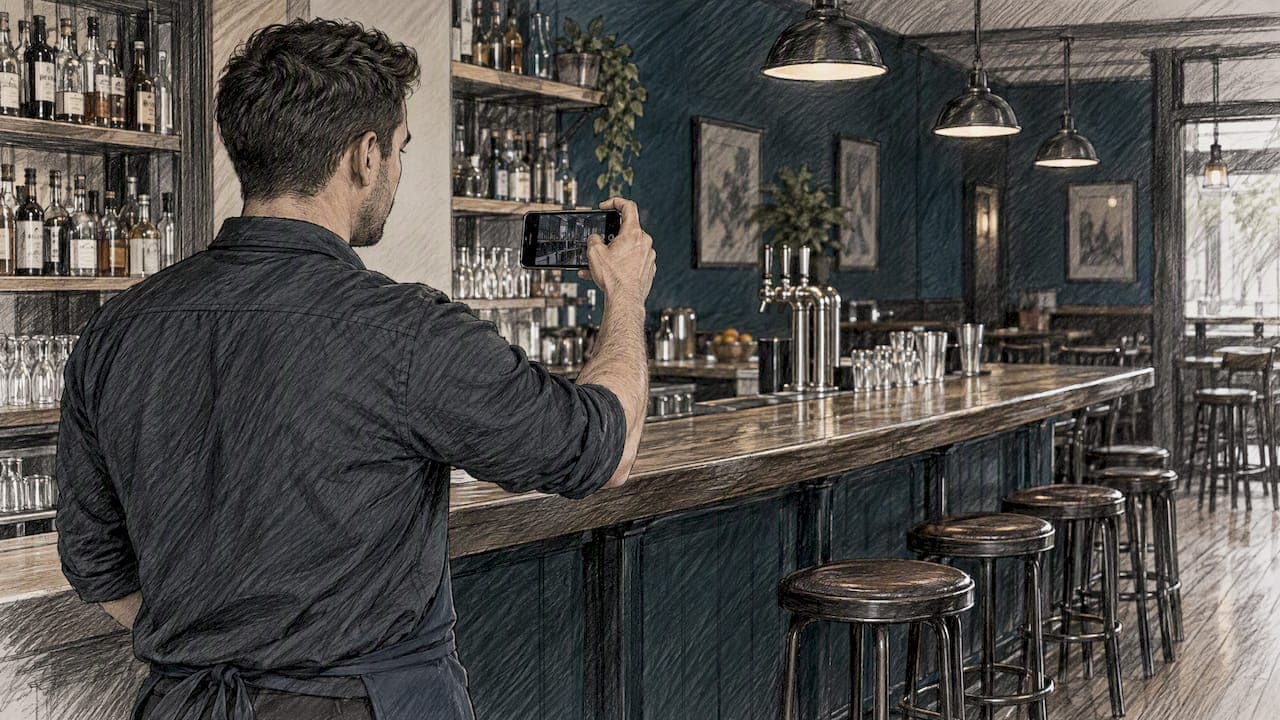
The most effective bar social media approach is also the simplest: pick one platform, promote your next event with personality-led content, and add a clear booking link. Publish a post about this week's big night right now. Do that consistently and you get two results fast: more people seeing your venue, and more of them actually booking a table.
TL;DR:
- Post three to four times weekly across five themes, and assign one staff member a fixed task to keep publishing consistent.
- Put booking links in event captions, your bio, and paid posts, and keep the menu at one URL to prevent outdated offers.
- Track reservations, ticket sales, or footfall alongside reach, profile visits, and link clicks, then review the results after 30 days.
- Reply to negative comments within a day, acknowledge the specific issue publicly, and move to direct messages only after showing that you take it seriously.
- For paid promotion, start with one event post targeted by distance from the venue; compare its profile visits and link clicks with organic performance.
Table of Contents
- 1. Post ideas you can reuse every week
- 2. Build a strategy you can actually sustain
- 3. Which platforms matter and how to use them
- 4. A four-week posting plan you can copy
- 5. The few metrics worth tracking
- 6. Turning social attention into confirmed bookings
- 7. Handling a bad review or a viral complaint
- 8. Contests, polls and influencer collaborations that fit a bar
- 9. Paid social basics for a bar's budget
- A hospitality marketer's honest take
- How Served turns social buzz into booked tables
- FAQ
- Sources
1. Post ideas you can reuse every week
Bars do not need a content agency. They need a small rotation of formats that staff can shoot and publish in minutes. These six cover most of what guests respond to.
- Event promotion: a countdown story, a ticket link, and a quick highlight of the artist or theme.
- Staff cocktail favourites: a short reel of a bartender making their go-to drink, with their name on screen.
- Behind-the-scenes prep: a 30-second clip of the bar getting ready before doors open, often paired with the first song of the night for atmosphere.
- Menu and drink highlights: one photo, one caption, one shareable link to the menu rather than a different upload on every platform.
- User-generated content: ask guests to tag you, then repost with credit and a quick thank-you reply.
- Flash offers: a time-limited deal with a clear deadline and a single call to action.
Pro Tip: Film three staff cocktail reels in one quiet afternoon and schedule them out over a month, so you are never scrambling for content on a busy night.
Each of these works because it needs almost no production. A phone, decent lighting near the bar, and thirty seconds of footage is enough. The mistake most venues make is waiting for a "good enough" photo instead of publishing something rough but timely. A countdown post the morning of an event beats a polished one that goes up a week late.
User-generated content deserves particular attention because it costs nothing to produce and carries more trust than a venue's own posts. Ask permission before resharing, tag the original poster, and reply publicly: it signals that you read your comments and builds the kind of social proof that customer reviews in hospitality depend on.
2. Build a strategy you can actually sustain
A strategy does not need to be complicated. It needs six decisions, made once and revisited monthly.
- Pick one measurable goal, such as reservations or ticket sales, with a single KPI attached to it.
- Define your primary persona and note which nights of the week actually attract them.
- Build a five-theme content wheel: events, drinks, people, offers, community.
- Set a sustainable cadence, three to four posts a week is plenty for most bars, and assign who posts what.
- Repurpose one asset across three formats: a reel becomes a story, a still, and a caption quote.
- Run a pre-publish checklist: correct date, working link, tagged location, and a scheduling tool queued for peak hours.
Pro Tip: Give one staff member ownership of Monday's post. A predictable weekly task gets done; a vague "someone should post more" never does.
Hospitality businesses tend to use social media heavily for marketing, reputation management and guest engagement, yet many lack a formal strategy behind that activity. That gap is exactly where a six-step plan like this earns its keep: it turns scattered posting into something you can actually measure and improve.

3. Which platforms matter and how to use them
You do not need to be everywhere. Pick the platforms where your persona actually spends time, and match tactics to what each one rewards.
- Instagram: reels for atmosphere, geotags for discovery, a link to your menu in bio, and saved highlights for recurring nights.
- Facebook: events pages, local groups, and boosted posts for reaching people nearby who have not followed you yet.
- TikTok: trend-led short clips, particularly strong for reaching younger demographics who discover new venues through video rather than search.
- X, Threads or WhatsApp: quick announcements and a direct line to regulars for last-minute changes.
The decision rule is simple: match the platform to your persona and to what your team can realistically sustain. A two-person bar team running five platforms badly will lose to a team running one platform well. In 2025, 78.25% of accommodation and food service businesses across the EU reported using social media, so presence alone is not a differentiator. Consistency and fit are.
4. A four-week posting plan you can copy
This is not a rigid schedule, it is a starting rhythm. Adjust the days to match your busiest nights.
- Week 1: event post (Monday), reel (Wednesday), staff profile (Friday).
- Week 2: menu highlight (Monday), UGC repost (Wednesday), event countdown (Friday).
- Week 3: behind-the-scenes clip (Monday), flash offer (Wednesday), staff cocktail reel (Friday).
- Week 4: community shoutout (Monday), event post (Wednesday), month recap story (Friday).
Caption template for events: "This Friday: [event name]. Doors from [time]. Tables are limited, book yours: [link]." Keep the booking link in the first line of the caption and repeated in the bio, not buried after three paragraphs.
- Evenings between 5pm and 8pm tend to catch people planning their night out.
- Weekend mornings work for posts aimed at brunch or daytime trade.
- A free scheduler queued a week ahead removes the daily pressure to remember to post.
5. The few metrics worth tracking
Most bars drown in vanity numbers. Three or four are enough to prove whether social media is paying off.
- Primary outcome metric: reservations, ticket sales or footfall tied directly to a promoted event.
- Supporting social metrics: reach, profile visits and link clicks, which tend to move before bookings do.
- Simple tools: native platform insights plus Google Analytics with a basic UTM tag on your booking link.
- A 30-day test: promote consistently for a month, then decide whether to scale the approach or change tactics.
Many hospitality businesses that invest in social media use it primarily for marketing, reputation management and customer engagement, which means the metrics that matter most tie back to bookings, not just likes.
A practical 90-day digital marketing playbook gives a useful benchmark for how long a fair test should run before you judge results.
6. Turning social attention into confirmed bookings
Posts that get likes but no bookings usually fail at the conversion step, not the content step. A few fixes close that gap quickly.
- Sync your menu to one URL so every platform shows the same offers, avoiding the reupload errors that creep in when you update a PDF on Facebook but forget Instagram, a step covered in syncing your menu to Facebook.
- Run a quick visibility scan to catch broken listings, outdated hours, or missing booking links before you spend money boosting a post to fix traffic.
- Put your booking link in three places: bio, every event post, and any paid boost, so the path from scroll to confirmed table never takes more than one tap.
- A 48-hour website fix for booking links often removes the single biggest source of lost reservations from social traffic.
7. Handling a bad review or a viral complaint
Reputation problems on social media move fast, and bars are more exposed than most venues because a single bad night can generate a wave of comments within hours. The right response is calm, quick, and public where possible.
Reply to negative comments within a day, acknowledge the specific issue, and move the conversation to direct messages only once you have shown you take it seriously in public. Deleting a review or comment rarely helps and often escalates the situation once screenshots start circulating. If a review looks fabricated or part of a coordinated attack, there are formal routes to report fake reviews rather than simply ignoring them.
Monitor tags and mentions daily, not just your main feed, since most complaints start in comments or stories rather than direct messages. A dedicated queue for public replies keeps the tone consistent across whoever is answering that week, which matters more than people expect when three different staff members are replying to the same thread.
The goal is not to avoid every negative comment, that is not realistic for any bar with a door policy or a last call. The goal is to respond fast enough and clearly enough that the reply, not the complaint, becomes what new visitors see first.

8. Contests, polls and influencer collaborations that fit a bar
Bar audiences respond to engagement that feels social rather than transactional. A poll asking "Negroni or Espresso Martini for Friday's special?" gets more genuine interaction than a generic "like and share" contest, because it asks people to actually care about the answer.
Contests work best when the prize is relevant: a free round for the best photo of the night, or a table for four at your next ticketed event. Keep rules simple and the judging fast, a contest that drags on for two weeks loses momentum.
Influencer collaborations do not require a large following to be useful. A local food or drinks creator with a modest but genuinely local audience often drives more actual footfall than a large national account with no connection to your area. Offer a complimentary visit in exchange for honest content, not a scripted post, and be upfront that it is a partnership.
9. Paid social basics for a bar's budget
Organic reach alone will plateau, particularly on Facebook, where boosted posts remain one of the most reliable ways to reach people near your venue who have not followed you yet.
Start small: a modest daily budget on a single boosted post promoting a specific event, targeted by location and age range rather than broad interests. Running one promoted post against an equivalent organic post for the same event, then comparing profile visits and link clicks, gives a clear read on whether paid spend is earning its place before you commit more budget.
Targeting by radius around your venue usually outperforms broad demographic targeting for a bar, since proximity matters more than almost any other factor in whether someone actually shows up.
A hospitality marketer's honest take
Perfection is the wrong goal. Consistency beats polish every time, and event-driven posts with real people outperform stock images by a wide margin. If you do nothing else, delegate one predictable weekly post to a staff member and let that habit compound.
— Ignacy Jurkowski
How Served turns social buzz into booked tables

We built Served around the gap between a good social post and an actual reservation. Our platform syncs your menu and offers across channels, runs a visibility scan to catch the listing problems that quietly cost bookings, and gives you a commission-free booking path so every table you fill through social stays yours, with no per-cover fee.
- A free Growth Scan shows exactly where your booking path breaks down.
- Visibility Brain keeps your menu, offers and booking links consistent at £69 a month or £660 a year.
- Real human support is included on every plan, not just the paid tiers.
Start with the free Growth Scan and see what your current booking path is actually costing you.
FAQ
How do you socialize at bars?
Bars encourage socialising through shared spaces like the bar counter, communal tables, trivia nights and live music, which give strangers a natural reason to talk. Social media extends this by promoting events that bring the right crowd together before they even arrive.
What are some social media content ideas?
Strong options include event countdowns, staff cocktail reels, behind-the-scenes prep clips, menu highlights, reposted user-generated content and short-term flash offers. Rotating these five or six formats keeps a feed fresh without needing new ideas every day.
What are some good pub websites?
A good pub or bar website shows an up-to-date menu, clear opening hours, and a visible, working booking link rather than a buried contact form. A 48-hour website checklist covers the specific features that most affect whether a visitor actually books.
Can alcohol brands advertise on social media?
Yes, alcohol brands and venues can advertise on social media, though platforms typically apply age-targeting restrictions and regional advertising rules that vary by country. Check the specific platform's alcohol advertising policy and your local regulations before running paid campaigns.
Sources
- Social media - statistics on the use by enterprises
- Social media usage and value in hospitality (academic paper)