
The best SevenRooms alternative depends on what you need to fix. If SevenRooms is too heavy or too expensive for a single venue, look at flat-fee, commission-free systems with published prices. If you want diner discovery, look at a marketplace. If you sell ticketed or prepaid experiences, look at a specialist. Below we compare six real options on fees, guest data and who each one suits. We are Served, so we cover our own platform too, and we say where it is not the right fit.
TL;DR
- SevenRooms is strong on guest CRM and marketing tools, but it has no self-serve price in the UK and is priced around groups more than single sites.
- Most alternatives fall into three models: flat subscription, marketplace with per-cover fees, and ticketing specialist. Pick the model first, then the brand.
- Served is a commission-free flat subscription: Visibility Brain is €69 per month or €660 per year, with human support and no resale of guest data.
- Before you switch, price your real volume, check guest-data export, and run one full shift on the new system.
- You can test your current online booking path for free with the Booking Path Scan before you commit to anything.
Table of Contents
- Why venues look for a SevenRooms alternative
- What to check before you choose
- SevenRooms alternatives compared
- How the three models compare on cost
- Our perspective: visibility comes before the diary
- Start with a free look at your booking path
- How to switch without losing bookings
- How to judge claims about more bookings
- FAQ
- Sources
Why venues look for a SevenRooms alternative
SevenRooms is built for hospitality groups and upscale venues that want deep guest profiles, automated marketing and loyalty tools attached to the booking diary. That is a real strength. It is also why some independent owners move on.
The reasons we hear most often:
- No published price. In the UK, SevenRooms routes pricing enquiries to sales, and extra modules such as marketing automation are quoted separately. A single café or pub cannot budget from that.
- More tool than the team uses. Segments, tags, campaigns and loyalty rules are useful if someone owns them. If nobody does, you pay for features that sit idle.
- Onboarding effort. A busy front-of-house team needs something it can run on a Friday night after an hour of training, not a project.
- Visibility. A booking system that only manages the diary does not make you easier to find. If your Google listing is thin, tables stay empty whatever software sits behind the button.
If you are comparing SevenRooms with the big marketplaces rather than leaving it, our SevenRooms vs OpenTable comparison and Resy vs SevenRooms guide go deeper on that choice.
What to check before you choose
Before you look at brands, set your own criteria. A short list does more than any feature grid.
- Count your booking sources. Phone, website, Google, Instagram, walk-ins, a marketplace. The system has to take all of them into one diary, or you will double-book.
- Price it at your volume. Take your monthly covers from the last three months and calculate the cost under each model. Marketplace platforms with per-cover fees get more expensive as volume grows, while subscriptions give a predictable monthly bill. Our flat fee booking breakdown shows where the crossover sits for small venues.
- Ask about deposits and card holds. No-shows cost real money. Check whether the system takes deposits, who processes the payment and what the processor charges on top.
- Check guest-data ownership and export. Can you export every guest record, with consent flags, in a standard file? Does the vendor use or resell the data? This matters most if you ever leave.
- Read the contract. Minimum term, notice period, set-up fees, and what happens to your data after cancellation.
- Test phone and walk-in handling. Most UK venues still take a large share of bookings by phone. If staff dislike the screen, they will go back to the paper diary.
- Run a real shift. Ask for a trial and use it on a busy service, not an empty Tuesday lunch.
On data, remember that you are the controller of your guests' details. The ICO's guidance for small organisations explains that you need a valid lawful basis for processing personal data and that consent is only one of the options. If you send marketing emails or texts to past guests, check the ICO's marketing rules before you import a list into any new system.
SevenRooms alternatives compared
The table groups the options by how they charge and who they suit. Where a price is shown, it comes from the source linked in the notes below the table. Where a provider does not publish one, we say so rather than guess. Check each provider's own page for the current figure before you decide.
| Option | Charging model | Published UK price | Best for |
|---|---|---|---|
| Served | Flat subscription, no commission or per-cover fees | €69 per month or €660 per year (Visibility Brain); free plan available | Independent restaurants, bars and cafés that want bookings and online visibility in one place |
| ResDiary | Subscription, 0% commission on bookings | £109 to £295 per month | Restaurants wanting a established UK reservation diary |
| Resos | Subscription | Check provider | Small venues wanting table management with a simple setup |
| OpenTable | Marketplace, per-cover fee on marketplace bookings | Quote only in the UK | Venues that want diner discovery and accept the fees |
| Resy | Marketplace and booking tools | Check provider | Upscale, brand-led venues |
| Tock | Ticketing and prepaid bookings | Check provider | Tasting menus and ticketed experiences |
The ResDiary range and the OpenTable and SevenRooms charging models come from a UK pricing comparison, which notes that OpenTable's US pricing adds a per-cover fee on marketplace bookings.
Served: commission-free bookings plus visibility
Served is a booking and visibility platform for restaurants, bars and cafés. You pay a flat subscription and keep every reservation: no commission, no per-cover fees, and we never resell guest data.
What you get:
- Table reservation management with a calendar and floorplan seating
- Real-time menu updates on your venue page
- Venue listings and review management in one queue
- Guest CRM and automated reminders
- Stripe-integrated payments
- Google listing analysis and an optimisation checklist
- Human customer support on every plan
The plans on our site: a Free plan, Visibility Brain at €69 per month or €660 per year, and OmniBrain, which has no published price. Ticketing carries add-on fees and dedicated onboarding is available, and neither has a published price. Prices were read from our site in October 2026.
Where Served is the stronger pick: you run one venue or a small group, you want a price you can see, and you care as much about being found on Google as about managing the diary.
Where it may not fit: if you need the deepest enterprise-level marketing automation across a large multi-site group, look at our guide to multi-venue reservation software first and test against your own workflow.
ResDiary: established subscription diary
ResDiary is a long-standing reservation system in the UK and Ireland. The comparison above shows published monthly prices of £109 to £295 and 0% commission on bookings. It suits restaurants that want a conventional diary with a predictable bill. Compare its higher tiers against your volume to see what the extras cost.
Resos: simple table management
Resos positions itself directly as a SevenRooms alternative, covering table reservations, guest management, no-show prevention and automated messages. It tends to suit small venues that want a straightforward setup. Ask for the current price and the terms of the contract on its own pricing page.
OpenTable: reach, with fees
OpenTable is a broad marketplace used by restaurants, cafés, bars and hotels. Its draw is discovery: diners already search there. The trade-off is cost, because marketplace bookings can carry a per-cover fee, and the diner relationship tends to sit with the platform. If you are weighing it up, read our OpenTable alternatives guide and the OpenTable vs Resy checklist of things to get in writing.
Resy: brand and guest data
Resy is often chosen by upscale venues that value its brand and its guest tools. It is most established in the US. Before you sign anywhere, ask what happens to your guest data and what the term is. Our Resy alternatives roundup covers six other routes.
Tock: ticketed and prepaid
Tock is positioned for high-end venues and larger groups that sell prepaid or ticketed experiences, such as tasting menus and events. If most of your revenue comes from tickets, a specialist makes sense. If it is a small slice, a general system with ticketing add-ons is usually enough. Our guide to event venue management software explains how to avoid per-cover fees on events.

How the three models compare on cost
The sharpest difference is not the feature list. It is how you are charged.
- Marketplace (per-cover fee). Cost rises with every guest. Good if the platform sends you new diners you would not otherwise get. Painful if it takes credit for guests who already knew you.
- Flat subscription. Cost is fixed. Every extra booking is free. This favours venues with strong regulars, a busy phone line or a steady social following.
- Quote-only enterprise. Cost depends on negotiation, module count and venue number. It can be good value for a group, but you cannot compare it until you have a quote.
A quick test: take last month's covers and multiply by a typical per-cover fee, then compare it with a monthly subscription. If your covers are in the hundreds, the answer will often be obvious. For small venues the maths flips once bookings pass a certain threshold, as our flat fee booking analysis works through.
Our perspective: visibility comes before the diary
Most SevenRooms comparisons stop at features. We think that is the wrong place to start. A booking system only helps if guests can find you, trust what they see and book in a few taps.
We built Served around that order. First, check your visibility: does your Google listing show the right hours, menu and booking link? Second, fix the booking path so a guest never hits a dead end. Third, own the relationship: guest data stays with you, and we do not resell it. That is why we offer a free scan before a paid plan, and why a flat fee makes sense to us. When you pay a commission per booking, the platform is rewarded for taking credit for guests you already had. A flat fee removes that conflict.

We also think support matters more than most owners expect. A reservation tool fails on a Saturday at 7pm, not on a Tuesday morning. Every Served plan includes real human support, because small teams do not have time to chase a chatbot.
We do not claim Served is right for every venue. A large group with a dedicated CRM manager may want heavier tooling. For a restaurant, bar or café that wants to get found, get booked and keep its guests, a flat-fee platform is usually the simpler and cheaper route.
— Ignacy Jurkowski
Start with a free look at your booking path
Before you pay for any system, find out what is actually leaking bookings. Our Booking Path Scan checks how a guest finds you and where they drop off between search and a confirmed table. You get a clear list of fixes, whichever system you end up using.
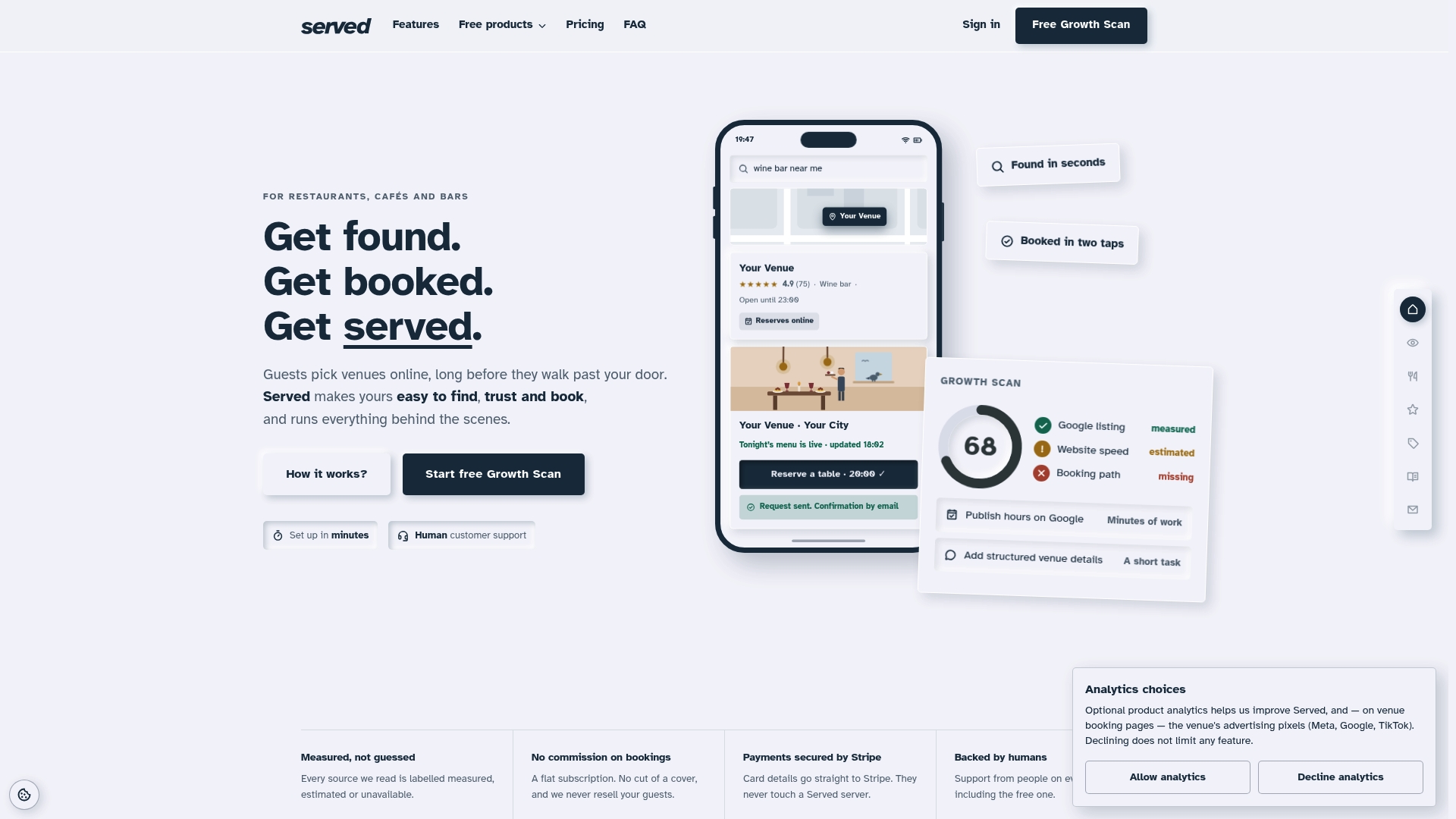
If you then want everything in one place, Visibility Brain covers bookings, your venue page, menu updates and reviews at a flat €69 per month or €660 per year. You can try the platform without talking to a sales team.
How to switch without losing bookings
Moving system is mostly a planning job. Here is a safe order of work.
- Export first. Download your guest list, notes, allergies and booking history from SevenRooms before anything else. Confirm the file opens and contains consent status.
- Check your contract. Find the notice period and the last billing date. Do not cancel until the new system is live.
- Set up the new system in parallel. Add your opening hours, tables, floorplan, service times and booking rules. Import guests.
- Replace links. Update your website button, Google listing, Instagram bio and any QR codes. Missed links are the main cause of lost bookings during a switch.
- Keep existing bookings safe. Leave future reservations in the old system until their dates pass, or re-enter them by hand and confirm with guests.
- Run one shift as a test. Have a manager watch the first busy service and write down every snag.
- Close the old account only once the last reservation has been honoured and you have kept a copy of your data.
If you are leaving a marketplace rather than SevenRooms, see our page on switching to Served or the specific guide for switching from OpenTable. For a wider shortlist, our guide to restaurant reservation systems that keep guest data with you is a good next read.
How to judge claims about more bookings
Every vendor says it will fill your tables, ours included. Treat the claim as a hypothesis and test it.
- Measure a baseline. Record weekly online bookings, no-show rate and the share of bookings from each source before you switch.
- Compare like with like. Season, local events and weather move bookings more than software does. Compare the same weeks year on year where you can.
- Ask for named references in your own category and city, and call them.
- Look at the free tools. A vendor confident in its product lets you try it without a sales call. You can use our free tools to see how your venue appears online today.
Owners tell us they see more foot traffic and better visibility after fixing their listings and booking path. Treat that as a reason to test, not a guarantee. Your own numbers decide.
FAQ
What is the cheapest SevenRooms alternative?
Served has a Free plan, and its paid Visibility Brain plan is €69 per month or €660 per year with no commission. Other providers publish different prices, and some are quote-only, so check each provider's own page and price it against your covers.
Is there a SevenRooms alternative with no commission?
Yes. Served and ResDiary both describe commission-free models, and SevenRooms itself does not charge a per-cover fee. The main commission risk comes from marketplaces, where per-cover fees can apply to bookings the platform sends you.
Can I move my guest data out of SevenRooms?
Ask SevenRooms for a full export before you cancel, including notes, tags, visit history and consent status. Then check that the new platform can import it. Make sure you have a lawful basis for any marketing you plan to send, as the ICO's guidance explains.
Which option suits a single café or pub?
A flat-fee system with published pricing and quick onboarding is usually the best match, because you pay a fixed amount and need little training. Run a trial through one busy service before you commit.
Do I need a marketplace as well as my own booking system?
Not always. A marketplace brings discovery but may add per-cover fees and keep the guest relationship. Many venues start with their own commission-free booking link, a strong Google listing and then decide whether a marketplace adds enough new guests to justify the cost.
Sources
- ResDiary vs SevenRooms vs OpenTable UK pricing comparison
- Restaurant table reservation software buyer's guide, 2026
- ICO: marketing and data protection in detail