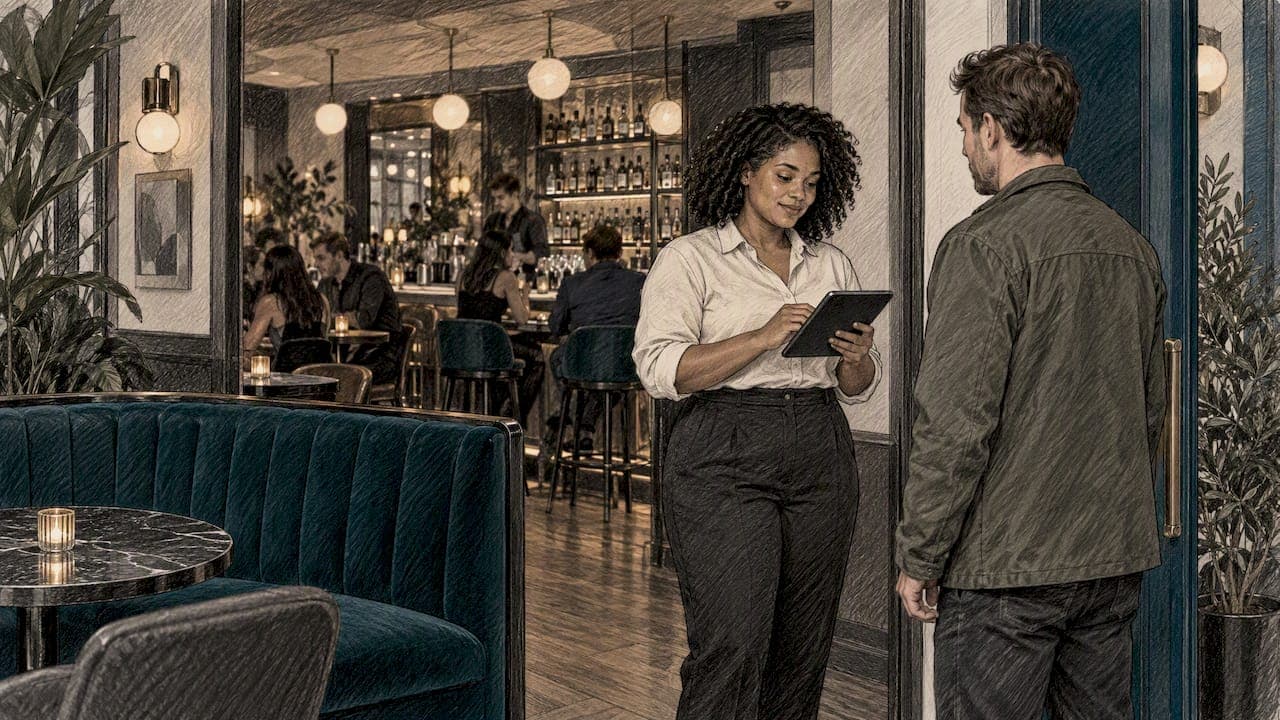
Good cocktail bar reservations do three things. They make you easy to find, they make booking take under a minute, and they protect your busiest hours from empty tables. Get those right and the rest is detail. This guide shows you how to set up bookings for a cocktail bar, what to do about no-shows, and how to avoid paying a fee on every guest you bring in yourself.
It is written for owners and managers of bars, not for diners looking for a table. If you run a venue, read on.
TL;DR
- Hold a share of your room for bookings and keep the rest for walk-ins. Friday and Saturday need the tightest rules.
- Make sure guests can find you and book from your Google listing, your website and your socials, all in the same place.
- State your cancellation and no-show policy at the moment of booking, and base any fee on what a typical guest spends.
- Avoid booking tools that charge per cover or per booking. Those fees grow exactly when you get busy.
- Scan your booking path first. Fix the gaps that cost you bookings before you add any new tool.
Table of Contents
- Why cocktail bars need reservations now
- How many tables to take on reservation
- Walk-ins versus bookings: finding the balance
- Make your bar easy to find and trust
- Booking tools: what to look for
- No-shows: protect your Friday and Saturday
- Fill the quiet nights too
- Our view: own your guests, not rent them
- Try the free scan, then choose a plan
- A simple setup plan for the next 30 days
- FAQ
- Sources
Why cocktail bars need reservations now
For years, a cocktail bar could live on foot traffic. Good location, good lighting, a queue on Saturday. That model is shrinking. Guests decide before they leave the house, and they decide on a phone.
The numbers we have are from Germany, so read them as a signal, not a UK statistic. A METRO AG survey from February 2025 found that 70% of German restaurant guests use digital platforms to search for places to eat. Half of all visitors had booked online at least once, rising to 71% among weekly guests. The same survey found that online reviews matter very or fairly to 63% of under-45s when choosing where to go.
The pattern is unlikely to stop at a border. If a guest cannot find your bar, cannot see the menu, or cannot book without calling during service, they pick the next bar on the map.
For a cocktail bar this matters more than for a café. Your sales are concentrated into a few hours on a few nights. Every empty seat at 9pm on a Friday is revenue you cannot get back on Tuesday.
How many tables to take on reservation
This is the question every bar owner argues about. There is no single answer, but there is a sensible way to decide.
Split the room by purpose
Divide your space into three types of seating:
- Bookable tables. Seats guests can reserve online, usually for groups of two to six.
- Walk-in zones. The bar top, a few high tables or the standing area. This keeps the room feeling alive and gives locals a reason to pop in.
- Flex seats. Tables you release for booking only when demand is clear, for example 48 hours before a weekend night.
A bar with 40 seats might open 20 for booking, keep 12 for walk-ins and hold 8 as flex. Adjust to your own mix. The principle is to never be fully committed in advance and never be fully open to chance.
Set time slots that match how people drink
Cocktail guests do not linger like diners at a long lunch, but they do not rush either. Most bars work well with a fixed seating window, for instance 90 minutes to two hours, with a clear message at booking. Guests accept a time limit when they know about it before they arrive. They resent it when a host announces it halfway through their second drink.
On quiet nights, drop the limit. On Fridays and Saturdays, enforce it kindly.
Plan for groups
Groups are the highest-value booking a cocktail bar gets, and the most likely to cancel at short notice. Set a minimum group size for a reservation (many bars use six or more for a deposit), and collect a contact number you can actually reach. If you host private hires, route them through a separate enquiry form so they do not clog the main calendar.
If you run events, a booking system that also handles tickets will save you a spreadsheet. We cover event formats in our guide to bar event ideas with a revenue lever.
Walk-ins versus bookings: finding the balance
Advance bookings change how a bar feels on the night. Too many and the room is stiff, with reserved signs on every table and walk-ins turned away. Too few and your peak hours depend on luck.
Prep helps you manage the swing. If your team is not buried at the start of the evening, a half-full booking sheet is easy to handle. One practical idea is to look at how batch cocktails before guests arrive can speed up service at busy times. That is how bars absorb a rush of reservations at 8pm without slowing down the bar for walk-ins.
A simple rule: if your bar regularly turns people away at the door on Friday, you are under-using your calendar. Open more bookable slots in the early evening. If you regularly sit half-empty at 6pm and packed at 10pm, offer a small perk for early arrivals, such as a welcome drink or a shorter menu at a set price, and make it visible on the booking page.
Make your bar easy to find and trust
Reservations start long before the booking form. They start in search results.
A guest searching for a cocktail bar near them will see your Google listing first. They look for four things: photos, opening hours, a menu they can read, and a way to book. If any of these is missing or out of date, a share of them will leave.
The minimum your listing needs
- Current opening hours, including bank holidays and late-night closing times.
- A menu that matches what you actually serve, with prices.
- A booking link that works on mobile and takes the guest straight to date and party size.
- Recent photos of the bar, the drinks and the room, not just the exterior.
- Answers to reviews, good and bad.
The same applies to your own website. A guest who lands there from Instagram should be able to book in two taps. Our checklist for what a bar website should include walks through the pages and buttons that matter, and it can be done in a couple of days.
Reviews decide close calls
When two bars look similar, reviews break the tie. Replying promptly shows that a real team stands behind the bar. A short look at customer reviews in hospitality explains how guests use them to pick a place. If you are juggling several review sites, our review management tool puts them in one queue.
Booking tools: what to look for
Many UK bars start with a phone, a notebook and a shared inbox. That works at ten covers a night and breaks at forty. When you compare booking tools, judge them on these points.
| Criterion | What to check |
|---|---|
| Fee model | Flat subscription, or a fee per cover or per booking? Ask what you pay in a month with 800 covers. |
| Guest data | Who owns it? Can you export it? Is it ever resold or used to promote other venues? |
| Calendar and floorplan | Can you see tables, set time limits and block seats for walk-ins? |
| Confirmations and reminders | Does the guest get an automatic confirmation and a reminder before the night? |
| Deposits and payments | Can you take a card guarantee or prepayment for groups and peak nights? |
| Visibility | Does the tool help you show up on Google, or only record bookings? |
| Support | When something breaks at 6pm on a Saturday, can you reach a person? |
The fee model deserves most of your attention. A per-cover fee feels small on a quiet night and large on a good one. It also taxes the guests who found you on their own, through your own Instagram or because they walk past every day. We go deeper in our guide to bar reservation software and per-cover fees, and the same logic applies to wine bars if you run a hybrid venue.
No-shows: protect your Friday and Saturday
No-shows hurt cocktail bars more than most venues. Your margin sits in a few peak hours, and a held table cannot be resold at 10pm.
The best figures we found come from German-speaking countries. They are not UK data, but they show the direction. NZZ reported in April 2025 that the average no-show rate for online reservations in Switzerland reached 2.3% in 2024, up from 1.4% in 2019. The same coverage points to bars suffering most on Fridays and Saturdays, their peak revenue days. A 2025 Austrian report carries the headline that one in eight guests does not turn up despite a reservation.

The Swiss trade body GastroSuisse calls no-shows a relevant problem for the industry, especially at peak times and for venues with few casual visitors. That description fits a reservation-led cocktail bar well.
A no-show policy that guests accept
Most hosts do not like policing guests. They see themselves as hosts first. That instinct is a strength, but it needs a system behind it. Here is a policy that keeps both.
- Say it at booking. Put the cancellation window and any fee on the booking page and in the confirmation. Guests rarely object to a rule they read in advance.
- Set a clear cancellation deadline. Many bars use 24 hours. Make cancelling a one-tap action from the confirmation message.
- Send a reminder. A text or email on the day cuts down on forgetful no-shows more than any penalty will.
- Ask for a card only where it counts. Larger groups and Friday and Saturday evenings are the places to start.
- Base fees on real spend. Practitioners quoted by NZZ suggest tying a fee to average consumption, for example a main course plus a drink, rather than a random punitive figure. For a cocktail bar, think of the likely spend of two or three drinks per guest.
- Use the fee sparingly. Waive it when a guest has a genuine reason. Your regulars will remember it.
A note on the law. In Austria, WKO guidance says venues may claim no-show fees as a contractual penalty, and recommends stating the terms clearly at booking. That is Austrian guidance and not UK law. Before you charge fees in the UK, check your terms with a solicitor or your trade association, so your wording is clear and fair to consumers.
Fill the quiet nights too
Reservations are not only a way of managing the rush. They can also move demand into slower evenings.
- Offer something bookable on Tuesday to Thursday. A tasting flight, a masterclass or a set cocktail menu gives guests a reason to plan ahead.
- Use tickets for events. Ticketed nights bring cash in before the doors open, and the no-show problem shrinks when guests have already paid.
- Show quiet slots first. If your booking page shows early-evening and midweek slots clearly, price-sensitive guests will find them.
- Follow up with regulars. A guest list with visit history lets you invite your best customers to a new menu launch.
For a step-by-step approach to growing bookings in weeks rather than months, see our guide on how to grow bar reservations with visibility first. If your booking process leaks guests before they confirm, the 30, 90 and 180 day booking flow plan shows what to fix and in what order.
Our view: own your guests, not rent them
Here is where we stand, and why.
We built Served because many venue owners told us the same story. A marketplace brings a guest, charges a fee on the booking, and keeps the guest's details. The next time that guest wants a drink, the marketplace may show them a different bar. You paid to acquire someone you never owned.
So we do it differently. Served charges no commission on bookings and no per-cover fees. You pay a flat subscription. We never resell guest data. Your guest list, your reviews and your online presence belong to you.

We also think visibility comes before booking software. A booking button on a page nobody finds does nothing. That is why we start with a scan of your public booking path: your Google listing, your website and the route a guest takes from search to confirmation. Then you fix the biggest gaps first. Most are small. A missing menu. A broken link. Opening hours that are wrong on one platform.
And we believe a bar team should reach a human when it needs help. Real people answer on every plan, because service hours are the worst time to read a help article.
— Ignacy Jurkowski
Try the free scan, then choose a plan
Start with the Booking Path Scan. It looks at how guests find and book your bar and shows where you lose them. You can try it without talking to a sales team.
If you want to act on the results, there is a Free plan at 0 one-off, so you can see how the platform works. The paid Visibility Brain plan costs €69 per month or €660 per year, with a flat fee and no commission on bookings. OmniBrain, dedicated onboarding and ticketing fees are also available, and you can find the details on our main site.
The platform covers table reservations, a calendar and floorplan, reminders, real-time menu updates, a guest CRM and review management. For events, ticketing and stock sits in the same place.
A simple setup plan for the next 30 days
You do not need to do everything at once. Work through it in this order.
Week 1: find and fix. Run a scan. Correct your opening hours, photos and menu on Google. Add a booking link.
Week 2: set your rules. Decide how many tables are bookable, how long a booking lasts and your group size threshold. Write your cancellation policy in two sentences.
Week 3: switch on the basics. Turn on confirmations and reminders. Reply to every recent review. Put the booking link in your Instagram bio and on your website.
Week 4: review and adjust. Look at what the calendar shows. Which nights filled? Where did no-shows happen? Move the number of bookable tables up or down by a few seats, and change one thing at a time.
If you want a fuller operating plan, our guide to fixing small venue booking in 30 days breaks it into five jobs.
FAQ
Should a cocktail bar take reservations at all?
Yes, for at least part of the room. Reservations give you predictable peak hours and a record of who is coming. Keep a walk-in zone so the bar still feels open and spontaneous. Start with a small share of tables and adjust each month.
Is it right to charge a deposit or no-show fee?
It can be, if you state the terms clearly at booking and keep the amount reasonable. Tie it to what a guest would normally spend and use it first for groups and Friday or Saturday nights. Austrian guidance from WKO recommends clear communication of fees at booking. For UK rules, take advice from a solicitor or your trade body.
How do I avoid paying commission on bookings?
Choose a tool with a flat subscription rather than a fee per booking or per cover. Then send guests to your own booking link from Google, your website and social profiles. Ask any provider in writing what you would pay in your busiest month.
How far ahead should guests be able to book?
Most bars open the calendar several weeks ahead for weekends and keep some tables back for later release. Shorter windows suit smaller venues that change menus often. Whatever you choose, show the same availability everywhere you list your bar.
What should I do first if my bookings are low?
Check whether guests can find you and book easily. Run a Booking Path Scan and fix the biggest gap it shows. Often it is a Google listing issue, not a lack of demand.
Sources
- METRO AG: Representative Survey on Digital Gastronomy (21 February 2025)
- NZZ: No-Shows nehmen in der Schweiz zu (13 April 2025)
- heute.at: Trotz Reservierung, jeder achte Gast erscheint nicht
- GastroSuisse: FAQ Medien
- WKO: No-Show-Gebühren in der Gastronomie