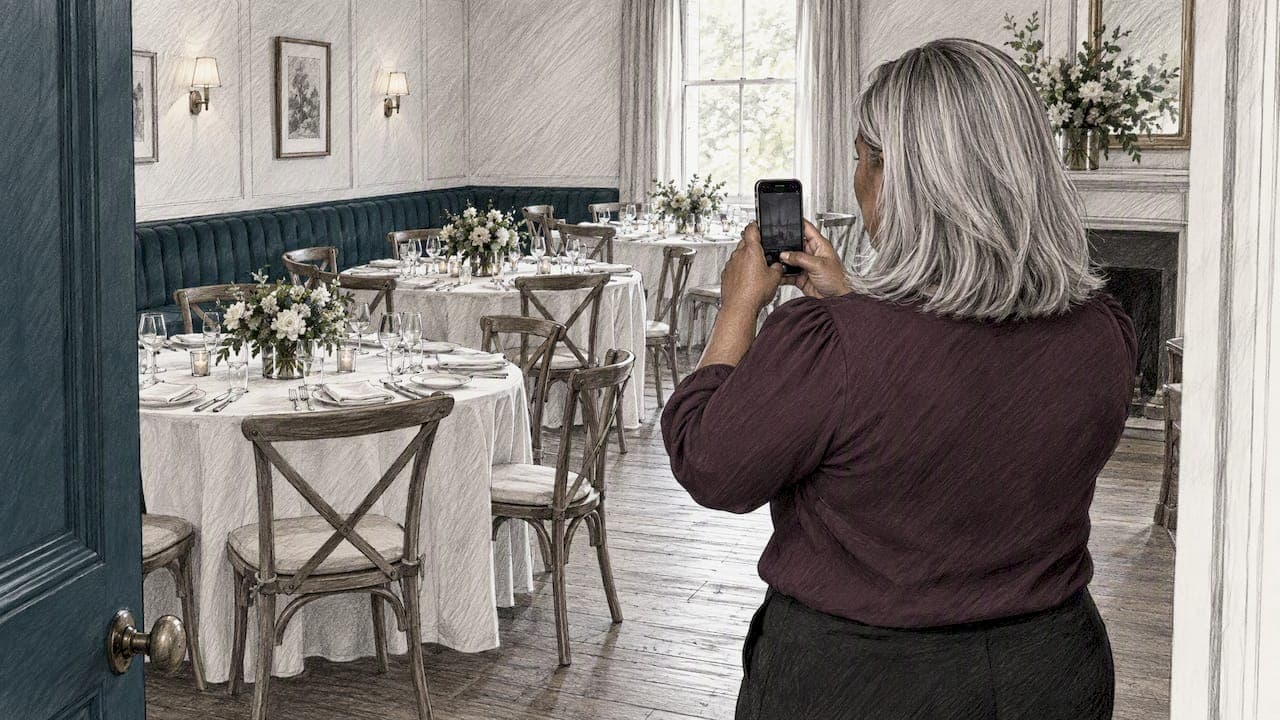
The best event venue marketing ideas are not clever campaigns. They are fixes to the path between a person searching and a person booking: a Google profile that shows your space, a page for each type of event, proof from real guests, and a booking route that sends the enquiry to you and not to a middleman. Get those right and everything else, from partnerships to paid ads, works harder.
This guide is for restaurant, bar and cafe owners who also hire out rooms, tables or the whole venue for birthdays, private dining, parties, corporate evenings and live music. Each idea below says what to do, why it works and how to tell whether it worked.
TL;DR
- Fix the basics first. A complete Google profile, real photos of set-up events and a direct enquiry button beat any new campaign.
- Build one page per event type. Weddings, corporate dinners and birthdays search differently, so each needs its own copy and call to action.
- Collect proof on a schedule. Ask every happy guest for a review and reply to all of them.
- Use partners and local creators. Planners, florists, musicians and small local creators bring in better-fitted enquiries than broad ads.
- Track the source of every enquiry. If you cannot say which idea produced a booking, you cannot decide where to spend next.
Table of Contents
- Start with how people actually find event venues
- Idea 1: Make your Google profile do the selling
- Idea 2: Build a landing page for each event type
- Idea 3: Show the space with photos and video
- Idea 4: Make reviews and guest content a habit
- Idea 5: Partner with the people who plan events
- Idea 6: Pay for search only when the page is ready
- Idea 7: Give the booking path no friction
- Idea 8: Run events that sell themselves
- How to measure what is working
- Our perspective
- Put it to work with Served
- A 30 day plan for your venue
- FAQ
- Sources
Start with how people actually find event venues
Someone planning a 40th birthday does not search for your brand. They search for a type of occasion in a place: private dining room, function room for a party, venue for a team dinner. Hospitality SEO guidance makes the same point: target occasion-and-location searches, and build pages for the specific queries that directories serve poorly.
That tells you where your effort goes. Before you spend anything, check three places:
- Your Google listing. Does it show the right category, opening hours, photos of the event space and a working booking or enquiry link?
- Your website. Can a phone user find capacity, rough pricing and an enquiry button in under 30 seconds?
- Your booking path. When someone clicks "book" or "enquire", where do they land? A broken or indirect link is the most common leak.
We built a free Booking Path Scan for exactly this check. It looks at what the public can see about your venue and where a guest would drop out. If you prefer to do it by hand, our 10 minute Google listing audit walks through it step by step.
Idea 1: Make your Google profile do the selling
For most venues, Google is the first shop window. Google says local ranking rests mainly on relevance, distance and prominence, and that you cannot pay for a better local ranking. Prominence grows with reviews and links from other sites. So the work is in being a complete, active, well-reviewed result.
What to fix, in order:
- Category and description. Name the event services you offer in plain words: private dining, party hire, live music nights.
- Photos of real events. Show the room laid out for 20, for 60, for a standing reception. Guests want to picture their own night.
- A direct booking or enquiry link. Point it at your own page, not a third-party listing.
- Opening hours and special hours. Wrong hours cost trust faster than weak photos.
- Replies to reviews. More on that below.
Most of this takes under an hour. Our guide to Google Business Profile booking fixes breaks it into 30 to 90 minute jobs.
Idea 2: Build a landing page for each event type
One "Events" page that tries to speak to everyone speaks to no one. A bride, an office manager and a parent booking a christening tea want different details, different photos and a different next step.
Dedicated landing pages for each event type let a venue rank for specific intent and give each audience tailored copy and calls to action. The same source notes that different occasions need different answers. A simple page structure works:
| Section | What to put in it |
|---|---|
| Headline | The occasion and the place, in plain words |
| Who it suits | Group size range, typical format (seated, buffet, standing) |
| Photos | Your room set up for that occasion |
| What is included | Menu options, drinks packages, music, staffing |
| Price guide | A starting spend or minimum spend, honestly stated |
| Next step | One button: check availability or request a quote |
Transparent pricing helps. Visitors who see a realistic range self-select, and you spend less time on enquiries that were never going to convert.
If you host entertainment, give it its own mention. A page for wedding receptions can name the options guests can add, such as live piano for weddings and galas, so the page answers "what will the evening feel like?" and not just "how many can you seat?"
Music venues have a particular version of this problem. Our piece on music venue website design features covers what gig-goers and promoters look for.
Idea 3: Show the space with photos and video
Event buyers cannot visit ten venues. They shortlist from images. Event venue marketing guidance points to high-quality photos and video, virtual tours and clear calls to action as what turns website visitors into enquiries.
A practical shot list:
- The room empty, in daylight, from the doorway and from the far corner.
- The same room laid out for each format you sell.
- Real events in progress, with guests' permission.
- Food and drink as served at events, not only your standard menu.
- The entrance, the toilets and step-free access. Planners ask.
A 30 to 60 second phone walkthrough video, shot steadily in landscape, is often enough. Put it on the event page and on your Google profile.
Idea 4: Make reviews and guest content a habit
Reviews feed two things at once: your local ranking and a stranger's confidence. Hospitality SEO guidance says encouraging and answering reviews influences both, with recent reviews often carrying more weight.
Passive collection does not work. Local Brand Hub's 2026 guide recommends QR codes, follow-up emails and staff requests, and sets 20 or more Google reviews by month-end as an aim for a newly opened restaurant. Treat that as a target to adapt, not a rule.
For event venues, build asking into the event itself:
- At the end of the night, the host or manager thanks the organiser and hands over a card with a QR code to your review page.
- The next morning, send a short thank-you email with the same link.
- Reply to every review within a couple of days. Name the event type in your reply where it is natural: "Glad the team dinner worked so well in our back room."
Guest-created content works the same way. Franki's 2026 data says content from real customers performs three to five times better than branded content because it feels more authentic. It is a company blog figure, so treat it as a direction, not a promise. Ask organisers to tag the venue, and repost with permission.
Idea 5: Partner with the people who plan events
Many event enquiries do not start with a search at all. They start with a recommendation from a planner, florist, photographer, caterer or band. Venues can generate enquiries by partnering with local service providers and hosting networking evenings for planners. Local supplier recommendations also let you promote combined experiences.
Simple ways to start:
- Open evening for planners. Invite local planners, office managers and PAs for drinks and a tour on a quiet night.
- Supplier list on your site. Name trusted florists, photographers and musicians, and ask them to link back.
- Referral thank-yous. A complimentary drink or a fair commission-free thank-you from your own side keeps referrals coming. Keep the terms written down.
- Local creators. One 2026 dataset from Contenido Restaurante reports that local niche creators with 5K to 40K followers produced 6 to 14 bookings per 10K impressions, at a lower cost per booking than national creators. It comes from a Colombian company blog and is in US dollars, so use it to justify a small local test, not to forecast your own results.
Merchandise can also support corporate bookings. A branded gift for a client group, such as personalised event chocolate, gives the organiser something to take away and a reason to remember where the event was held.
Idea 6: Pay for search only when the page is ready
Paid search on high-intent terms can reach people actively researching local event spaces. One UK venue marketing guide recommends sending them to a booking-focused landing page. That last part is the point. An advert that lands on a general homepage wastes the click.
Before you pay for anything:
- Have the event-type page live and mobile friendly.
- Have one clear enquiry button and a response promise ("We reply within one working day").
- Add a tracking tag so you know which advert produced which enquiry (see the measurement section below).
Start small, with one event type and a tight local area. Run it long enough to see enquiries, then judge it on bookings, not clicks.
Idea 7: Give the booking path no friction
You can win the click and lose the booking on your own site. Muntin Digital's audit of 50 independent restaurant websites found a median revenue leak of 0.94%, caused by issues such as broken reservation links and missing direct-order calls to action. It is a US study of a small sample, so read it as a warning about the type of fault to look for.
The same audit makes a point about cost: it says aggregator-only ordering carries a 30% commission, against a 3.6% processor fee for direct. Venues who rely on third-party marketplaces for event and table bookings should ask the same question: what does each booking cost me, and who owns the guest afterwards?
Practical checks:
- Click every booking and enquiry button on your phone, from Google and from social profiles.
- Put your own reservation link first, ahead of third-party links.
- Keep mobile navigation simple. Mobile-first design and clear navigation are described as critical for turning discovery into direct enquiries.
- Cut form fields to the essentials: date, group size, occasion, contact.
Our guide to what a bar website should include is a 48 hour checklist for this. If you are weighing booking tools, Resy versus SevenRooms covers the guest data trade-off, and our note on event venue management software explains how to avoid per-cover fees.
Idea 8: Run events that sell themselves
Some of the best marketing is the event you host for your own guests. A tasting night, quiz, supper club or live set fills a quiet evening and shows organisers what the space does when it is working. Each one also produces photos, reviews and a reason to post.

Pick events with a revenue lever attached: a set menu, a ticket, a pre-paid package. Our bar event ideas lists ten, each with the lever that makes it pay. If you sell tickets, see how event ticketing and stock works for restaurants and bars.
How to measure what is working
Traffic is not the goal. Bookings are. A Dutch venue case study from Coby Agency describes tracking revenue, reservation value and return on ad spend instead of visits alone, using GA4 and UTM tagging, and connecting quote requests to their source and to the reservation system.
You can copy the principle at small scale:
- Tag every link you control with UTM parameters: Google profile, Instagram bio, email, partner pages, adverts. Our 3 UTM steps shows how.
- Ask on the enquiry form: "How did you hear about us?" Offer a short list plus "other".
- Log each enquiry with its source, event type, group size and outcome.
- Review monthly. Count enquiries, bookings and booked value per source.
- Cut or double down. SearchX suggests finding the weakest part of the customer journey before planning the next campaign. Fix that before you add spend.
Once an enquiry becomes a booking, reminders protect it. Tools built for other booking-led venues show the idea well: reminders and attribution reporting keep the diary full and make results easier to read. Look for the same two things in any system you use.
Our perspective
We talk to venue owners who spend on adverts, social posts and directory listings while the booking path itself has a hole in it. A link goes to the wrong place. A menu is out of date. A Google profile shows no photos of the private room. Marketing money poured on top of that is wasted.
So we start with the scan, not the campaign. Find where guests drop out, fix the smallest thing that stops the most bookings, then measure again. Do not pay a commission on a booking you earned yourself. And do not hand your guest list to a platform that will market a competitor to them.
For a venue owner, simple beats clever. A flat fee, a clear page for each event type, real photos and a person to talk to when something breaks. That is what keeps enquiries coming.
— Ignacy Jurkowski
Put it to work with Served
Served is a commission-free booking and visibility platform for restaurants, bars and cafes. Start with the free Booking Path Scan. It shows what the public sees when they search for your venue and where a booking could slip away.
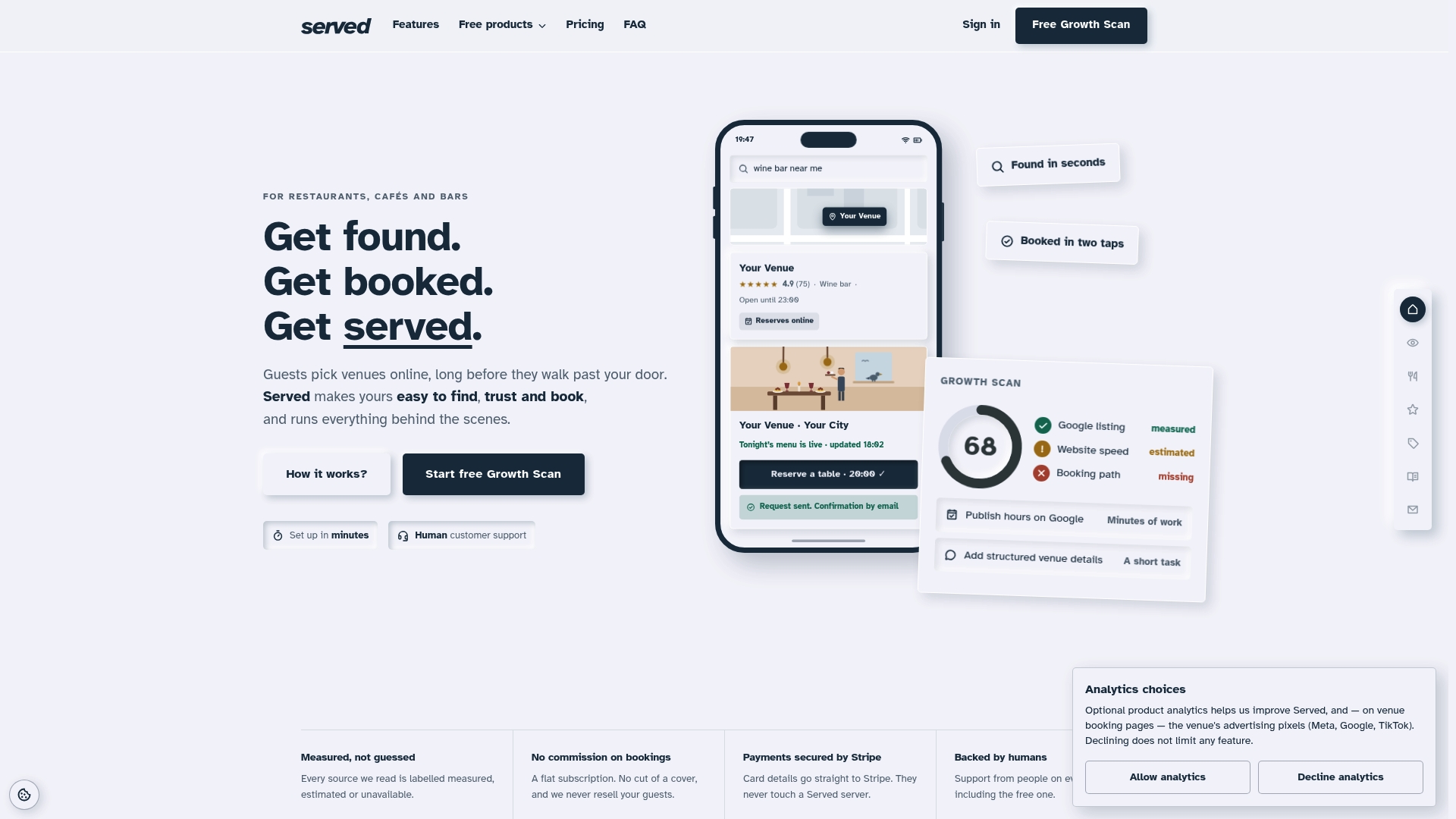
If you want the fixes handled in one place, the Free plan costs €0 and lets you try the platform. Visibility Brain is €69 per month or €660 per year, with no commission on bookings, see the plans. Human support is part of every plan, and you keep your guest relationships. Ticketing fees and dedicated onboarding are add-ons, so check the current terms on our site.
A 30 day plan for your venue
If you want a simple order of work, use this.
Week 1: Fix the basics. Run the scan. Complete your Google profile. Test every booking button on a phone.

Week 2: Build the pages. Write one landing page for your strongest event type. Shoot new photos of the room as set up for it. Add a clear price guide.
Week 3: Collect proof. Start the review routine: card, QR code, follow-up email. Reply to all existing reviews.
Week 4: Reach out and measure. Invite five local planners or suppliers to an open evening. Tag every link. Start your enquiry log.
At the end of the month, you will know which of these brought enquiries. Repeat what worked, then add the next event type.
FAQ
How do I get more event bookings at my venue?
Fix the path before you promote it. Complete your Google profile, publish a page for each event type with real photos and a price guide, and make the enquiry button work on a phone. Then add reviews, partner referrals and, if the pages are ready, paid search.
Can I pay Google to rank my venue higher locally?
No. Google states that you cannot request or pay for a better local ranking. Results rest mainly on relevance, distance and prominence. You can improve each by keeping your profile accurate and complete and by earning reviews.
Which event venue marketing idea is cheapest to start?
Updating your Google profile and replying to reviews costs only time. Most of it can be done in an afternoon. Next, ask every organiser for a review on the night. Both support local visibility and trust without any ad spend.
How do I know which idea brings the bookings?
Tag your links with UTM parameters, ask every enquirer how they found you and log the source against the outcome. Judge ideas by booked value, not clicks. Reviewing the log monthly shows what to keep and what to drop.
Sources
- Hospitality SEO: Visibility Strategies for Hotels, Restaurants and Venues
- Tips to improve your local ranking on Google
- The Complete Guide to Event Venue Marketing
- How to Promote a Newly Opened Restaurant, Local Brand Hub
- How to increase foot traffic in restaurant, Franki
- How to Market Your Restaurant for Events
- Food Creator Collaborations: Myth vs Reality 2026
- The 1% margin audit, Muntin Digital
- De Eenhoorn case study, Coby Agency
- The Hospitality Demand & Booking Visibility Guide, SearchX